



Expert Guide to Sheet Metal Bending Techniques
Sheet metal processes are versatile processes used in metal forming industries. Due to its various advantages, sheet metals are widely used in manufacturing industries. All cars bodies, metal doors, fan blades, metal desks etc. are sheet metal products. There are various processes to transform sheets into required product. These processes can be classified into three ways.
Sheet Metal Bending:
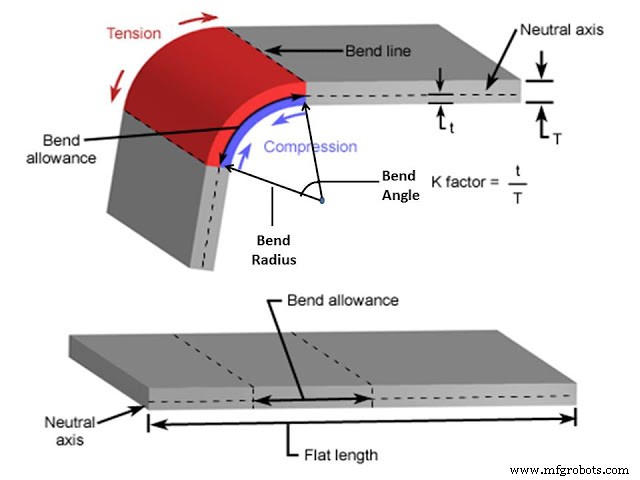
Bending is a most common sheet metal forming operation. Many products like automobile components and its body, home appliance, paper clip, metal doors etc. are shaped by bending process. Before discussing about bending process and its types, first you should learn about basic terminologies used in bending. It will help you to clearing understanding of process and its various parameters. These are given below.Bending Terminology:
 |
| Image Source |
Neutral Axis: It is an imaginary axis which does not undergo any stress during bending.
Bending Process:
Bending is a process in which the metal is deform in such a way that the length and thickness before bending and after bending remains same. It only changes shape of the work piece. Actually it is an ideal condition but practically length and thickness changes up to some extent in bend area. Every metal when subjected to a moment or couple, it tends to bend. Sheet metals have high bending ability which makes it versatile for various shaping and forming process.Different Sheet Metal Bending Process:
These are most common bending process.Press Brake Forming:
This process uses a mechanical or hydraulic press brake to bend a sheet. This machine utilizes long dies to convert sheet into various shapes. It is easiest way of bending and can be easily automated.Roll Bending:
This process uses a three rollers set to bend a sheet by adjusting the distance between rolls. This process can utilize to form various curvatures.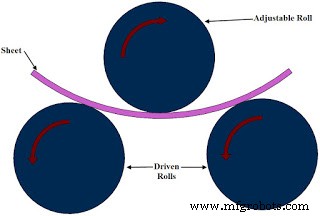
Four Slide machine Bending:
This process uses three movable and one stationary slide to bent a work sheets as shown in figure. This is used to bent small work pieces.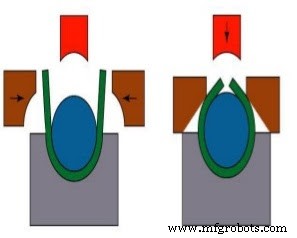
Beading:
It is a process in which the periphery of the sheet metal is bent into the cavity of a die. It increases moment of inertial of the section and stiffness. It also eliminates exposed sharp edges.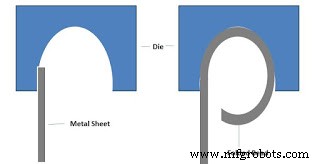
Flanging:
It is a process of bending the edges of the metal sheet at perpendicular to the length. It can be further divided according the shape like straight flange, stretch flange, joggled flange, shrink flange etc. as shown in figure.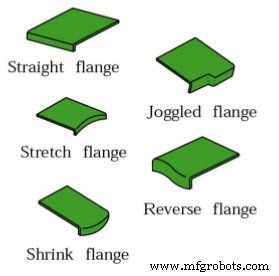
Dimpling:
It is a process in which first a hole in made into the sheet metal and then it is expanded into a flange using punch die system.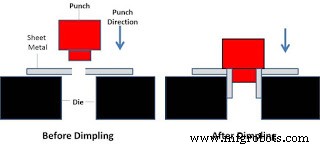
Hemming:
It is an operation in which the edge of the sheet is folded over itself. This process increases stiffness of the part and eliminate sharp edges.
Roll Forming:
It is an continuous bending process used for long work piece. This process uses a serious of rolls of various shapes according to the bending process. The metal sheet allows to pass through these rolls and the part is sheared and stacked continuously.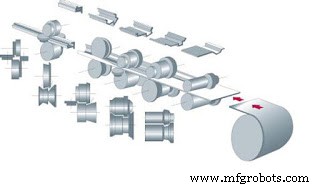
These are most common sheet metal bending processes. If you have any query regarding this article, ask by commenting. If you like this article, don’t forget to share it with your friends. Subscribe our website for more informative articles. Thanks for reading it.
Deep Drawing Process Explained: How Sheet Metal is Formed into Complex Shapes
Key Sheet Metal Operations in Modern Manufacturing
Manufacturing process
- Mastering Sheet Metal Bending with a Press Brake: Techniques, CNC Power, and Industry Insights
- Understanding Sheet Metal Fabrication: Techniques & Applications
- Deep Drawing Process Explained: How Sheet Metal is Formed into Complex Shapes
- Key Sheet Metal Operations in Modern Manufacturing
- Sheet Metal Forming: Techniques & Applications for Modern Manufacturing
- Precision Sheet Metal Bending: Cost‑Effective & Reliable Fabrication
- Sheet Bending Machines Explained: Types, Processes, and Applications
- Revolutionize Sheet Metal Bending with Robotics: Boost Efficiency & Safety
- Top Sheet Metal Forming Techniques for Modern Engineering
- Sheet Metal Operations Explained: Types, Techniques & Diagrams