



Cubic Zirconia: Production, Quality, and Market Outlook
Background
Gemstones encompass both natural and man‑made materials used for adornment. In the United States, they are classified into natural, synthetic, and simulant categories. Natural gemstones are cut from crystalline minerals such as beryl, corundum, and quartz, or from organic materials like amber and pearls. Synthetic gemstones are engineered in laboratories to match the optical, physical, and chemical properties of their natural counterparts—examples include lab‑grown diamonds, rubies, and sapphires. Simulants, on the other hand, imitate the appearance of a natural stone but differ in their inherent properties. Cubic zirconia (CZ) is the most widely used diamond simulant, first introduced into jewelry production in 1976.
On the Mohs hardness scale, natural diamonds score a perfect 10, while CZ ranges from 8.5 to 9. The refractive index of diamond is 2.42, whereas CZ falls between 2.15 and 2.18, giving it a similar but slightly less pronounced sparkle.
Earlier diamond imitators such as strontium titanate (1955) and yttrium aluminum garnet were eventually supplanted by CZ because of its closer visual resemblance to diamond and superior durability in jewelry settings.
Raw Materials
Cubic zirconia is synthesized from a blend of high‑purity zirconium oxide powders that are stabilized with magnesium and calcium oxides. Precise control of each component—and occasionally the addition of trace elements—ensures that the final product achieves the desired optical clarity and color match.
The Manufacturing Process
Gemstone production methods fall into three broad categories: melt growth, solution growth, and high‑temperature, high‑pressure synthesis. For CZ, the skull‑melting technique is employed due to its high melting point and reactive nature.
Skull‑Melting Method
- A copper cup with a hollow interior, called the “skull,” is lined with water that cools its inner walls. The cup is filled with the powdered mixture and heated via radio‑frequency induction until it melts.
- Because the walls are cooled, only the material in the cup’s center melts, creating a self‑contained molten zone surrounded by unmelted powder.
- After heating, the system is allowed to cool. Crystals nucleate and grow until the melt solidifies. One skull cycle typically yields about 2.205 lb (1 kg) of CZ.
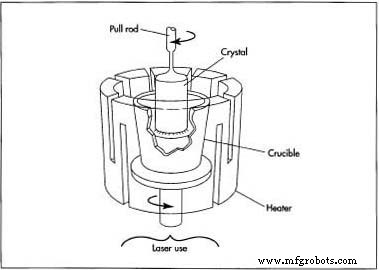
Other gemstones, such as emeralds and rubies, may be produced using Vemeuil, Czochralski, or hydrothermal processes, but these are not applicable to CZ due to its extreme thermal requirements.
Cutting and Polishing
Expert stonecutters evaluate each crystal to maximize clarity and carat weight while minimizing waste. The process begins with precise marking of cleavage planes, followed by cleaving or sawing with diamond‑impregnated tools. Modern programmable machines then shape the stone to predetermined dimensions.
- Rounding (bruting) smooths the corners with a diamond tool.
- Faceting is performed with a cast‑iron wheel, followed by polishing to achieve a mirror‑like finish.
- Final cleaning involves boiling in acid to remove residual oils, powders, and debris.
Quality assessment relies on the four Cs—carat, color, clarity, and cut—mirroring the evaluation of natural diamonds. For CZ, carat weight is measured by mass; color ranges from near‑colorless to vivid hues; clarity is controlled in the lab but can vary with melt quality; cut quality is judged against the 58‑facet Brilliant Cut standard established by Marcel Tolkowsky in 1919.
Quality Control
Advanced microscopy, refractometry, and specific gravity tests ensure each CZ stone meets stringent optical and physical criteria. By comparing its refractive index and density to known standards, technicians can verify authenticity and quality.
The Future
Industry analysts predict a steady growth of approximately 10% for CZ jewelry. Its affordability, improved brilliance, and versatility make it a popular choice for studs, solitaires, and tennis bracelets. While new simulants like synthetic moissanite have entered the market, CZ remains the most cost‑effective and widely available alternative to diamond.
Annual U.S. production of synthetic and simulant gemstones is valued at roughly $20 million, with natural gemstone output about 2.5 times higher. The continued expansion of mass‑market retailers and consumer acceptance of high‑quality simulants are expected to sustain CZ’s prominence in the coming decade.
Manufacturing process
- Natural Gas: From Extraction to Distribution – A Comprehensive Overview
- Understanding Resin: Types, Uses, and Everyday Applications
- Natural Resin: Definition, History, and Modern Applications
- GNPPCK-a: Premium Fused Calcia‑Stabilized Zirconia for Advanced Ceramic Applications
- GNPGraystar Fused Calcia‑Stabilized Zirconia: High‑Purity, Ultra‑Strong Ceramic for Advanced Applications
- High-Performance Fused Calcia-Stabilized Zirconia (PCD) – Advanced Ceramic Material
- Fused Calcia‑Stabilized Zirconia (PCD‑C): Premium High‑Purity Ceramic for Advanced Applications
- Fused Calcia-Stabilized Zirconia (FCD) – Premium Electro-Fused Ceramic for Advanced Applications
- GNP7YD-a Fused Yttria-Stabilized Zirconia – Premium Material for Advanced Applications
- High-Performance Fused Yttria-Stabilized Zirconia (GNP7YD-aQ) – Superior Density & Stability