



Sand: Composition, Uses, and Modern Processing Techniques
Background
Sand is a naturally occurring, loose material composed of tiny fragments of rocks, coral, shells, and minerals. It provides bulk, strength, and texture to construction materials such as asphalt and concrete, serves as a decorative element in landscaping, and is essential in glass manufacturing, metal casting, and abrasive applications like sandblasting and sandpaper.
Historically, sand has been used for millennia. Around 6000 B.C., early cultures ground and polished stone tools on wetted sandstone. The first glass beads with a glaze appeared in Egypt between 3500–3000 B.C., produced by melting sand—though naturally occurring volcanic glass was likely known earlier.
In the United States, sand was utilized for glassmaking as early as 1607 in the Jamestown colony. A sustained glass industry emerged in 1739 in Wistarburgh, New Jersey, led by Caspar Wistar. Demand surged during World War I and the 1920s with road paving, and the post‑war housing boom further increased sand use in concrete construction.
Today, sand processing is a multi‑billion‑dollar industry, ranging from small local suppliers to highly automated plants delivering hundreds of truckloads daily.
Raw Materials
Common sand types include:
- Quartz sand—colorless or slightly pink, high in silica, used for glass and as abrasive for sandpaper.
- Feldspar sand—pink or amber hues, also rich in silica.
- Black sands—found in Hawaii, composed of obsidian; other black sands contain magnetite or homblende.
- Coral sand—white or gray, from broken coral fragments.
- Shell sand—light brown, from broken shell fragments.
- Limestone sand (oolite)—white sands of the Gulf of Mexico, formed from small limestone grains.
- Gypsum sand—white sands of White Sands, New Mexico, composed of gypsum crystals.
Quartz sands with high silica content also serve as the primary source of silicon for semiconductor chips. Molding sands for metal casting typically contain 80‑92 % silica, up to 15 % alumina, and 2 % iron oxide to provide the necessary binding strength.
Bank‑run sand—unsorted riverbank sand—remains a common construction and landscaping material.
Sand particle sizes range from 0.063 mm to 2.0 mm (0.0025‑0.08 in). Particles below this range are classified as silt; those above are granules or gravel. In construction, aggregates <0.25 in (6.4 mm) are “fine aggregates” (including sand), while 0.25‑6.0 in (6.4‑152 mm) are “coarse aggregates.”
Typical sand density is 2,600‑3,100 lb/yd³ (1,538‑1,842 kg/m³), varying with trapped water content.
The Manufacturing Process
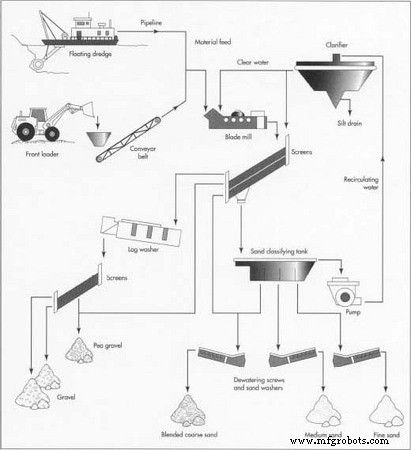
Sand preparation involves five core steps: natural decomposition, extraction, sorting, washing, and, when needed, crushing.
Natural Decomposition
- Mechanical forces—glacier movement, freeze‑thaw expansion, rock impacts—break solid rock into chunks.
- Chemical weathering and mechanical abrasion further reduce chunks into grains.
- Grains are transported by water, depositing along banks or beaches, while wind‑borne sand forms dunes.
Extraction
- Riverbank sand can be scooped with a front loader; underwater deposits are dredged using floating dredges equipped with rotating cutter heads and suction pipes.
- Collected material is transported by truck, train, conveyor belt, or pipeline to the processing plant.
Sorting
- At the plant, material is mixed with water (if necessary) and fed through a perforated screen to remove rocks, clay, sticks, and other contaminants. Heavily bound material may pass through a blade mill.
- Multiple screens with varying hole sizes (up to 10 ft × 28 ft, angled 20‑45°) separate particles by size. The largest particles exit the top screen, with progressively smaller sizes below.
Washing
- Coarsest material is washed in a log washer—an inclined trough with rotating blades that scrub away remaining clay.
- Intermediate material can be blended with coarser or finer fractions to create specific aggregate mixes.
- Fine material passes into a horizontal sand‑classifying tank where it settles; heavier sand drops first, lighter silt is carried away and separated in a clarifier.
- Dewatering screws lift sand from the tank’s bins; the sand is washed again to remove residual silt and conveyed to stockpiles.
Crushing (Optional)
- When a specific size or shape is required, a rotating cone crusher reduces particles that exceed the desired separation distance.
Quality Control
Large aggregate plants use computer‑controlled systems to regulate feed rates, screen vibration, and water flow, ensuring precise particle size distributions that meet asphalt and concrete specifications. The process must produce aggregates with the required proportions of shape and size to guarantee structural integrity.
The Future
Regulatory constraints are tightening worldwide. In the United States, the Army Corps of Engineers—under the Federal Clean Water Act—requires permits for sand extraction from rivers, streams, and other waterways. The cost of required environmental studies often bars smaller operators from entering the market. Additionally, residential development near aggregate plants can trigger restrictions on noise, dust, and truck traffic. Consequently, many regions may face higher transportation costs for construction sand and gravel in the coming years.
Manufacturing process
- Sand Casting Explained: The Fundamentals of Metal Mold Fabrication
- Mastering Foundry Sand: Expert Guide to Green Sand Casting
- Understanding Sharp Sand: Composition, Uses, and Benefits
- Understanding Sand Screens: Key Filtration in Oil and Mining
- Sand Casting vs. Centrifugal Casting: Choosing the Right Metal Part Production Method
- Sand Casting vs Forging: Choosing the Right Metal Fabrication Method
- Sand Casting Explained: A Proven, Cost‑Effective Metal Fabrication Method
- AMPCOLOY® 83 Sand Castings – High-Performance Beryllium Copper Alloy
- AMPCO® 21: High-Performance Sand Castings with Superior Wear Resistance
- AMPCO® 18.23: Premium Heat‑Treated Sand Castings for Superior Strength and Wear Resistance