



Wind Turbine Technology: History, Design, and Future Impact
Background
A wind turbine transforms the kinetic energy of wind into rotary mechanical energy, which can then be converted into electricity via a generator. For millennia, windmills have powered water pumps and grain mills; the first electric wind turbines emerged in the 1920s, but early models were limited in capacity and reliability.
In 1934, Palmer C. Putnam built the United States’ first large‑scale turbine, a 33.5‑meter tower with 53‑meter stainless steel blades that generated 1,250 kW—enough to serve a small town. The project was abandoned in 1945 due to mechanical failure.
The 1970s oil embargo reignited interest in wind power. In 1975 the DOE’s Mod‑O prototype produced 100 kW with 19‑meter blades, and subsequent models (Mod‑OA, Mod‑1, Mod‑2, etc.) grew in size and output. Today, the DOE targets turbines exceeding 3,200 kW.
While vertical‑axis Darrieus turbines exist, horizontal‑axis designs dominate commercial markets. Three‑blade horizontal turbines, typically up to 30 m in length, run smoother and are easier to balance than two‑blade versions, making them the most economical choice for many applications.
Across the U.S., wind farms—particularly in California—feature thousands of turbines. Currently, 17,000 turbines produce 3.7 billion kWh annually, enough for 500,000 homes.
Raw Materials
A turbine comprises three core components: the tower, nacelle, and rotor blades.
- Tower – Usually a steel lattice or tubular structure, often coated with zinc alloy for corrosion resistance. Towers average 80 ft (24 m) tall and weigh about 19,000 lb (8,600 kg). They are fabricated off‑site and assembled on‑site with bolts, then lifted into place by crane.
- Nacelle – A fiberglass shell housing the drive shaft, gearbox, blade‑pitch control, and yaw system. The nacelle also contains the generator and electronics. A typical nacelle weighs ~22,000 lb (10,000 kg).
- Blades – Most commercial blades are fiberglass with a hollow core; alternatives include lightweight wood and aluminum. A standard 15‑m fiberglass blade weighs ~2,500 lb (1,130 kg). Blades are assembled around a two‑part mold, cured, and finished with sanding, sealing, and paint.
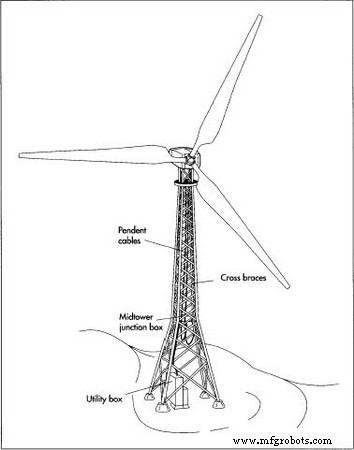
- Utility Box – Located at the tower base, it houses the power conversion system and connects to the grid via cables to neighboring turbines and the transformer.
The Manufacturing Process
Successful turbine construction begins with careful site selection: consistent winds exceeding 15.5 mph (25 km/h) and proximity to power lines are essential. Ideal locations are open, slightly rolling terrains near ridges or mountain ranges that funnel wind.
Preparing the Site
- Roads are graded and paved to accommodate heavy equipment.
- Each turbine base receives a concrete foundation, underground cables, and a connection to the remote control center.
Erecting the Tower
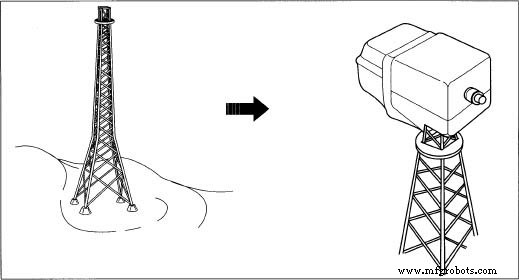
- Pre‑assembled steel sections are bolted on‑site, then lifted into place by crane. Stability is verified before final tightening.
Installing the Nacelle
- In the factory, the nacelle’s internal gear train, pitch, and yaw mechanisms are assembled onto a base frame.
- On site, the nacelle is hoisted onto the completed tower and bolted into position.
Attaching the Rotor Blades
- Blades are typically bolted to the nacelle after the tower is set.
- For easier ground assembly, some turbines mount two blades on the nacelle first, then attach the third after the nacelle is in place.
Installing Control Systems
- The utility box and the turbine’s electrical communication system are installed concurrently with the nacelle and blades.
- Cables run from the nacelle to the utility box, and from there to the remote control center.
Quality Control
Wind turbine manufacturing is a relatively new industry, and standardized quality controls are still evolving. Common issues include blade cracks, alignment errors, and electrical sensor failures due to surges. Manufacturers are adopting stricter testing protocols and sensor technology to mitigate these risks.
Maintenance schedules are critical: inspections occur quarterly, with major checks every six months that include lubrication, oil‑level checks, and on‑site electrical diagnostics.
Environmental Benefits and Drawbacks
Wind turbines generate clean electricity, emitting no pollutants. In contrast, coal, oil, and natural gas emit 1–2 lb of CO₂ per kWh. The current 3.7 billion kWh output from U.S. wind farms equals roughly 4 million barrels of oil or 1 million tons of coal.
Drawbacks include visual impact and noise, as well as occasional bird collisions. Site selection—avoiding wilderness areas and migratory paths—alongside ongoing noise‑reduction research, helps mitigate these concerns.
The Future
Wind energy’s potential remains largely untapped. The U.S. Department of Energy projects a tenfold increase in output by 1995 and a seventyfold increase by 2005, which could bring wind power to 10 % of U.S. electricity production.
Research focuses on extending turbine lifespan from 5 years to 20–30 years, improving blade efficiency (the theoretical limit is 59.3 % but current turbines average ~30 %), enhancing drive‑train durability, and bolstering surge protection. DOE has partnered with leading corporations to address mechanical failures through 2020‑2030 initiatives.
Global manufacturers, such as U.S. Windpower, plan to expand capacity from 4,200 MW (8,000 turbines) to 20,000 MW (20,000 turbines) by 2000. International collaborations are accelerating adoption in developing countries, while Denmark aims to double its wind turbine output.
Conclusion
As technology matures, wind turbines will become more efficient, reliable, and widespread—offering a sustainable path to meet growing energy demands while protecting the planet.
Manufacturing process
- New Research Aims to Boost Wind Turbine Efficiency Through Advanced Flow Control
- GE, DOE Partner on 3D‑Printed Wind Turbine Blade Innovation
- GE Unveils Cypress 6.0‑164: The Most Powerful Onshore Wind Turbine
- Wind Power: Converting Air Movement into Clean Electricity
- Ensure Safety and Efficiency: The Critical Role of Wind Turbine Brakes
- How to Choose the Ideal Wind Turbine Brake for Reliable Performance
- Essential Guide to Wind Turbine Components: Mastering Modern Energy
- 6 Key Wind Turbine Maintenance Tips for Long-Lasting Performance
- Wind Turbines Explained: Types, Benefits, and Applications
- Wind Turbines Explained: How They Generate Clean Power