



An Expert Guide to Wine Production, History, and Quality Control
Background
Wine is an alcoholic beverage crafted by fermenting grape juice, though a variety of fruits—berries, apples, cherries, and even rice—can also yield fermented wines. The process harnesses natural sugars, acids, tannins, minerals, and vitamins inherent in the fruit to create the complex flavors that define wine.
Grapes belong to the botanical family Vitaceae, with many species cultivated worldwide. The two species most commonly used in commercial winemaking are Vitis labrusca and, above all, Vitis vinifera, which has been the cornerstone of wine production for centuries.
The accidental discovery of wine is widely accepted: the combination of grape pulp, juice, and seeds naturally hosts the sugars and acids needed for fermentation. The frosty bloom on grape skins captures airborne yeast and enzymes, turning juice into wine over time.
Vineyard cultivation—viticulture—produces grapes that are harvested in the fall, ranging in hue from pale yellow to deep ruby. Regardless of scale, whether home-brewed or produced in large wineries, the flavor, sweetness, dryness, and alcohol level are largely determined during fermentation.
Wine is categorized by color—white, rose, and red—and by alcohol content, typically 10–14 %. Broad categories include table wines, sparkling wines, fortified wines, and aromatic wines. Table wines span red, white, and rose; sparkling wines encompass Champagne and other “bubbly” varieties; aromatic wines feature fruit, plant, and floral notes; fortified wines blend brandy or other spirits into base wines.
The name of a wine usually derives from the principal grape, the geographic origin, or a specific vineyard parcel. The vintage year appears on bottles aged two or more years; younger wines are not marked with a date.
Red wines are generally aged seven to ten years before release, while white and rose wines benefit from only one to four years of aging. While age often correlates with quality and price, other factors—grape quality, harvest timing, care, fermentation control, and storage—play pivotal roles.
Wineries offer a range of bottle sizes—half, pint, standard, and gallon—and often feature custom label designs. Many use colored glass to protect red and rose wines from light-induced aging once on the market.
Viticulture has evolved with technology that increases yield and variety without sacrificing tradition. Modern mechanical harvesters, crushers, temperature‑controlled tanks, and centrifuges streamline production, though their impact on quality remains a subject of debate among connoisseurs.
History
Documented in biblical texts and archaeological findings, wine dates back to at least 5,000 B.C. Egyptian tomb murals and pottery provide evidence of early wine use. As the climate and soil of northern regions proved favorable, wine production spread from the Nile to Persia, Europe, and eventually North America.
Ancient Greek wines surpassed Egyptian varieties, prompting Egyptian imports. Roman vintners—later linked to modern Italian, Spanish, and French wines—refined techniques that set new standards. By the Renaissance, France and Germany dominated, shifting the epicenter from the Mediterranean to central Europe. Bordeaux, in southern France, has produced world‑renowned wines for over 2,000 years.
European colonists brought viticulture to the American East Coast by the mid‑1600s. The first recorded New World wine appears in a Pilgrims’ 1623 Thanksgiving celebration. European cuttings struggled against native plant diseases until the 19th century, when Vitis labrusca vineyards thrived across Pennsylvania, Virginia, Ohio, Indiana, Alabama, Mississippi, and North Carolina.
In 1697, Franciscan priests introduced Vitis vinifera to California at Mission San Francisco Xavier. The grape soon dominated California winemaking. Hungarian nobleman Colonel Agoston Haraszthy further expanded the industry in the 1850s, laying the foundation for modern California wines.
Today, California and New York lead U.S. wine production, with California ranking among the world’s largest producers. While celebrated table wines showcase quality, California’s large wineries also supply bulk wines, concentrates, and brandy precursors for blending and specialty products.
Raw Materials
Wine grapes naturally contain all necessary components: pulp, juice, sugars, acids, tannins, and minerals. Some producers add yeast for stronger fermentation or cane/beet sugar (chaptalization) to raise alcohol levels. Sulfur dioxide is typically incorporated to control wild yeast and preserve aroma.
The Manufacturing Process
While the core steps of winemaking remain unchanged, modern equipment—mechanical harvesters, crushers, temperature‑controlled tanks, and centrifuges—has increased efficiency. Automation dominates medium to large wineries, whereas small producers often rely on hand presses and cellar storage.
Timing is critical: picking, pressing, fermentation, and aging all require precise coordination to achieve desired flavor profiles.
The process is commonly divided into four stages: harvesting & crushing, fermentation, aging, and packaging.
Harvesting and crushing grapes
- Vineyardists use a refractometer—a handheld, telescope‑sized device—to measure sugar content and decide when grapes are ripe.
- Once ripe, mechanical harvesters (often suction pickers) gather grapes into mobile hoppers. Many harvesters now mount grape crushers, enabling grapes to be crushed and transferred to the winery as must, preventing oxidation that can occur from manual crushing.
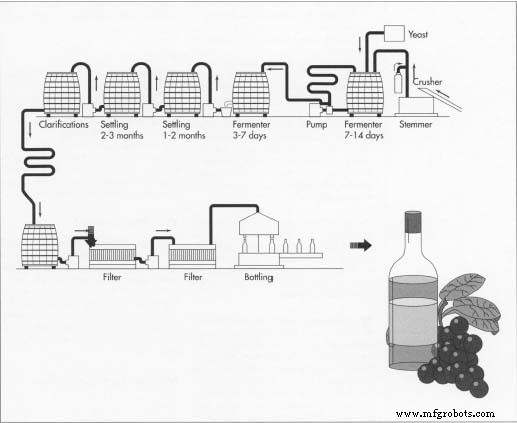
- Hoppers are transported to the winery where a crusher‑stemmer removes stems and yields liquid must. The must may then be transferred to stainless‑steel fermentation tanks or wooden vats, depending on the wine style. (See image below.)
Fermenting the must
- For white wines, skins are separated from must via filtration or centrifugation before fermentation. Red wines keep skins in the must, extracting color and tannins; rose wines have a brief skin contact before filtering.
- Wild yeast initiates fermentation, converting sugars to alcohol. Winemakers may add commercial yeast or cane/beet sugar (chaptalization) to boost alcohol content. Hydrometers gauge sugar levels, and fermentation typically lasts 7–14 days.
Aging the wine
- Post‑fermentation, wines undergo filtering, settling (racking), and optional blending. Many wineries maintain subterranean cellars; larger operations use temperature‑controlled stainless‑steel tanks. Red wines often receive a secondary fermentation for clarity and color stability.
- Racking involves pumping wine into tanks at 50–60 °F for reds and 32 °F for whites, allowing sediment to settle over 1–2 months. A second racking may follow for an additional 2–3 months.
- After settling, wines are filtered or centrifuged again, then aged in stainless‑steel or oak vats. White and rose wines age 1–4 years; reds 7–10 years.
- Final filtration removes remaining sediment before bottling.
Packaging
- Modern bottling lines automate the process. Corks (often oak‑derived) cover with aluminum foil or plastic seals; cheaper wines use screw caps. Bottles are sealed, labeled, crated—typically in wooden crates for premium wines or cardboard for lower‑priced bottles.
Quality Control
Every step—from harvest timing and crushing speed to fermentation temperature, sugar and acid balances, and sulfur dioxide levels—impacts the final product. Meticulous control throughout the process ensures consistency, safety, and the high standards expected by wine professionals and consumers alike.
Manufacturing process
- Brandy: History, Production, and Quality Control – An Expert Guide
- Cognac: The Art and Craft of France’s Premier Brandy
- Champagne: History, Production, and Craftsmanship
- Avient Launches Natural‑Looking TPE Wine Corks with New Special‑Effect Masterbatch
- Wine & Spirits Marketers Demand Blockchain Proof for Tamper‑Proof Traceability
- U.S. vs. EU Aircraft Subsidy Dispute: Wine Industry Suffers Consequences
- Biz4Intellia IoT Level Monitoring: Transforming Wine Production with Smart Asset Management
- Atlas Copco Showcases NGP+ Nitrogen Generator at 2017 WIN Expo
- The Art and Science of Crushing Grapes in Winemaking
- How Premium Compressed Air Enhances Wine Production