



Champagne: History, Production, and Craftsmanship
Background
Champagne remains the quintessential celebratory beverage, used to toast new beginnings, honor achievements, and mark milestones. Its allure stems from the effervescence that erupts when a bottle is opened, created by carbon dioxide produced during the unique double fermentation that defines champagne.
Fine champagne today is synonymous with sophistication, yet early wine connoisseurs dismissed sparkling wines as frivolous. In 1688, Dom Perignon—whose name is now the benchmark for excellence—worked tirelessly to tame the bubbles he produced as cellarer of the Benedictine Abbey of Haut‑Villers in France’s Champagne region. Ironically, his preference for bottling rather than cask fermentation amplified the build‑up of carbonic acid, creating the very pressure that gives champagne its signature fizz.
The Champagne province stretches from Flanders in the north to Burgundy in the south, and from Lorraine in the east to Île‑de‑France in the west. Historically, it vied with Burgundy for the title of premier still red wine producer. However, the region’s cooler climate limits the sun needed for robust red grapes, prompting Dom Perignon to focus on mastering the Pinot Noir grape for high‑quality white wine.
Pinot Noir, often called “black grape,” has a blue exterior and a red interior. The juice is white, but careful harvesting is required to prevent skin rupture and color transfer.
Climate is a decisive factor in winemaking. In Champagne, short, inconsistent summers lead to variable harvests. To mitigate this, vintners store surplus wine from good years and blend it with juice from poorer seasons. After the fall harvest, the wine ferments until winter halts activity; it resumes in late spring or early summer, where additional sugar is added. The wine is then bottled and sealed. Because carbonic acid cannot escape through glass, pressure builds until the cork is released.
Early production risked catastrophic explosions—20‑90% of bottles burst—necessitating iron face masks for cellar workers. By 1735, a royal ordinance regulated bottle shape, size, and weight. Corks were standardized at 1.5 in (3.75 cm) long and secured with strong pack thread. Deep cellars with constant temperatures and the region’s chalky soil helped prevent explosions.
Three years after Perignon’s death, Canon Godinot recorded the monk’s specifications for making champagne:
- Use only Pinot Noir grapes.
- Prune vines aggressively; keep them no taller than three feet.
- Harvest grapes carefully to preserve skins. Keep the grapes as cool as possible, working early in the morning or on cool, rainy days. Reject broken or bruised fruit.
- Set up the press near the fields. If transport is required, use slower pack animals such as mules or donkeys to avoid jostling.
- Do not crush grapes or allow skins into the juice.
While modern vintners employ technology to streamline certain steps, the core process has remained largely unchanged for three centuries.
Raw Materials
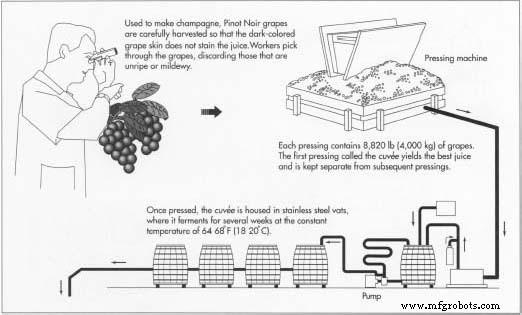
The primary ingredient is the Pinot Noir grape. Grown in bunches, each grape is carefully selected to avoid pigment transfer. Workers pick through the vines, discarding unripe or mildewy fruit. A typical pressing uses 8,820 lb (4,000 kg) of grapes, which are taken directly to the press to preserve juice purity.
During the double fermentation, several natural ingredients are added. Yeast—typically Saccharomyces cerevisiae—initiates the first fermentation, converting grape sugars to alcohol. A liquer de tirage, a syrup of cane sugar dissolved in still champagne wine, is added for the second fermentation. A liquer d’expédition, composed of cane sugar, still wine, and brandy, is added afterward; the sugar level determines the champagne’s sweetness: 0.5 % for brut, 1 % for extra sec, 3 % for sec, and 5 % for demi‑sec.
The Manufacturing Process
Pressing
- The grapes are gently loaded into a square wooden press surrounded by adjustable rails and topped with a heavy oak lid. The lid is lowered and raised at intervals, rupturing the fruit and allowing juice to flow through the rails into stainless‑steel vats. The first pressing yields the cuvée— the highest‑quality juice—kept separate from subsequent presses. The cuvée begins fermenting immediately, with scum skimmed off and lees settled.
First Fermentation
- The cuvées are moved to temperature‑controlled stainless‑steel vats and fermented for several weeks at 64‑68 °F (18‑20 °C). Some producers also perform malolactic fermentation at this stage to reduce acidity.
Blending
- The head cellarer (chef de caves) and assistants taste and blend wines from multiple pressings to achieve the desired profile. The blended wines are then churned in vats by sweeping mechanical arms.
Bottling and Second Fermentation
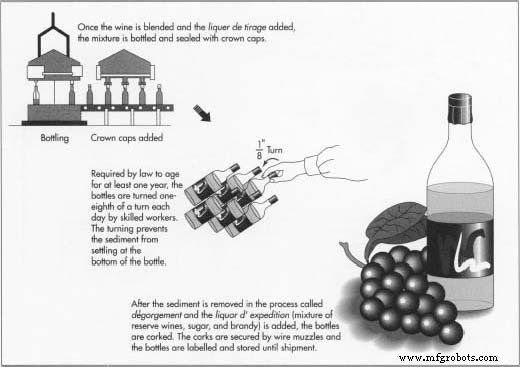
- The blended wine is drawn into bottles, liquer de tirage is added, and bottles are sealed with crown caps. Because carbonic acid is trapped in glass, pressure builds to levels comparable to a bicycle tire, priming the second fermentation.
Aging
- French law requires non‑vintage wines to age a minimum of one year; vintage wines must age at least three years, with many houses extending this period. Non‑vintage wines combine current‑year juice with reserves from prior excellent vintages and are not labeled with a specific year. Vintage wines, made from grapes harvested in a single year, carry the vintage on the cork and label and are produced only when conditions are exceptional.
Racking (Remuage)
- During aging, bottles are turned daily to keep dead‑yeast sediment from settling on the bottom. Skilled workers give the bottles a one‑eighth turn each day. Bottles start horizontal and finish vertical, with the necks pointing toward the floor so sediment gathers against the cork.
Degorgement
- The bottleneck is plunged into freezing liquid, forming a frozen plug of champagne in the neck. The crown cap is carefully removed, allowing the ice to expel the sediment.
Liquor d’expédition Added
- Reserve wines, sugar, and brandy are added to the bottles to achieve the target sweetness.
Corkage
- A long, fat cork—often branded with the house name—is hand‑driven halfway into the bottleneck, then the exposed portion is pressed into the neck and secured with a wire muzzle. The bottles are labeled, stored, and later shipped in crates or cartons.
Quality Control
Champagne houses set rigorous internal standards guided by French regulations and the Institute National des Appellations d’Origine, which enforces soil quality and production methods. Every step of the process is overseen by seasoned experts skilled in tasting and blending, ensuring each bottle meets the highest quality benchmarks.
The Future
While the labor‑intensive craft of champagne will continue to evolve, mechanization is already reshaping the industry. Agricultural advances have reduced rot risks, lessening manual grape‑picking. Many large houses have replaced traditional round wooden presses with horizontal models equipped with inflatable rubber bags, gently pressing grapes. Experimental systems are also exploring automated bottle rotation to replace costly hand‑turning, though none have yet proven fully effective. Industry observers agree that mechanization is inevitable.
Manufacturing process
- Brandy: History, Production, and Quality Control – An Expert Guide
- Cognac: The Art and Craft of France’s Premier Brandy
- An Expert Guide to Wine Production, History, and Quality Control
- Avient Launches Natural‑Looking TPE Wine Corks with New Special‑Effect Masterbatch
- Wine & Spirits Marketers Demand Blockchain Proof for Tamper‑Proof Traceability
- U.S. vs. EU Aircraft Subsidy Dispute: Wine Industry Suffers Consequences
- Biz4Intellia IoT Level Monitoring: Transforming Wine Production with Smart Asset Management
- Atlas Copco Showcases NGP+ Nitrogen Generator at 2017 WIN Expo
- The Art and Science of Crushing Grapes in Winemaking
- How Premium Compressed Air Enhances Wine Production