



Cognac: The Art and Craft of France’s Premier Brandy
Background
Cognac is a distinguished type of brandy produced from white grapes cultivated in the Charente region of France. The spirit derives its name from the town of Cognac, located in this renowned area. Often referred to as “burnt wine,” the term stems from the Dutch word brandewijn, highlighting the double‑heating process that characterizes its production.
Beyond its primary role as a fine sipping beverage, cognac enriches culinary creations—sauces, marinades, fruit preserves, and chocolates—adding depth and complexity to a wide range of dishes.
History
In the 17th century, the town of Cognac was a thriving exporter of salt and wine, attracting Dutch and English merchants who sought to preserve wine quality during long sea voyages. These merchants began distilling the wine, creating the early form of what we now call cognac.
Chevalier de la Croix-Marrons pioneered the practice of reheating wine and re‑distilling it—an early method that earned the name “burnt wine.” The distilled spirit was then aged in oak barrels, where it acquired a smoother profile and developed nuanced flavors.
By the 18th century, Jean Martell and James Hennessy established distilleries on the Charente River, laying the foundations for two of the most celebrated cognac houses. In 1783, the term “cognac” was officially adopted, and the French government introduced labeling regulations that classify the spirit by age and quality:
- V.S. (Very Superior) – minimum 2½ years
- V.S.O.P. (Very Superior Old Pale) or Reserve – minimum 4 years
- X.O. (Extra Old) – minimum 5 years
While the original warehouses were built along the river for ease of transport, the resulting damp environment contributed to a milder, more refined spirit. Modern producers continue this tradition, maintaining humidified cellars to preserve the delicate character of cognac.
French law mandates that distillation takes place in copper pot stills—known as alembics—equipped with a long “swan’s neck.” Stills are kept small to ensure a slow, precise distillation, and the process must be completed between November and March 31.
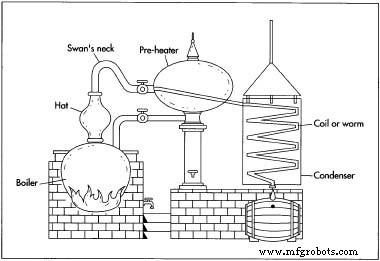
The heat source has evolved from wood and coal to natural gas, reflecting advances in technology while preserving traditional methods.
Raw Materials
The ideal grape varieties for cognac include Colombard and Saint‑Emilion, with additional varieties such as Blanche, Folle Juirancon, Monfis, and Sauvignon contributing to flavor diversity. These grapes are cultivated in six designated crus—Grande Champagne, Petite Champagne, Borderies, Fins Bois, Bons Bois, and Bois Ordinaires—each imparting a unique profile to the spirit.
Harvesting occurs in late winter when grape sugar levels yield 8–9% alcohol content, the optimal range for producing a balanced spirit. Grapes outside this range result in either insufficient aroma or overly concentrated flavors.
Cognac ages in oak casks crafted from 100‑year‑old Limousin or Tronais timber. Limousin wood, rich in tannin, accelerates maturation, while Tronais releases tannin more slowly, contributing to a smoother finish. Major cognac houses control the cooperage process, seasoning wood for a minimum of three years before shaping barrels with metal hoops to avoid flavor‑altering adhesives.
The maturation of cognac can span decades, with the spirit’s alcohol content gradually decreasing to a palatable 40%. Blending with distilled water and other brandy varieties helps achieve consistency, while caramel or sugar syrup may be added to balance color and sweetness.
The Manufacturing Process
Pressing the Grapes
- The grapes are pressed, and the juice ferments naturally without added sugars or sulfite.
First Distillation
- Fermented wine is transferred to pot stills within brick kilns. Each still holds roughly 660 gallons (≈3,000 bottles). Kilns are heated to 173–212°F (78–100°C), allowing alcohol vapor to separate from the mash.
- The vapors condense into “brouillis,” reducing the volume by one‑third and resulting in a 30% ABV liquid.
Second Distillation
- The brouillis undergoes a second heating known as “bonne chauffe.” The distiller isolates the “heart” of the liquid, separating it from the high‑alcohol “heads” and low‑substance “tails.” Heads and tails are re‑distilled for blending.
- The remaining liquid, the clear “eau‑de‑vie,” is further reduced to 70% ABV, effectively cutting the volume by another third. This meticulous process consumes 9 liters of wine to produce 1 liter of cognac, a cost reflected in the final product.
Casking the Distilled Brandy
- The eau‑de‑vie is transferred to oak casks and stored in damp cooperages. Each cask is labeled with vintage, cru, and date.
- Initial aging occurs in new casks for 1–2 years, allowing tannins to impart character. Subsequent transfers to older casks refine the spirit’s profile.
Aging and Blending
- Coopers oversee annual tastings, primarily by nose, to decide when a batch should move to a new cask.
- Blending across vintages and crus creates the house style, with each cognac house maintaining a consistent flavor profile passed down through generations.
Bottling the Cognac
- Premium bottles—often crystal and wax‑sealed—are the hallmark of each house. The bottling line operates at approximately 5,000 bottles per hour, with each bottle inspected and hand‑dried before packaging or storage.
Manufacturing process
- Brandy: History, Production, and Quality Control – An Expert Guide
- Champagne: History, Production, and Craftsmanship
- An Expert Guide to Wine Production, History, and Quality Control
- Avient Launches Natural‑Looking TPE Wine Corks with New Special‑Effect Masterbatch
- Wine & Spirits Marketers Demand Blockchain Proof for Tamper‑Proof Traceability
- U.S. vs. EU Aircraft Subsidy Dispute: Wine Industry Suffers Consequences
- Biz4Intellia IoT Level Monitoring: Transforming Wine Production with Smart Asset Management
- Atlas Copco Showcases NGP+ Nitrogen Generator at 2017 WIN Expo
- The Art and Science of Crushing Grapes in Winemaking
- How Premium Compressed Air Enhances Wine Production