



Wool: History, Production, and Global Impact
Background
Anthropologists trace the use of wool back to the Neolithic Age, when early humans sought protection and warmth from animal pelts. These pelts proved not only cozy but also durable, inspiring the development of rudimentary tools and techniques for processing wool. By 4000 B.C., Babylonians were already wearing crudely woven woolen garments, marking the beginning of a long tradition of textile innovation.
As societies advanced, the practice of raising wool‑bearing herds became common. Sheep, in particular, emerged as the preferred source due to their abundant and versatile fiber. By the 11th and 12th centuries, the wool trade flourished across Europe: English shepherds perfected sheep rearing while Flemish craftsmen mastered spinning and weaving. This collaboration created a thriving export economy, with English wool flowing to the Low Countries and processed fabrics returning to England.
England soon recognized the strategic importance of controlling the entire supply chain. Laws were enacted to encourage domestic production—requiring judges, professors, and students to wear robes made from English wool, and mandating that burial shrouds be woven from native fibers. In the 18th‑century colonial era, similar statutes were introduced to protect the “golden fleece,” including draconian measures aimed at curbing the export of sheep genetics to the colonies.
Today, the wool industry is a global enterprise. Major producers include Australia, Argentina, the United States, and New Zealand, with Australia alone supplying about 25 % of worldwide output. The U.S. remains the largest consumer of wool fabrics, while Australian fleece accounts for the largest share of raw material sold internationally. The annual global production now exceeds 5.5 billion pounds, underscoring wool’s status as the premier animal fiber even as cotton dominates plant-based textiles.
Raw Materials
While sheep are the most common source, wool also comes from camels, goats, and rabbits. Scientifically, wool is a keratin protein, typically ranging from 1.5 to 15 inches (3.8 to 38 cm) in length depending on breed. Each fiber comprises three layers: the cuticle, cortex, and, in some fine wools, a medulla that provides thermal insulation.
The cuticle—an outer layer of overlapping scales—enables fibers to cling together, facilitating spinning. The cortex contains millions of cigar‑shaped cells; in natural‑colored wool, melanin in these cells gives rise to the characteristic crimp. The medulla, a honeycomb‑like network, creates air pockets that enhance insulation.
Wool’s hydrophilic nature makes it highly absorbent and easy to dye. It can stretch 25–30 % before breaking, yet tends to shrink when wet. Its high elasticity and natural crimp give wool fabrics their distinctive feel and durability.
Design
While selective breeding can modify fiber properties, most design alterations occur during manufacturing. Wool can be blended with natural or synthetic fibers, and a range of finishes and treatments are applied to tailor performance.
Key fleece types include:
- Lambs’ wool – harvested from sheep under eight months old, offering a soft, tapered fiber.
- Pull‑up wool – sourced from animals processed for meat; the fiber is chemically extracted and typically yields lower‑grade cloth.
- Virgin wool – never previously processed; however, “virgin” does not guarantee superior quality.
Wool fabrics fall into two main categories:
- Woolens – composed of short, curly fibers, resulting in soft, fuzzy, and insulating fabrics with low thread counts.
- Worsteds – made from long, straight fibers, producing smooth, tightly woven textiles with higher durability and a refined finish.
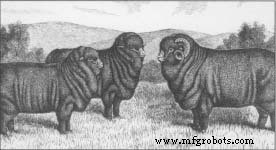 The deep wrinkles on imported A‑type Merino ewes (left) and rams (right) contributed to increased wool yields per sheep for American producers.
The 19th‑century mechanization of the woolen industry—except for shearing and grading—transformed production. From 1790 to 1890, every step from carding to weaving was mechanized, freeing labor to focus on quality control and innovation.
In the 17th and 18th centuries, American wool supplied “homespun” cloth that rivaled hand‑loom imports. The introduction of English breeds such as Southdowns and Spanish Merinos elevated domestic standards, enabling the U.S. to compete with the best European textiles.
The Merino’s tightly folded fleece produced high yields, sparking a “Merino craze” in the early 19th century. By 1810, an American diplomat successfully imported 20,000 purebred Merinos, catalyzing growth across Vermont, Pennsylvania, and Ohio.
William S. Pretzer
Manufacturing Process
The journey from sheep to finished fabric involves these key stages: shearing, grading and sorting, cleaning and scouring, carding, spinning, weaving, and finishing.
Shearing
- Sheep are sheared once a year, typically in spring. Experienced shearers can process up to 200 animals daily, recovering 6–18 lb (2.7–8.1 kg) of fleece per sheep.
- Traditional hand shearing remains common, though advanced robotic systems are increasingly adopted.
Grading and Sorting
- Grading categorizes fleece by overall quality, while sorting separates fibers by body region—shoulders and sides yield the finest fibers for apparel; lower legs produce coarser fibers used for rugs.
- High‑grade wool does not always translate to maximum durability, making expert assessment essential.
Cleaning and Scouring
- Raw wool, also known as grease wool, contains sand, dirt, grease, and dried sweat (suint), accounting for 30–70 % of total weight. Images of contaminated fleece illustrate the extent of impurities.
 The scouring process uses alkaline baths of water, soap, and soda ash to remove these contaminants. Byproducts such as lanolin are recovered for household products.
Carding
- Carding straightens and blends fibers into slivers, removing residual dirt. For worsted yarn, gilling and combing align longer fibers, followed by drawing to refine the sliver.
- Woolen yarn fibers bypass these additional steps, proceeding directly to spinning.
Spinning
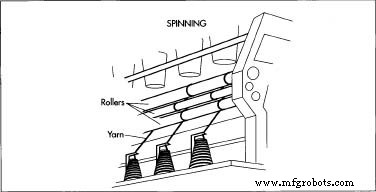
- Fibers are twisted together to form yarn. Woolen yarns typically use mule spinning machines; worsted yarns may be spun on various machines. Finished yarn is wound onto bobbins, cones, or drums.
Weaving
- Two primary weaves are used: plain weave for woolen fabrics, yielding a softer, napped surface; and twill weave for worsteds, producing a tighter, smoother finish. Both techniques preserve fiber integrity while achieving desired fabric characteristics.
Finishing
- Post‑weaving treatments include fulling (water immersion to lock fibers), crabbing (setting the interlock), decating (shrink‑proofing), and dyeing. Dyeing may occur pre‑carding or after weaving, depending on desired effect.
Byproducts
Efficient waste management is crucial for profitability. Wool industry byproducts are categorized into four classes:
- Noils – short fibers separated during combing; high‑quality and often reused in premium products.
- Soft waste – material shed during spinning and carding; typically reintroduced into the process.
- Hard waste – generated during spinning, twisting, winding, and warping; requires extensive reprocessing and is considered lower value.
- Finishing waste – clippings, short ends, sample runs, and defects; diverse and requires meticulous sorting, making it the lowest‑grade waste.
Quality Control
Quality assurance relies on visual inspection, tactile assessment, and precise measurement. Defects such as loose threads are removed using burling irons, knots are tucked, and minor imperfections are corrected before finishing.
In 1941, the U.S. Congress enacted the Wool Products Labeling Act to protect producers and consumers from undisclosed substitutions. The Act mandates that all non‑upholstery wool products display labels indicating material content and percentages. It also standardized industry terminology, defining key terms such as:
- Wool – new or reclaimed fiber from scraps and broken threads.
- Repossessed Wool – recovered from new woven or felted fabrics.
- Reused Wool – derived from old clothing and rags.
The Future
Wool’s continued prominence is supported by its enduring attributes—warmth, durability, and value. Unless a groundbreaking innovation emerges that matches these qualities, wool is poised to remain a cornerstone of the textile industry.
Manufacturing process
- What is VMC Machining? An Expert Overview of Vertical Machining Centers
- Expert Guide to Aluminum Laser Marking: Precision, Durability, and Industry Applications
- MIG vs. TIG Welding: Selecting the Right Arc Welding Technique for Your Project
- Comprehensive Guide to Laser Marking: Types, Benefits, and Applications
- Key Considerations for High‑Volume Swiss Machining
- CNC Prototyping Guide: Precision, Speed, and Cost‑Effective Production
- Steel Wool: History, Production, and Safety Insights
- Wool: History, Production, and Global Impact
- The Art and Science of Dyeing Wool: Techniques, Dyes, and Best Practices
- Electric Sheep Robotics Unveils Dexter: Transforming Commercial Mowers into Autonomous Lawn Care Solutions