



Essential Guidelines for Secure Hazardous Material Storage in Warehouses
Many warehouses across America contain some sort of hazardous materials. Usually referred to as hazmat by those in industry, hazardous materials range from corrosive or acid products to highly flammable liquids. Many warehouses also store materials that are threats to the environment. Those products include everything from gas cylinders to paint and ink supplies.
As a warehouse manager or facility operator, your primary concerns are the safety of your employees, your inventory and your building. Properly storing warehouse hazmat products is a top priority for minimizing the chance of an accident in your workplace. Buying equipment that safely stores hazardous materials in your warehouse is the best way to protect your warehouse and your workers.
Warehouse Storage of Hazardous Materials
Unfortunately, serious accidents involving hazardous materials occur all too often. The potential for accidents exists everywhere safe storage solutions aren’t applied. Warehouse facilities are the most common sites where hazmat incidents happen. You might think transporting hazardous goods would be higher risk than stationary storage, but that’s not necessarily the case.
The United States Agency for Toxic Substances and Disease Registry (ATSDT) reports that 75 percent of hazmat emergencies occur at storage facilities like warehouses. Drilling deeper, the U.S. Chemical Safety and Hazard Investigation Board (CSB) reports almost half of hazmat incidents are caused by inadequate material storage and handling. Of these incidents, 36 percent involve incompatible chemicals stored improperly and 22 percent happen inside storage equipment like non-compliant cabinets.
You can drastically decrease your chance of being an ATSDT or CSB warehouse accident statistic. The key to safety improvement is understanding the many rules and regulations pertaining to hazardous material storage and handling. As with all safety issues, knowledge about hazardous materials gives you the power to implement proper safety procedures. Here are the main federal requirements governing what’s legally required to handle volatile goods safely — and to store them.
Hazardous Material Storage Requirements

There are many hazmat requirements in the warehouse. Most hazardous material storage and handling regulations are found in federal acts, but some requirements exist at the state and local level. These are the three important regulators and websites you must know as a proactive warehouse manager concerned with safely storing hazardous materials:
- Occupational Safety and Health Administration (OSHA) Chemical Hazards and Toxic Substances: OSHA is the United States' leading regulator and advisory agency. At one time, OSHA was more of a safety enforcement agency than a safety promoter and accident preventer. Eventually, that gave way to a new OSHA that partners with business owners and managers to ensure they can raise the safety bar as high as possible. Today, OSHA focuses on worker training and education as well as being a tremendous source of hazardous materials identification. OSHA creates publications like the Hazard Communication Standard (HCS) and the table of Permissible Exposure Limits (PEL).
- Environmental Protection Agency (EPA): The EPA is America’s environmental watchdog. Like OSHA, the EPA has enforcement authority over all its federal regulations, including those overseeing safe storage and handling of chemicals and hazardous substances. The EPA website offers a wealth of information that assists you in identifying hazardous material properties and safe handling precautions. Familiarizing yourself with EPA regulations and guidelines makes your management job easier, especially when it comes to selecting specialized containers and cabinets for holding any type of material in your warehouse. EPA publications on regulated chemicals, exposure pathways, the exposure-response guidebook and the chemical hazards response information system provide excellent guidance.
- National Fire Protection Association (NFPA): The NFPA is a private trade association that sets industry standards concerning fire protection issues. Although the NFPA is a non-government agency, its information is highly respected and endorsed by federal government regulators including OSHA and the EPA. The primary NFPA publication you should be aware of as a warehouse supervisor or manager is the NFPA 30 Flammable and Combustible Liquids Code. This detailed document clearly defines the difference between flammable liquids and combustible liquids. It also prescribes acceptable specifications for construction of hazardous materials containment and storage cabinets, saying hazmat storage cabinets should not be ventilated unless there are exceptional circumstances.
Warehouse Regulations on Hazardous Materials
OSHA, the EPA, and the NFPA provide exceptional knowledge and guidance on hazmat storage that you can refer back to in the future. You must also understand critical safety information so you can ensure your employees’ and facility’s wellbeing. The most important things to know about hazmat classification and storage requirements involve defining safety parameters through hazardous material classifications and what constitutes safe storage cabinetry by regulatory design.
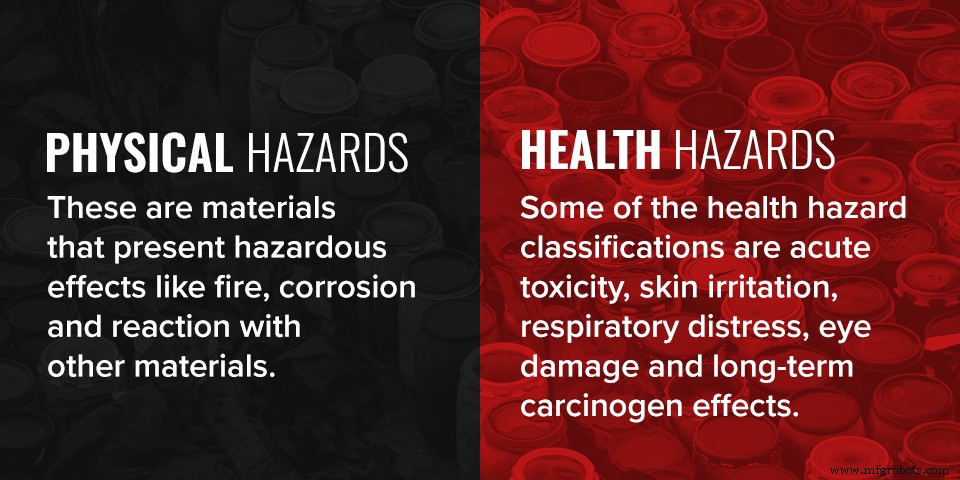
Fire is the most dangerous hazmat situation you can prevent within your warehouse. Gas explosions, acid corrosion burns, and polluting leaks also rank high on the threat list, but fire remains your biggest concern. These are the most common hazmat you will encounter:
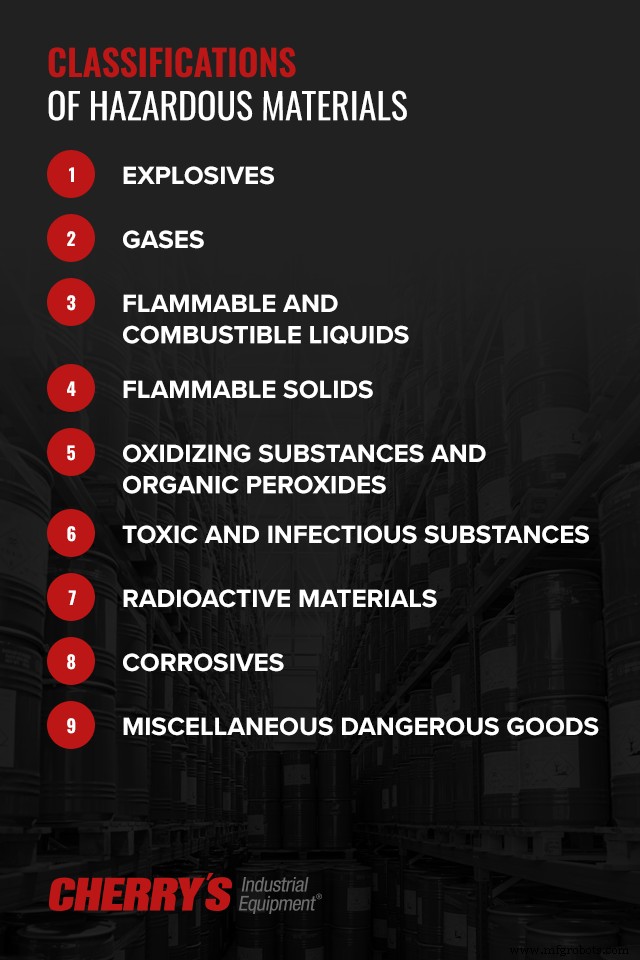
- Flammable Liquid: These fluids easily catch fire. They have a flashpoint, or ignition temperature threshold, below 100 degrees Fahrenheit.
- Combustible Liquid: This fluid classification burns at higher temperatures ranging from 100 to 200 degrees Fahrenheit. They also produce vapors that could explode if exposed to an ignition source.
- Flammable Solid: These are solid substances that readily burn if exposed to ignition or friction. Spontaneous chemical changes also make flammable solid materials dangerous if not properly stored in an approved cabinet.
- Oxidizer: Substances that yield oxygen to stimulate organic matter combustion are dangerous. Minimizing air exposure should be the safest solution when storing oxidizers, and you can do this with the right cabinet.
- Corrosive: By hazmat definition, corrosives are liquid substances that dissolve SAE1020 steel at a greater rate than 0.25 inches at 130 degrees Fahrenheit over a certain test time. It takes special methods such as steel cabinets to store corrosives safely.
- Poison: This is a general term for toxic substances that present any risk to human health or life. By OSHA and EPA regulations, all poisons in your warehouse must be properly labeled and safely stored in approved storage cabinets.
- Compressed Gas: Any solid or liquid material stored under sufficient pressure to turn it into a vapor state is a compressed gas. Regardless if compressed gas is liquid petroleum or propane trapped in an approved cylinder, you must also store it in an approved cabinet if it’s held in your warehouse.
Classifications of Flammable and Combustible Liquids
Flammable and combustible liquids have unique classifications laid out by the NFPA and adopted by OSHA and the EPA:
- Class IA Flammable Liquids have flashpoints below 73°F and boiling points below 100°F. Examples are diethyl ether, ethylene oxide, and some lightweight oils.
- Class IB Flammable Liquids have flashpoints below 73°F and boiling points above 100°F. Examples include automotive and aviation gasoline as well as some paint thinners.
- Class IC Flammable Liquids have flashpoints at or above 73°F and below 100°F. Examples are hydrazine, xylene, styrene, and turpentine. Some paints and solvent-based cements also qualify.
- Class II Combustible Liquids have flashpoints at or above 100°F and below 140°F. Examples include diesel fuel and most paint thinners.
- Class III Combustible Liquids have flashpoints at or over 140°F and are broken into two sub-classes. Typical Class III hazardous materials are home heating oil, motor oil, and home cooking oil.
Federal regulations govern safety cabinet storage capacity. These volume ratings are proportional to each classification and mandate the maximum storage amount a cabinet can hold for each class. Here are the maximum approved capacities for hazmat storage cabinets:
- Flammable Liquids Class IA, IB, and IC — 60 gallons
- Combustible Class II — 60 gallons
- Combustible Class III — 120 gallons
How to Store Hazardous Materials in Warehouses

Following the guidance of these regulatory bodies, regulations and classifications might seem overwhelming and confusing. You can avoid confusion by taking a straightforward look at a simple system of storing your hazardous materials. Fire prevention is your highest priority for warehouse hazmat safety. But you can also have safe chemical storage in the warehouse and prevent chemical spills when you invest in approved safety storage cabinets. OSHA’s Standards on Hazardous Materials, Flammable Liquids (section 1910.106(d)(3)) lays out hazardous material metal cabinet construction parameters:
- Cabinets must be No. 18 gauge steel construction on the bottom, top and sides.
- Cabinets must be double walled with a 1½-inch airspace.
- Cabinet joints must be riveted, welded or made tight by equal means.
- Cabinet doors must have a three-point, non-sparking latch.
- Cabinet doors must be raised 2” above the floor for spill containment.
- Cabinets must be conspicuously labeled “Flammable – Keep Fire Away.”
- Cabinets must be fire tested for a 10-minute duration with an internal temperature not to exceed at 325°F.
You might think ventilating your hazmat safety cabinets would be a smart move. That is not the case. The NFPA 30 Code makes a specific reference to not ventilating safety storage cabinets in NFPA 30 A.9.5.4. It states “ventilation has not been demonstrated as necessary for fire protection. Additionally, ventilation could compromise the cabinet’s ability to protect its contents. Therefore, ventilating storage cabinets is not recommended.”
Proper Cabinets for Storing Hazardous Materials
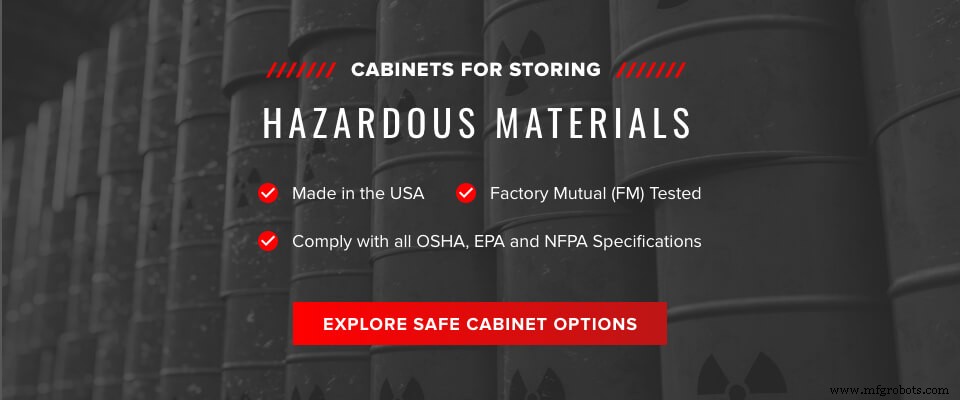
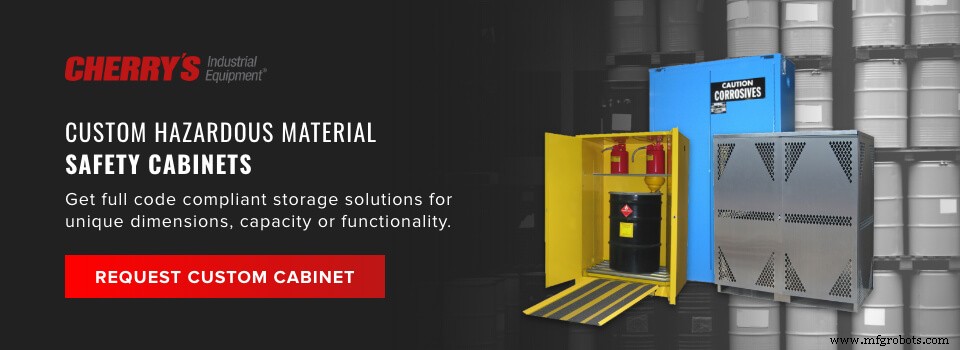
To find approved hazardous material storage, make sure you consider American-made safety cabinets from Cherry’s Industrial Equipment. All Cherry’s industrial and chemical storage cabinets are made in the USA and comply with all OSHA, EPA and NFPA specifications. Hazmat safety cabinets from Cherry’s Industrial Equipment are Factory Mutual (FM) tested to assure you’re buying the best hazardous material storage systems.
All Cherry’s Material Handling and chemical storage cabinets give you the ideal solution for safely storing every hazardous material in your warehouse. We specialize in different storage cabinets for specific applications. Our application groups include:
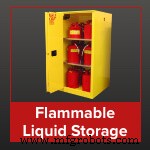
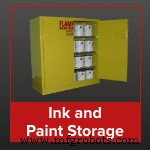
- Corrosive and Acid Storage
- Environmental Hazard Storage
- Flammable Liquid Storage
- Gas Cylinder Storage
- Ink and Paint Storage
All Cherry’s hazmat storage cabinets are available in various dimensions, colors and exterior metal options. No matter if you’re handling 55-gallon drums of flammable liquid, compressed gas cylinders or corrosive products, you will find the right storage cabinet at Cherry’s Industrial Equipment. That includes solutions for containing messy paint and ink spills that could become an environmental disaster.
Corrosive Liquid and Acid Storage in the Warehouse
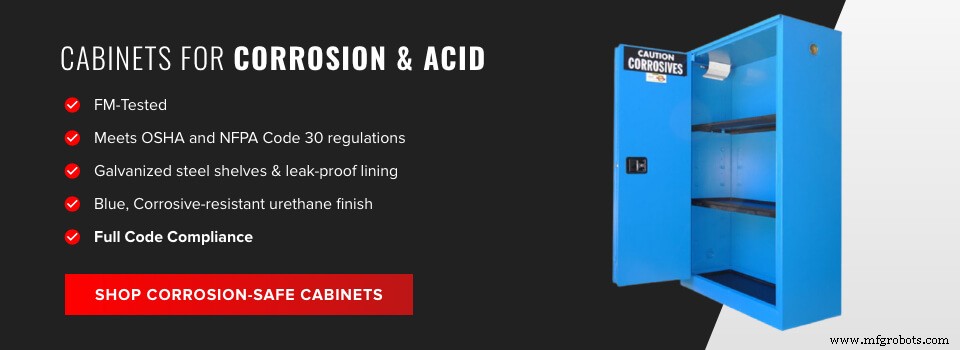
Corrosive and acid liquid materials are inherently safe — as long as you use them responsibly and store them properly. There are two dangerous elements when dealing with corrosive products like acid-based materials. One is the escape of the liquid. The other is failing to contain fumes caused by chemical reactions.
We design Cherry’s corrosive liquid and acid storage cabinets to store all types of flammable and nonflammable corrosive substances safely. Our FM-tested safety equipment meets all OSHA, EPA and NFPA requirements, so you have no concern about being non-compliant if you are inspected. Cherry’s acid storage cabinets have galvanized steel shelves and highlight a blue, corrosive-resistant urethane finish.
All corrosive liquid and acid storage cabinets have a specialized leak-proof lining that holds accidental spills inside the cabinet housing. Nothing escapes to harm incidental products or unsuspecting workers. You have plenty of time to clean up even the most sensitive materials before they can do serious damage.
With corrosive and acid storage cabinets from Cherry’s Material Handling, you have full code compliance. This allows you to focus on your business with the confidence you have done all you can for your workers' safety. Also, Cherry’s has a huge selection of storage cabinets to suit your unique needs. If we don’t stock what you require, we can custom build it.
Environmental Storage in the Warehouse
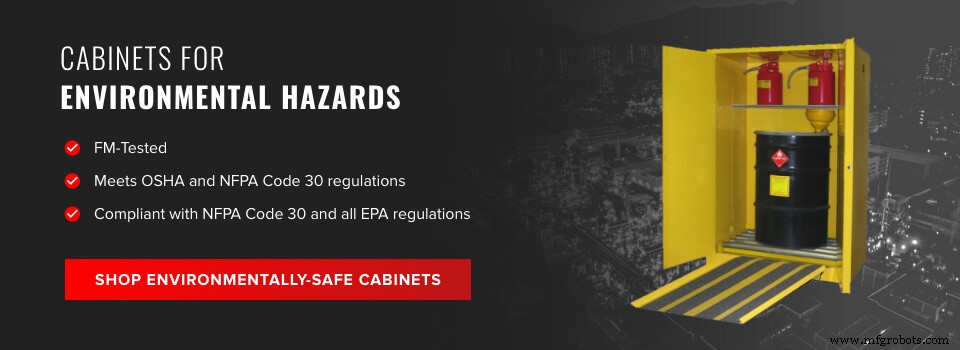
You can safely store environmentally sensitive materials in your warehouse with Cherry’s environmental cabinets. As a business owner or manager, you have a responsibility and duty of care to the area around you. That takes into account the environment your employees work in and the outside environment where nature resides.
Why take a chance on compromising your environment when you can safely contain hazardous materials with Cherry’s storage cabinets? You’ll instantly recognize environmental safety storage cabinets from their bright yellow paint. Like all hazmat cabinets, environmental storage containers are compliant with NFPA Code 30 and all EPA regulations.
With environmental storage cabinets, you receive many choices, including a wide size range and varied shelving. We know there’s no such thing as a one-size-fits-all solution. Browse our online catalog to see the many environmental cabinets you can choose from. We offer drum storage with options such as:
- Ball bearing rollers
- Capacity for up to a 75-gallon drum
- Flush mounted locking handle
Flammable Liquid Storage in the Warehouse
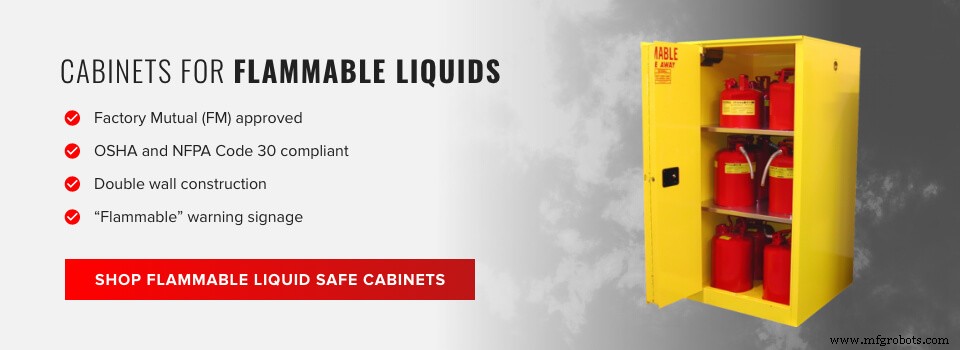
There’s no need to worry about an accidental hazardous materials fire when you have flammable and combustible products safely stored in your Cherry’s flammable liquid storage cabinets. Your warehouse takes a leap ahead in safety precautions with OSHA and NFPA-approved safety storage systems. Your FM-tested containers give you the added assurance that you’ve done thorough due diligence in your hazmat management program.
All Cherry’s flammable liquid storage cabinets stand out in your warehouse. Their bright red paint and yellow letters warn everyone “Flammable – Keep Fire Away.” No one can miss this safety alert, and you’ll have no concern that anyone could mistake what’s stored inside.
As with all Cherry’s hazardous materials storage solutions, you have numerous options with flammable liquid storage cabinets. You can choose your size, capacity and security features. You also have input into shelving design and signage.
All flammable liquid storage containers are built to the best and latest code compliances. At Cherry’s Industrial Equipment, we realize how important safety regulations are. To meet and exceed all code requirements, Cherry’s commits to going above and beyond to offer your warehouse safe and compliant equipment.
Gas Cylinder Storage in the Warehouse
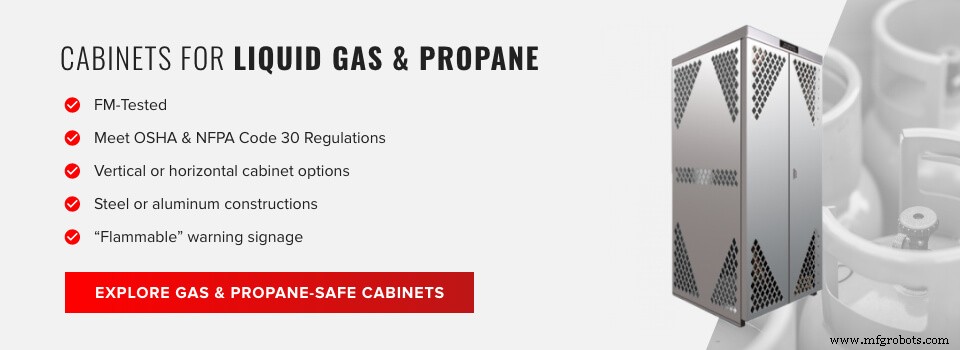
You can safely store liquefied gas and propane in Cherry’s industrial cylinder storage units. We provide unique designs for specific applications. Whether you require vertical storage for tall cylinders like oxygen and acetylene equipment or horizontal space for stubby propane bottles, Cherry’s has a solution for your warehouse.
You’ll find a range of sizes and materials in our gas cylinder storage container line. You have the choice of steel or aluminum construction. You can order naturally ventilated or securely enclosed cabinets. We can also custom build your order to get you what you need in your space.
Cherry’s Material Handling partners with you to ensure a safe workplace in compliance with all codes. We know how sensitive compressed gases are when not stored securely. With Cherry’s hazardous gas storage systems, you get peace of mind knowing your materials are secure.
You can reassure everyone in the warehouse that you have minimized the gas explosion or escapement risk. Cherry’s values safety and serves your business in a safe, respectful and compliant manner. You can explore Cherry’s gas cylinder safety cabinets online, and contact us online or give us a call at 877-350-2729 to discuss your options.
Paint and Ink Storage in the Warehouse
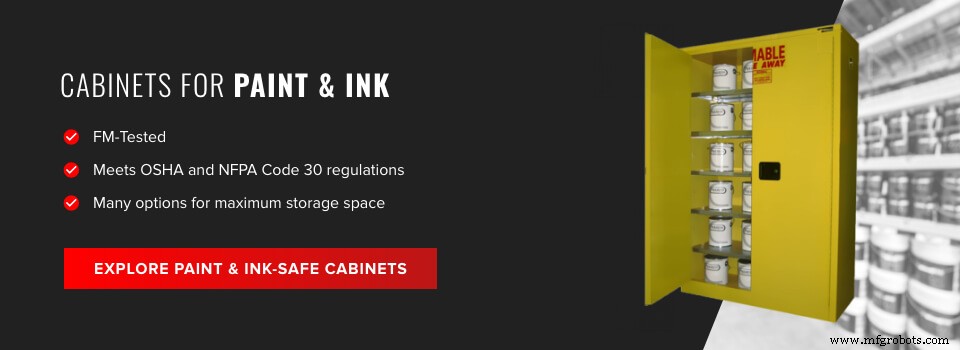
Many people assume ink and paint containers are inert objects that pose little risk to personal and environmental safety. That is incorrect and becomes a problem when paint and ink containers are stored improperly. Cherry’s has the right solution for safe ink and paint storage in the warehouse.
OSHA, EPA and NFPA regulations offer great detail about safely storing ink and paint supplies. Many of these products constitute hazmat risk from fire and pollution. Some have noxious odors that can cause acute or chronic worker health problems.
You can easily manage your paint and ink hazardous materials risk with one of Cherry’s storage cabinets. OSHA and the NFPA Code 30 rules have strict stipulations about the allowable storage quantities of paint and ink in your warehouse. Cabinets from Cherry’s Industrial Equipment take this into account.
All paint and ink safety cabinets have shelving spaced to accommodate universal containers. Safety cabinets include a catchment feature built into the floor to contain spillage should an accident happen. That’s just one of many features and benefits you receive with Cherry’s paint and ink hazmat cabinets.
How to Handle Warehouse Hazardous Materials Spills

Investing in industrial storage cabinets is wise because warehouse hazardous material spills are inevitable. Accidents will happen. The trick is being prepared by being ready to clean up warehouse chemical spills. You can also go a long way toward preventing a hazmat incident if you have the right equipment. Here are a few of our suggestions on how to handle warehouse hazardous materials:
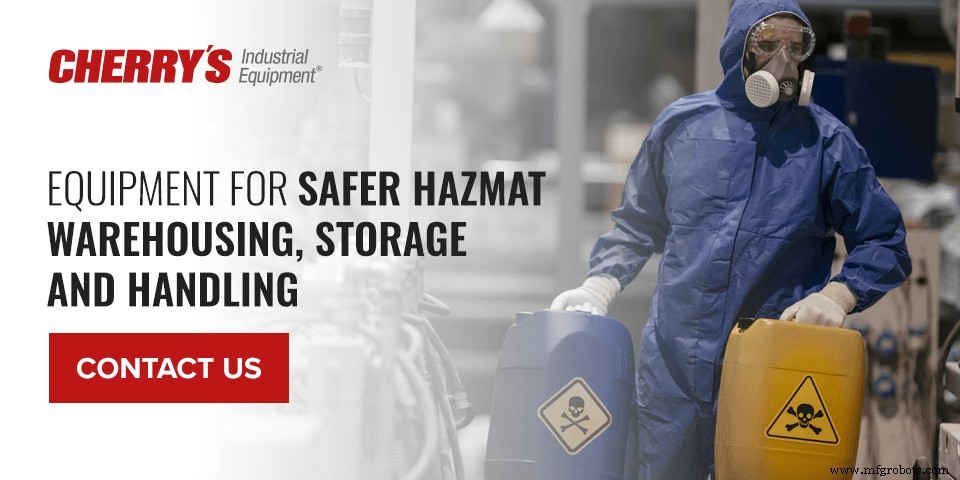
- Purchase Proper Employee Attire for Safe Handling of Hazardous Materials: Personal protective equipment (PPE) is vital for keeping your employees safe when handling hazardous materials. At the minimum, your workers must have OSHA-approved eye protection, gloves, and boots. Most warehouse situations rarely require full hazmat suits, but proper coveralls are strongly recommended. So are respirators and face shields if handling causative materials.
- Post Signs and Visual Aids: Cherry’s Material Handling carries a full assortment of 5S visual aids like preventative floor signs, floor safety tape, tool shadow tape, and aisle markings. We also carry safety supplies such as warehouse signs and factory signs. Cherry’s can even assist with custom warning signs for every warehouse situation.
- Erect Guards and Barriers: Securing your hazmat materials inside the appropriate cabinet is an essential first step. You also need to take additional precautions. Warehouses are active places where the slightest variance in routine or product movement can cause a problem. Consider extra preventive measures with Cherry’s safety guards and barriers.
Partner With Cherry’s Material Handling for Safe Handling of Hazardous Materials
Let Cherry’s Industrial Equipment partner with you for all of your hazardous materials safe-handling needs. Cherry’s is the go-to source for industrial safety supplies and material handling equipment. That includes our full line of hazmat storage solutions and protective measures.
Browse our safety and material handling products online to find the solutions you need. For more information about how Cherry’s can help you comply with safe and secure warehouse requirements, call us today at 877-350-2729. You can also contact us online.
Manufacturing process
- Thermoset Composites: Enhancing Durability, Efficiency, and Safety in HVAC Systems
- 4 Proven Strategies to Boost Your Manufacturing Plant's Profitability
- Optimizing Warehouse Racking: Proven Strategies for Small Businesses
- 3 Essential Tips for Safely Storing Your Aviation Borescope
- Master Building Project Logistics: 3 Proven Strategies for Seamless Supply Management
- Proven Strategies to Minimize Product Damage in Your Warehouse
- Master Warehouse Organization: Proven Strategies for Efficiency & Profit
- Boost Warehouse Picking Efficiency: Proven Strategies for Faster, More Accurate Order Fulfillment
- 15 Essential Tips for Selecting CNC Cutting Tools
- Mastering Sheet Metal Design: Essential Principles & Manufacturability Tips