



Abrasive Jet Machining (AJM) Explained: A Comprehensive Guide
Manufacturing companies use a variety of processes to remove unwanted material from workpieces. Some of these processes are relatively simple, such as cutting and drilling. Others, however, are more complex.
Abrasive jet machining falls under the latter category. It involves blasting a workpiece with highly abrasive particles to remove unwanted and excess material. To learn more abrasive jet machining and how it works, keep reading.
What is Abrasive Jet Machining?
Abrasive jet machining (AJM), also known as abrasive micro-blasting, pencil blasting, and micro-abrasive blasting, is an abrasive blasting machining process that uses abrasives propelled by a high-velocity gas to erode material from the workpiece.
Common uses include cutting heat-sensitive, brittle, thin, or hard materials. Specifically, it is used to cut intricate shapes or form specific edge shapes.
Material is removed by fine abrasive particles, usually about 0.001 in (0.025 mm) in diameter, driven by a high-velocity fluid stream; common gases are air or inert gases. Pressures for the gas range from 25 to 130 PSIG (170–900 kPa or 4 bars) and speeds can be as high as 300 m/s (1,000 km/h).
Also known as pencil blasting, abrasive jet machining is a machining process used in the manufacturing industry to remove unwanted material from a workpiece. It lives up to its namesake by blasting a workpiece with hard and abrasive particles.
The particles are propelled at a high velocity via a gas. As a result, they are able to erode material off the workpiece’s surface.
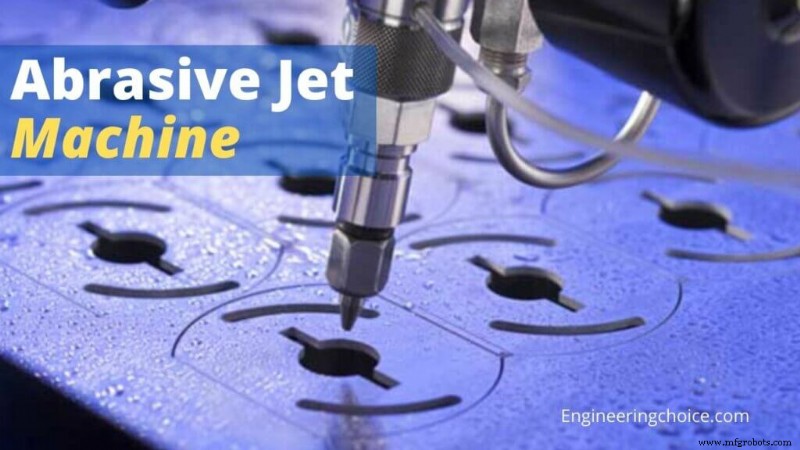
How Abrasive Jet Machining Works?
Abrasive jet machining is performed using a special machine that’s connected to an air compressor. The air compressor uses either inert air or gas. During the process, a nozzle propels fine particulate matter towards the workpiece.
The particles used in abrasive jet machining are very fine, often measuring just 0.001 inches in diameter. As the combination of air/gas and abrasive particles land on the workpiece, they remove material from its surface.
Most abrasive jet machines are bench-mounted. They are mounted on a bench where the compressor is able to mix the gas with the abrasive particles. The workpiece is then positioned in front of the machine. To remove material from the workpiece, the machine is activated with the nozzle positioned in the desired area.
Applications
- The process finds application in cutting slots, thin sections, contouring, drilling, for producing shallow crevices, deburring, and for producing intricate shapes in hard and brittle materials.
- It is often used for cleaning and polishing of plastic, nylon and Teflon components, the frosting of the interior surface of the glass tubes, etching of markings on glass cylinders, etc.
- It is used for deburring, etching, and cleaning of brittle metals, alloys, and non-metallic materials.
- Polishing of plastic, Nyon can be done easily.
- Drilling can be done easily.
- The fragile material can be easily machined.
Advantages of Abrasive Jet Machining
- Ability to cut intricate hole shapes in materials of any hardness and brittleness.
- Ability to cut fragile and heat-sensitive materials without damage as no heat is generated due to the passing of gas or air.
- Normally inaccessible portions can be machined with fairly good accuracy.
- Low capital cost.
disadvantage of Abrasive Jet Machining
The disadvantages of the process lie in the following:
- The material removal rate is slow and its application is therefore limited.
- Flaring can become large.
- The machining accuracy is poor and the nozzle wear rate is high.
- Additional cleaning of the work surface may occur as there is a possibility of sticking abrasive grains in softer materials.
- It is an expensive process.
Manufacturing process
- Abrasive Jet Machining: How It Works, Benefits, and Practical Applications
- Abrasive Jet Machining (AJM): How It Works & Key Benefits
- Welding Electrodes Explained: Types, Uses & How They Work
- Spark Testing Explained: A Comprehensive Guide to Classifying Ferrous Materials
- Ferrous Metals Explained: Properties, Types, and Uses
- Abrasive Water Jet Machining: Precision Cutting for Modern Manufacturing
- The Definitive Guide to CNC Swiss Machining: Precision, Automation & Market Trends
- NC Machining Explained: Definition, Applications & Core Principles
- Aluminum Gas Welding Explained: Techniques, Tips, and Best Practices
- Understanding Welding Electrodes: A Comprehensive Guide