



Submerged Arc Welding (SAW): Complete Overview & How It Works
What is Submerged Arc Welding (SAW)?
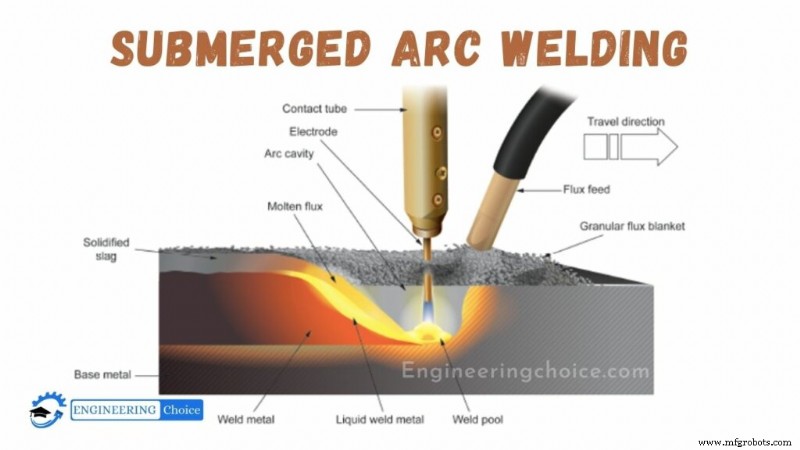
Submerged Arc Welding (SAW) is a joining process that involves the formation of an electric arc between a continuously fed electrode and the workpiece to be welded. A blanket of powdered flux surrounds and covers the arc and, when molten, provides electrical conduction between the metal to be joined and the electrode.
The first SAW patent was taken out in 1935. The process requires a continuously fed consumable solid or tubular (metal cored) electrode. The molten weld and the arc zone are protected from atmospheric contamination by being “submerged” under a blanket of granular fusible flux consisting of lime, silica, manganese oxide, calcium fluoride, and other compounds.
When molten, the flux becomes conductive and provides a current path between the electrode and the work. This thick layer of flux completely covers the molten metal thus preventing spatter and sparks as well as suppressing the intense ultraviolet radiation and fumes that are a part of the shielded metal arc welding (SMAW) process.
How Does Submerged Arc Welding Work?
Submerged-arc welding (SAW) is a common arc welding process that involves the formation of an arc between a continuously fed electrode and the workpiece. A blanket of powdered flux generates a protective gas shield and a slag (and may also be used to add alloying elements to the weld pool) which protects the weld zone.
Shielding gas is not required. The arc is submerged beneath the flux blanket and is not normally visible during welding. This is a well-established and extremely versatile method of welding.
The electrode may be a solid or cored wire or a strip made from a sheet of sintered material. The flux may be made by either fusing constituents to form a glassy slag (which is then crushed to form a powder) or by agglomerating the constituents using a binder and a corning process. The chemical nature and size distribution of the flux assists arc stability and determine the mechanical properties of the weld metal and the shape of the bead.
SAW is usually operated as a mechanized process. Welding current (typically between 300 and 1000 amperes), arc voltage, and travel speed all affect bead shape, depth of penetration, and chemical composition of the deposited weld metal. Since the operator cannot observe the weld pool, great reliance must be placed on parameter setting and positioning of the filler wire.
Although SAW is normally operated with a single wire using either AC or DC current, there are a number of variants including the use of two or more wires, adding chopped wire to the joint prior to welding, and the use of metal powder additions.
Additional productivity may be gained by feeding a small diameter non-conducting wire into the leading edge of the weld pool. This can increase deposition rates by up to 20%. These variants are used in specific situations to improve productivity through increasing deposition rates and/or travel speed. Replacing the wire with a 0.5mm thick strip, typically 60mm wide, enables the process to be used for surfacing components.
Submerged Arc Welding Applications
The applications of Submerged Arc Welding include the following
- The Submerged Arc Welding can be used to weld pressure vessels like boilers.
- A lot of structural outlines, pipes, earth moving tools, shipbuilding, railroad construction, and locomotives.
- This type of welding can be used to repair machine parts.
Advantages of Submerged Arc Welding
Some of the advantages of submerged arc welding include:
- Strong, sound welds are readily made
- Minimal welding fume is emitted
- Minimal arc light is emitted
- SAW is suitable for both indoor and outdoor works
- Less distortion
- Deep weld penetration
- Minimal edge preparation
- High deposition rates are possible
- Thick materials may be welded
- At least half or more of the flux is recoverable
Disadvantages of Submerged Arc Welding
Despite the good benefits of submerged arc welding offers. Some limitations also occur. The followings are the disadvantages of submerged arc welding.
- It is limited to some ferrous metals like steel and stainless steel
- It is also limited to long straight seams or rotated pipes and vessel
- Backing strips are required for proper penetration
- It is limited to high thickness materials.
Manufacturing process
- Welding Explained: Definition, Types, and Applications
- Flux-Cored Arc Welding (FCAW): Master the Process with Our Complete Guide
- Submerged Arc Welding (SAW) Explained: A Comprehensive Guide
- Understanding Gas Tungsten Arc (TIG) Welding: Process, Applications, and Benefits
- Plasma Arc Welding (PAW): Process, Parts, and How It Works
- Welding Explained: Definition, Processes, and Types
- Flux-Cored Arc Welding (FCAW): A Comprehensive Guide to the Process and Applications
- Understanding Welding Electrodes: A Comprehensive Guide
- Shielded Metal Arc Welding (SMAW): A Comprehensive Overview
- Submerged Arc Welding (SAW): Process, Equipment, and Key Benefits Explained