



Understanding LCD Pricing: Cost Drivers, Market Trends, and Future Outlook
In the previous posts, we’ve talked about the manufacturing process and the defects of LCD. What else do you need to know? Let’s turn to another important topic, price of LCD.
There’re mainly 4 parts in this article: price-deciding factors, price composition, price fluctuation and future trend.
Price-deciding factors
Factors that may influence the price of a certain type of LCD include: screen size, viewing angle, maximum brightness, color display, resolution and frame rate.
- Screen size: larger size display more, and larger size cost more, these’re common sense. For example, in last year’s iPhone 8P which used a 5.5-inch LCD screen, the display (including touchscreen) cost 52.5 dollars, while a 43-inch LCD TV cost 128 dollars.
- Viewing angle: it’s the maximum angle at which a display can be viewed with acceptable visual performance. It’s measured from one direction to the opposite, giving a maximum of 180° for a flat, one-sided screen. Early LCDs had strikingly narrow viewing angles, for now most of the manufacturers have improved them to more than 160°.
- Maximum brightness: usually determined by backlight system, till recently a method raises this parameter significantly by adding white color into color pixels. It’s a critical factor in mobile devices since we need to use them outdoor and even under sunlight, a situation that requires at least 600 nits brightness.
- Color display: in early or simple LCDs, only two or very few colors can be displayed. As the technology advances, TFT LCD can display up to 65536 colors.
- Resolution: a critical parameter in display industry. It’s often quoted as width × height, with the units in pixels, e.g. “1920 × 1080” means width is 1920 pixels and the height is 1080 pixels. Adding area into count, resolution can be provided in PPI (pixels per inch). Higher resolution brings clearer image given the same screen size.
- Frame rate: is the frequency at which consecutive images called frames appear on a display. In early stage it’s usually 30 Hz, and now it’s 60 Hz or a higher 144 Hz. Higher frame rate means better fluency.
Price composition
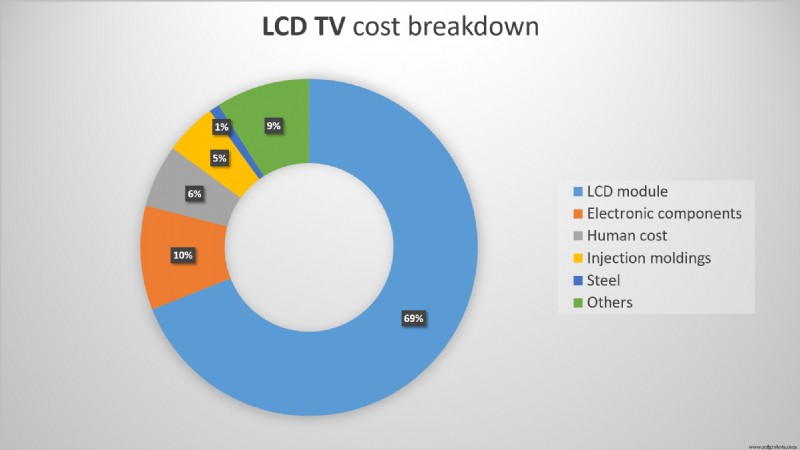
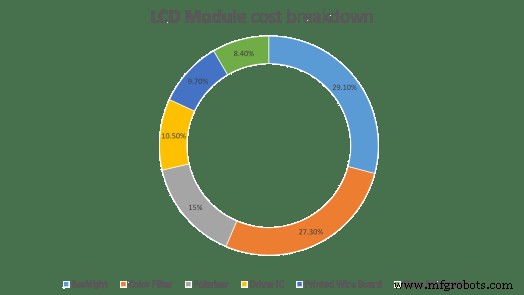
As the diagram shows above, LCD module covers the most part of the cost of a LCD TV. Within LCD module, there’re still many components. In the following diagram we’ll show you the price breakdown of these components.
Price fluctuation
Price of LCD module waves under the control of relation between supply and demand.
The third quarter in the year is usually the demand season of LCD module, as a result the price will be the highest. However, situation varies in different market.
Due to the massive investment and low cost of Chinese mainland manufacturer, the capacity of LCD module for TVs increases significantly, so the price of these modules stay pretty low for the past year.
In another aspect, technology innovations keep push the price of high-end LCD to a higher level. For many users that are planning to replace their old TVs, these high-end LCDs are tempting choices.
Future trend
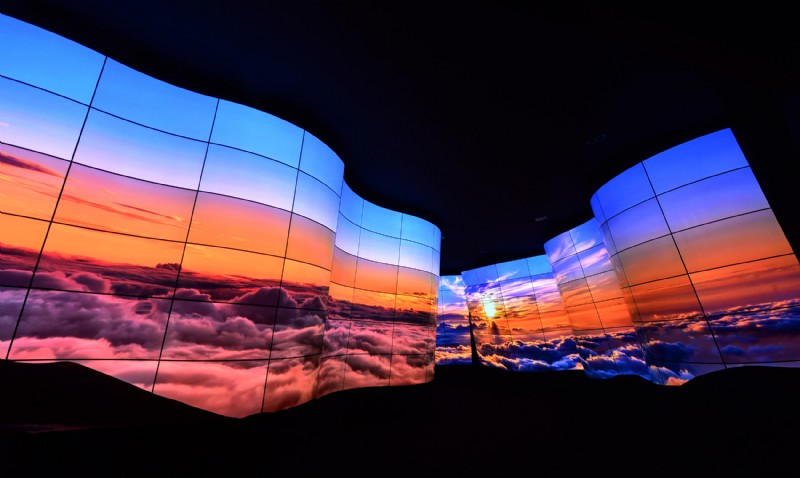
Actually, though LCD screen has many advantages, its average price is keep decreasing in the past years. New technology brings lower cost is one reason, a strong competitor called OLED is another.
Main difference between OLED and LCD is OLED can give out light itself, that is to say OLED screen can run at a lower load compared to LCD screen, at least it doesn’t need a backlight system.
Considering the principles of display technology, OLED definitely will be the better choice, it can be thinner, flexible, less power consuming and cheaper. But for now, OLED still has many disadvantages like short lifespan, image retention and not so balanced color, as its technology is quite immature.
In conclusion, OLED is for future and now it’s LCD.
This is the end of the post. If you find it useful or want to know more about LCD, just leave your comment below or contact us. We’re hearing!
Note: We do not own the images used in this post. Feel free to contact us if they belong to you, and we’ll take them down as quickly as we possibly can.
Manufacturing process
- Mesh Analysis Explained: Procedure, Examples, and Applications
- Robotic Grippers & End Effectors: Applications, Benefits, and Cost Breakdown
- Six-Axis Industrial Robots: Real-World Uses, Benefits, and Cost Breakdown
- Build Engaging LCD Animation & Gaming with Arduino UNO
- Optimizing Blast Furnace Design for Superior Performance and Longevity
- Understanding RFID Tag Costs: Breakdown, Savings, and Future Trends
- Pogo Pins: Manufacturing Process & Emerging Trends in Electronics
- Understanding Adapter Pricing: Key Factors & Future Trends
- Key Factors Influencing PCB Costs & Emerging Market Trends
- Controlling Ceramic Machining Costs for Future Innovation