



Precision Adapter Transformer Production: From SMT Assembly to Certified Quality Assurance
In the last post we’ve introduced some basics about adapter. To provide more information, in this article we’ll talk about the manufacturing process of the adapter and the related quality inspection and certificate.
Brief manufacturing process of the adapter
The main part of an adapter is a type of PCBA (Printed Circuit Board Assembly), which was mentioned in SMT. That is to say, the manufacturing process of an adapter is quite similar to that of SMT.
However, the components on the adapter’s PCB is always quite large, which demands another technique called wave soldering. In comparison, the one in SMT is reflow soldering, which is used to weld small components.
In wave soldering, components with pins will be plugged into the corresponding holes on the PCB. Then the prepared board are sent to the machine where there is molten tin, or called waves, to be soldered.
Some external parts like the socket are soldered by human hands in the following steps, and eventually we’ll use a plastic shell to pack the PCBA.
Manufacturing process of transformer
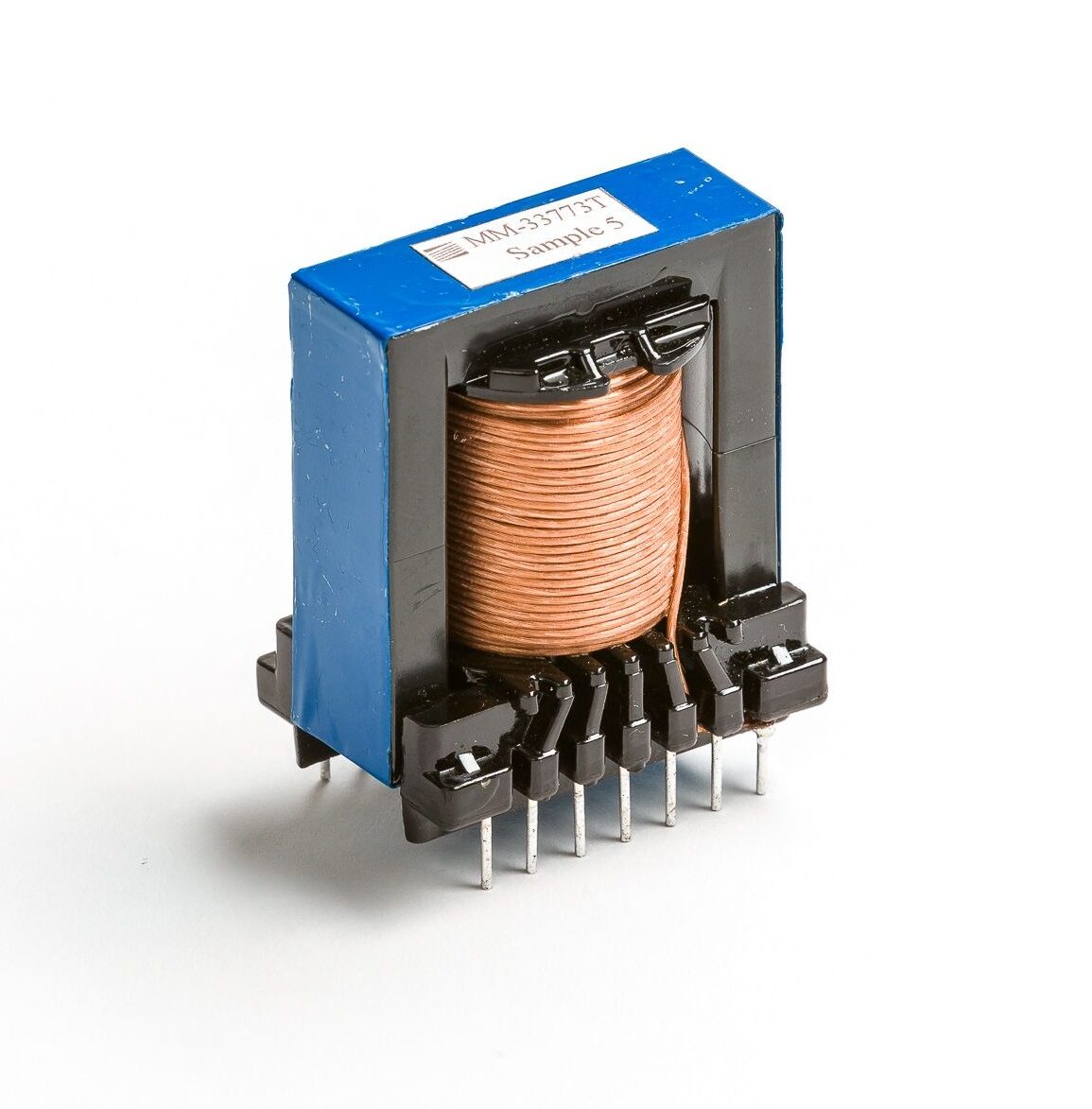
Transformer is a key element of an adapter.
It works together with capacitor and optocoupler in the control circuit to determine the output power and ensure safety.
If the transformer is in SMPS (switch-mode power supply), a switching component, usually MOSFET (metal-oxide-semiconductor field-effect transistor) will be added.
Transformer consists of two parts: metal core and coil. Simply put, to produce a transformer is to wind wire onto the metal core.
Another production method is to do the winding first, and then insert the core. In the following paragraphs we’ll share more about this method.
1. Coil winding
- Wind the primary coil on the bobbin in a compact or loose way;
- Wrap the margin tape on every layer of primary coil to ensure creepage distance;
- Wrap the insulating tape to insulate two coils;
- Wind the secondary coil in a compact or loose way;
- Wrap copper foil to have the coil shielded;
- Wind the end of coil around the pin on bobbin.
2. Tin soldering
We solder tin on the pin to help the soldering onto PCB:
- Arrange the pin on bobbin to a line;
- Prepare the molten tin;
- Dip the pin into the melton tin;
- Cool the pin and check if there is any defect.
3. Metal core assembly
The metal core is often made from the magnetic material like silicon steel sheet and ferrite.
- Prepare two metal cores for each coil;
- Dispense glue on the middle of metal core;
- Dispense glue on the juncture of two metal core;
- Wrap tape on the metal core;
- Roast the assembled core to dry the glue.
4. Exam the semi-finished transformer
- Check the equipment;
- Exam the semi-finished product.
5. Vacuum impregnation
We impregnation the transformer in a vacuum environment to exhaust the air within coils, so we can strengthen the coils and ensure insulation.
- Prepare the vacuum environment and varnish in impregnation machine;
- Place the transformer in impregnation machine;
- Impregnate the transformer for a certain time;
- Roast the impregnated transformer to dry the varnish.
6. Pin unification
- Cut the pin to the same length according to standard.
7. Final examination and packing
- Exam the final product and abandon the defective ones, pack the rest.
Quality inspections and certifications
Since electricity is highly relevant to security, it’s necessary to know something about the quality inspection and certification.
Quality inspection
- Input test: test the range of input voltage, current and frequency.
- Output test: test the range of output voltage, current, frequency and power. Pay special attention to ripple voltage, noise, voltage regulation factor and efficiency.
- Protection circuit test: test if the overcurrent, overvoltage and over temperature protection work properly.
- Environmental test: include storage temperature, storage humidity, operating temperature and operating humidity.
- Aging test.
Quality certification
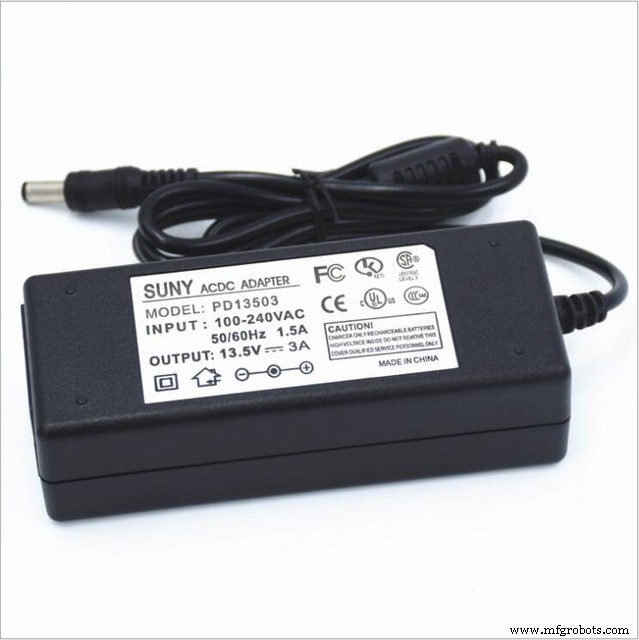
Major countries and regions all have brought up their own safety certification, here is the list:
- UL: stands for Underwriter Laboratories Inc, an american certification. Meanwhile there’s CUL for Canada.
- FCC: stands for Federal Communications Commission. Another american certification.
- CE: a French abbreviation, stands for European Conformity. A certification brought up by EU.
- GS: Germany certification. Stands for Germany ‘Geprufte Sicherheit’ or ‘Germany Safety’.
- PSE: Japanese certification. Stands for Product Safety of Electrical Appliance & Materials.
- CCC: China Compulsory Certification.
- SAA: Standards Association of Australian.
- KC: Korea Certification.
So much for this topic.
If you want to know more about adapter, just leave your comment below or contact us. We’d be glad to hear from you!
Note: We do not own the images used in this post. Feel free to contact us if they belong to you, and we’ll take them down as quickly as we possibly can.
Manufacturing process
- Optimizing Sinter Quality: Key Processes for Iron Ore Sintering
- Understanding Manufacturing Processes: Definitions, Types, and Key Components
- Maximizing Manufacturing Efficiency: Proven Production & Process Optimization Techniques
- Understanding Glass Types and Their Manufacturing Processes
- The Complete Process of Manufacturing Cables & Wires
- Optimizing Printed RFID Antenna Manufacturing: Process, Quality, and Performance
- Pogo Pins: Manufacturing Process & Emerging Trends in Electronics
- Carbon Fiber Varieties & Production Processes
- Ensuring Excellence in Carbon Fiber Manufacturing: Key Quality Control Strategies and Solutions
- High-Performance Metal CNC Manufacturing: Precision, Efficiency, and Cost Savings