



Linear vs. Switched‑Mode Power Supplies: Understanding SMPS Technology
Adapter is widely used in today’s life. Usually it appears as a brick-like black box and the first step to use a electronic device is to link the adapter and plug it into wall outlet.
Simple as it looks, adapter is quite complex in its inner structure. Let’s learn something about it together.
What is an adapter?
As the name suggests, an adapter is a device that adapt your electric appliance to the mains power.
Normally our home appliances like ice box and washer can work directly under the voltage, 120V and 60 Hz AC in USA, provided by mains electricity.
However, some electric devices we use work on a low voltage such as 20V, hence they need power adapter to lower the voltage to acquire the suitable power supply.
There are more and more functions being added into the home appliance, which demands a control circuit to arrange them.
Since the control circuit often work under a low voltage, some parts of the inner circuit of home appliances play the role of an adapter. This indicate that an independent adapter can help keep the main part of devices in a small size, which is extremely needed by today’s electronic devices.
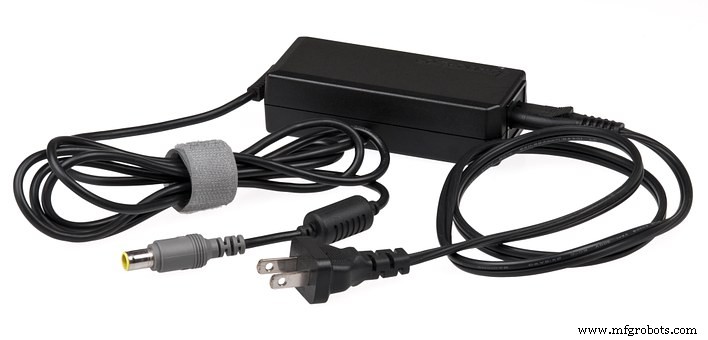
Types of adapter
The most common adapters we see are: linear power suppliers and switched-mode power suppliers (SMPSs).
Before we go into details, let me introduce several concepts to provide you with a better understanding.
- Transformer: always two different coils wound around a same core, can be used to adjust voltage between two circuits.
- Rectifier: converts alternating current (AC), which periodically reverses direction, to direct current (DC) that flows in only one direction. Includes many types like vacuum tube diodes, semiconductor diodes, etc.
- Filter: consists of capacitor, inductor and resistor. Smooths the pulsating waveform of rectified DC.
Linear power supply
Basically, inside the linear power supply, there is a transformer converting the mains electricity voltage to a lower voltage.
Then a rectifier converts it to pulsating DC, and finally a filter smooths the pulsating waveform of DC, with residual ripple variations small enough to leave the powered device unaffected.
A linear circuit must be designed for a specific, narrow range of input voltages and must use a transformer appropriate for the frequency, usually 50 or 60 Hz. Generally, due to the relatively low frequency, the transformer in linear circuit is large in size.
For equipment requiring a more stable or accurate voltage, linear voltage regulator is needed. Losses in large transformer and voltage regulator lead to a relatively low efficiency.
Meanwhile, the size of a transformer restricts the maximum power that a linear power supply can provide.
To conclude, if you’re selecting a power supply for devices, e.g. Hi-Fi audio box, which demand accuracy and work on a comparatively low load, linear power supply is a better choice.
Switched-mode power supply
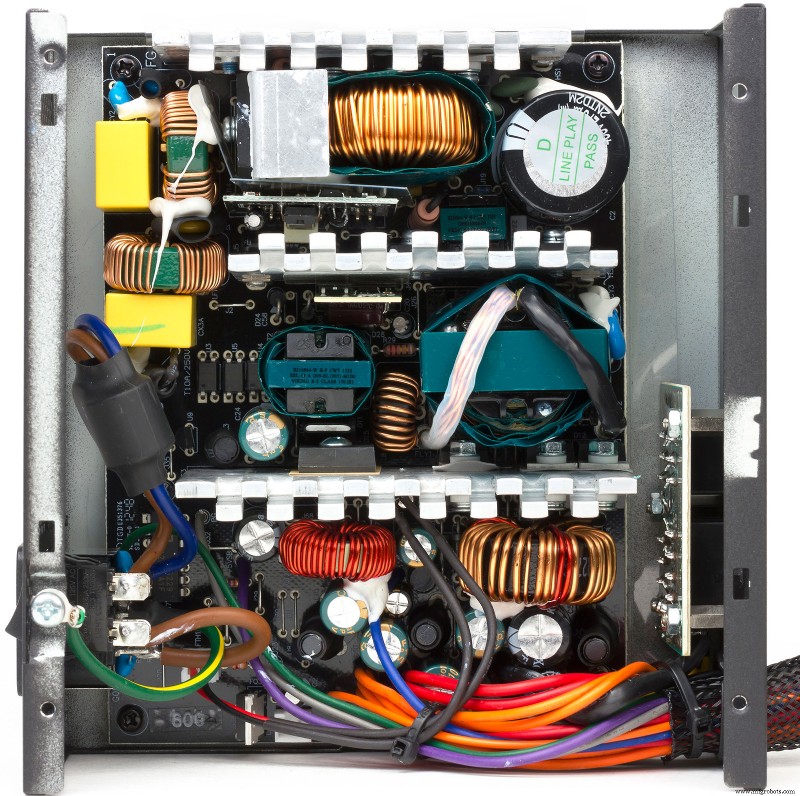
A SMPS is much more complicated than a linear power supply.
In a SMPS, the AC mains input is directly rectified and then filtered to obtain a DC voltage. Then the DC voltage is switched on and off at a very high frequency (typically 10 kHz — 1 MHz) by electronic switching circuitry, producing an AC current. Next the AC current will pass through a high-frequency transformer or inductor.
After passing through the inductor or transformer, the high frequency AC is rectified and filtered to produce the DC output voltage.
Now here’s the trick: the high frequency AC enables the use of transformers and filter capacitors that are much smaller, lighter, and less expensive than those found in linear power supplies operating at mains frequency.
Due to the characteristic of the switch components used in SMPS, it has a high efficiency which is more than 90%. And getting rid of the size limit brought by transformer, a SMPS can provide more power than a linear power supply.
That’s why the adapters we see charging our PC, phone and many other electronic devices are all SMPS.
In addition, the fast switching components in SMPS can cause electrical noise, which may influence the device attached to it.
Therefore, the output voltage from linear power supply is naturally more pure than that from SMPS, making linear power supply a better choice in those precise circumstances.
This marks the end of this post.
If you want to know more about adapter, just leave your comment below or contact us. We’re hearing!
Note: We do not own the images used in this post. Feel free to contact us if they belong to you, and we’ll take them down as quickly as we possibly can.
Manufacturing process
- Transformer‑Based Power Supply: Building a Safe 12 VAC Step‑Down Circuit
- PWM Power Controller: Build a Pulse‑Width Modulated Lamp Driver
- Power Supply Circuits: Types, Design Principles, and Performance
- Understanding Power in Electric Circuits: Measurement & Significance
- Three‑Phase Power Systems: Fundamentals and Benefits
- Accurate Power Measurement in AC Circuits: From Electrodynamometers to Hall‑Effect Sensors
- How to Choose the Right External AC/DC Power Supply for Your Product
- Choosing an Internal AC‑DC Power Supply for Your Product
- Efficient 230 VAC Power‑Outage Sensor for Raspberry Pi – Low‑Cost, Compact, and Safe
- Expert Guide to Diagnosing and Repairing Kaiser LS402 High‑Voltage Power Supplies