



Transformer‑Based Power Supply: Building a Safe 12 VAC Step‑Down Circuit
Transformer‑Based Power Supply
This guide walks you through assembling a 12 VAC power supply from a 120 VAC step‑down transformer. It covers the necessary parts, wiring practices, fuse selection, and safety checks to ensure a reliable and secure circuit.
Parts and Materials
- 120 VAC to 12 VAC step‑down transformer with center‑tapped secondary (e.g., Radio Shack catalog #273‑1365, #273‑1352, or #273‑1511).
- Terminal strip (minimum three terminals).
- Standard household wall‑socket plug and cord.
- Line‑cord switch.
- Optional enclosure (e.g., electrical junction box).
- Optional fuse and fuse holder.
Transformers can be salvaged from old radios, often available at thrift stores for a few dollars. For the most accurate specification, purchase a new transformer from an electronics supply retailer.
If you include a fuse, choose a slow‑blow (slow‑acting) type to withstand the transformer’s initial surge current without blowing prematurely. Calculate the fuse rating by dividing the transformer’s VA rating by 120 V to find the primary current and select a fuse with a slightly higher current rating.
Cross‑References
- Lessons in Electric Circuits, Volume 2, Chapter 1: “Basic AC Theory”
- Lessons in Electric Circuits, Volume 2, Chapter 9: “Transformers”
Learning Objectives
- Understand how a transformer steps down voltage.
- Learn the purpose of tapped windings.
- Apply safe wiring techniques for household power.
Schematic Diagram
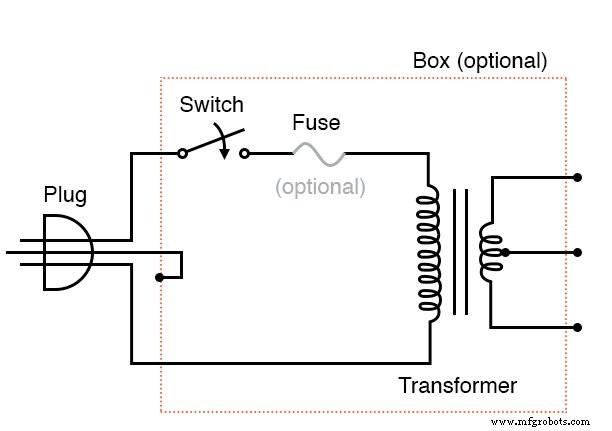
Illustration
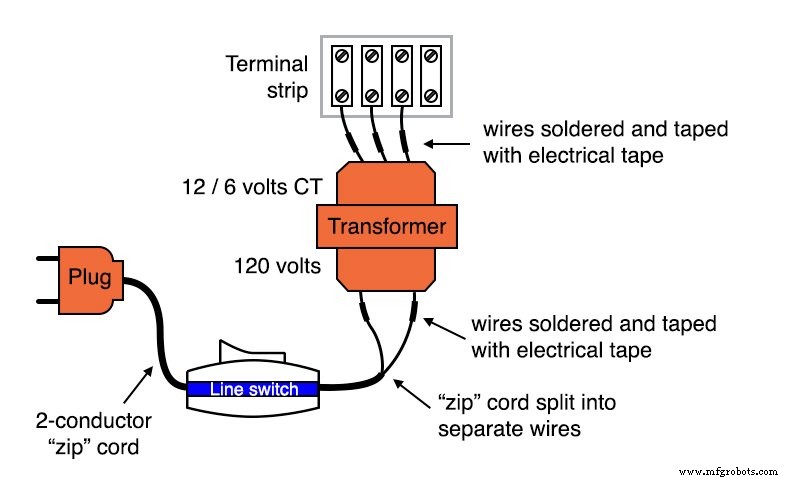
Instructions
Warning: This project involves 120‑V AC. Ensure all high‑voltage conductors are fully insulated and never expose bare wires on the primary side.
All wire connections should be soldered for reliability. Use genuine electrical tape—not duct, scotch, or packing tape—to insulate soldered joints.
If you enclose the transformer in a metal case, connect the ground prong of a three‑prong plug to the case to provide grounding. A plastic enclosure can be used without grounding, but a metal case is preferable for safety.
Before connecting to a wall socket, perform a safety check with an ohmmeter: with the line switch on, measure resistance between each plug prong and the transformer case. The reading should be infinite (no continuity). If a finite resistance appears, a short exists and must be corrected.
Next, test the transformer windings. With the switch on, the resistance between the plug prongs should be low. With the switch off, the resistance should rise to infinity, confirming an open circuit. Verify continuity on the secondary side as well; the secondary resistance should be much lower than the primary due to the turns ratio.
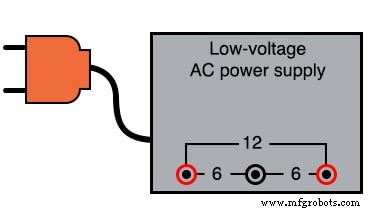
When the cord is plugged in and the switch turned on, measure the AC voltage across the secondary terminals. Two of the terminals should read approximately 12 V. The third terminal, the center‑tap, should read half that voltage relative to either of the other two terminals.
Maintain this assembly as a low‑voltage AC power supply for future experiments in this series.
Computer Simulation
Schematic with SPICE node numbers:
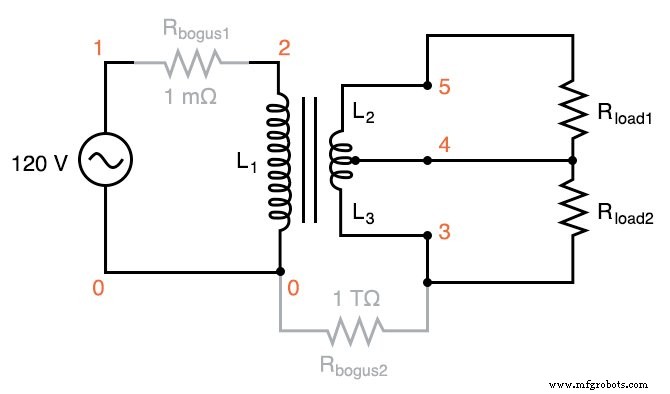
Netlist (copy into a .cir file):
transformer with center‑tap secondary v1 1 0 ac 120 sin rbogus1 1 2 1e-3 l1 2 0 10 l2 5 4 0.025 l3 4 3 0.025 k1 l1 l2 0.999 k2 l2 l3 0.999 k3 l1 l3 0.999 rbogus2 3 0 1e12 rload1 5 4 1k rload2 4 3 1k * Sets up AC analysis at 60 Hz: .ac lin 1 60 60 * Prints primary voltage between nodes 2 and 0: .print ac v(2,0) * Prints (top) secondary voltage between nodes 5 and 4: .print ac v(5,4) * Prints (bottom) secondary voltage between nodes 4 and 3: .print ac v(4,3) * Prints (total) secondary voltage between nodes 5 and 3: .print ac v(5,3) .end
Related Worksheets
- Step‑Up, Step‑Down, and Isolation Transformers Worksheet
- Basic AC‑DC Power Supplies Worksheet
- Impedance Matching With Transformers Worksheet
Industrial Technology
- Power Supply Circuits: Types, Design Principles, and Performance
- How to Choose the Right External AC/DC Power Supply for Your Product
- Choosing an Internal AC‑DC Power Supply for Your Product
- Professional Lambda Power Supply Repair Services – Trusted Expertise
- Expert Power Transformer Maintenance, Diagnostics & Monitoring – Extend Lifespan
- Why Transformers Fail on DC: The Risks Explained
- Dual ±12 VDC Power Supply from 230 VAC – Circuit Diagram & Guide
- Top 5 Causes of Power Supply Failures in 2020 — Insights & Prevention
- Choosing the Right LED Power Supply: A Comprehensive Guide
- Power Supply Rails Explained: The Backbone of Modern Electronics