



Reactive, Preventive, and Predictive Maintenance: Choosing the Right Strategy
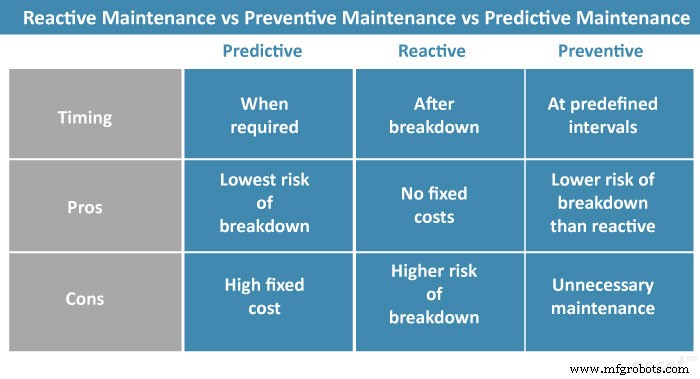
Reactive Maintenance, Preventive Maintenance and Predictive Maintenance are strategies have frequently been pitted against each when it concerns maintenance management. It can be challenging decision to choose a plan and strategy for an organization aligned with its functionality and need.
Many organizations across industries have confirmed that maintenance costs represent a sizable share of operating costs. Figures vary from company to company and as per industry. However, it has been concluded to be around 50% of overall production costs, without even taking into account planned or unplanned downtime, stock and tools management and purchasing function.
Many unexpected and uncontrollable events occur and lead to additional costs that a company can barely estimate in advance but are closely related to the maintenance activity.
Maintenance processes (whether reactive, preventive or predictive maintenance or any other, for that matter) used in an organization can have a bearing on their profitability and productivity.
Therefore, all organizations aim to implement a well-thought-out and optimized strategy to make sure that the assets and equipment work in the most productive manner possible. This shows how strategic moves can influence the overall productivity of an organization.
It can be difficult to pre-determine how frequently the equipment shall be serviced so that there is no loss of time or production due to a breakdown.
Maintenance strategies traditionally fall into the following three categories, each of which has its own challenges and benefits:
- Preventive Maintenance
- Reactive Maintenance
- Predictive Maintenance
Preventive Maintenance
Prevention of Problems Before They Occur
Preventive maintenance software is the strategy applied by teams and managers before any breakdown or failure actually occurs.
The main aim is to reduce the chances of breakdown or degradation of a piece of equipment, component or spare part. For implementing such maintenance, teams have to consider the history of equipment and keep track of its past failures. This paves the way to identify the frequency in which the equipment can have a breakdown and require repair/service.
Preventive maintenance is a planned strategy for maintenance operations as it is based on well-established maintenance facts, reports, history of the equipment, and requirement of the organization which works as an efficient equipment maintenance software.
Through preventive maintenance, a part of CMMS features, it is easy for a company to organize its maintenance tasks and ensure long-lasting productivity.
There is no doubt that preventive maintenance is one of the most popular and effective maintenance methods. However, it may not always be the right option as every organization has its own particularities. Sometimes preventive maintenance may be much more costly in comparison to the other possible approaches.
Benefits of a Properly Operated Preventive Maintenance Program
- Reduced equipment downtime and number of major repairs.
- Increased life expectancy of assets and elimination of premature replacement of machinery and equipment.
- Reduced overtime costs and more economical employment of maintenance workers due to scheduled activity.
- Timely, routine repairs prevent fewer large-scale breakdown repairs.
- Improved safety and quality conditions for personnel and equipment.
Drawbacks of Preventive Maintenance
- Labour intensive
- Probability of maintenance overestimation
- Prone to resource wastage
Reactive Maintenance
Allow Assets to Run to Failure
Reactive maintenance is the strategy of repairing assets to their standard operating conditions after breakdown is observed. The first benefits of reactive maintenance are less personnel needed to implement and possibly lower costs.
This is quite a simple maintenance strategy. Assets are utilized until they fall flat. When a breakdown occurs, reactive maintenance is executed to fix the equipment and return it to its full functional capacity. This methodology is normal when an asset does not essentially influence productivity, critical tasks or operations.
Generally, reactive maintenance entails lesser initial costs and fewer staff compared to proactive forms of maintenance. The activity is limited to fixing the identified issue alone. There is no elaborate preventive planning. Reactive maintenance calls for operation for particular equipment or limited operations, e.g. fixing of a light bulb.
Reactive maintenance is an approach that addresses the problems when an incident has happened or as it arise. Therefore, it requires less initial cost and is limited to some incidents. However, when it comes to plant and machinery, they require consistent and reliable approach to maintenance. Reactive maintenance can have serious limitations in preventing breakdowns.
Benefits of Reactive Maintenance
- Less time consuming
- No initial cost associated
- No maintenance planning required
Drawbacks of Reactive Maintenance
- Expensive
- Asset life expectancy
- Safety
- Time management
- Emergency costs
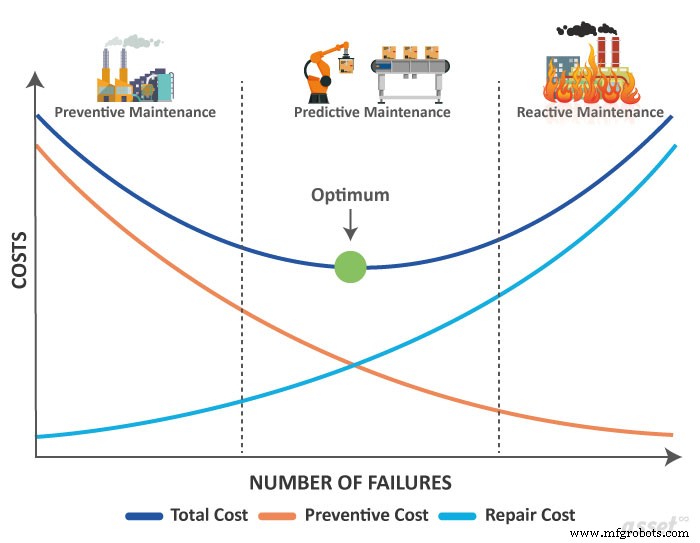
Note: Predictive maintenance programs have shown an increase in ROI with 25%-30% reduction in maintenance costs, 70%-75% decrease of breakdowns and 35%-45% reduction in downtime.
Predictive Maintenance
Predicting Problems to Increase Asset's Reliability
Predictive maintenance predicts the asset or equipment failure before it occurs so that maintenance can be planned and executed in prior.
This maintenance uses machine data to notify the maintenance team about the asset and the risk of failing.
Predictive maintenance is a technique that uses condition-monitoring tools and techniques to track the performance of equipment during routine operations to detect inherently possible defects and fix them before they can impact into downtime.
Generally, predictive maintenance follows the maintenance frequency to be as low as possible to prevent unplanned reactive maintenance, without actually experiencing costs associated with preventive maintenance.
When predictive maintenance is adopted as a strategy in a company, maintenance is performed on machines only when it is actually required and also before failure can strike operations. There are some condition-based predictive monitoring techniques that may be expensive and require experienced personnel to do data analysis.
Predictive maintenance cannot be implemented in every organization, especially not before a tracked experience record of planned maintenance activities. However, for large companies with experience in preventive maintenance and extra budget, predictive maintenance can provide an ROI that turns the maintenance function into an additional source of cost savings and increased operational benefits.
Benefits of Predictive Maintenance
- Early detection of potential asset failure
- Downtime is decreased
- Complete utilization of machine parts until they are not capable of carrying operation
- Cost minimized
Drawbacks of Predictive Maintenance
- Unpredictable costs
- High skill level required to perform this maintenance
- Employees must be well-trained
- Flexibility required
Conclusion
The above-mentioned maintenance approaches can be debatable for their suitability to companies. There is always an effort to adopt the maintenance program which is ideal to implement and will turn out to be more cost effective.
It therefore depends on your business strategy and requirement to fit a maintenance method into the business.
In you need any assistance for implementing any of the maintenance strategies, we are always available for you.
Equipment Maintenance and Repair
- Preventive vs. Predictive Maintenance: Choosing the Best Strategy for Your Factory
- How Preventive Maintenance Paves the Way for Predictive Maintenance Success
- Preventive vs. Predictive Maintenance: Mastering Equipment Reliability
- Predictive Maintenance: The Complete Guide to Reducing Downtime and Maximizing ROI
- Preventive Maintenance: How Proactive Care Drives Reliability & Saves Costs
- Preventive Maintenance: A Comprehensive Guide to Reliability, Cost Savings, and Equipment Longevity
- Choosing the Right Maintenance Strategy: Preventive vs. Predictive
- Predictive Maintenance Explained: How to Minimize Downtime and Maximize Asset Performance
- Preventive Maintenance: A Path to Higher Asset Availability & Lower Costs
- Preventive Maintenance Software: Boost Asset Longevity & Reduce Downtime