



Preventive Maintenance: A Comprehensive Guide to Reliability, Cost Savings, and Equipment Longevity
Preventive maintenance focuses on prevention and inspection, while corrective maintenance covers planning, scheduling, and execution. Together, they form a holistic approach to maintenance management.
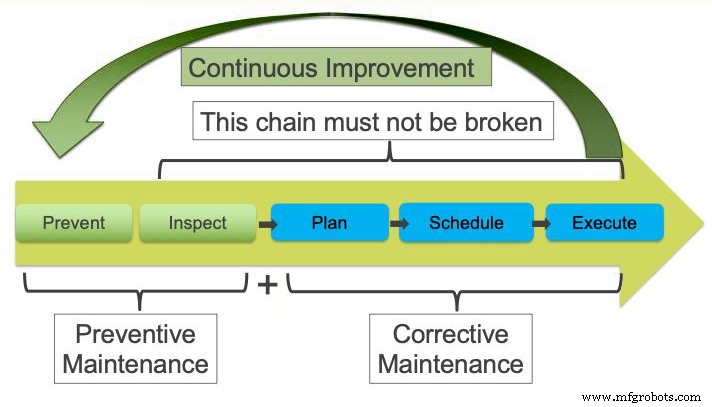
Think of preventive maintenance and work management as an unbroken chain. Prevention includes activities such as lubrication, operating practices, precision alignment, balancing, and scheduled maintenance. Inspections are only effective when the identified issues are promptly addressed before a breakdown occurs. The core sequence—early detection, urgency prioritization, corrective planning, scheduling, and execution—constitutes Condition‑Based Maintenance (CBM). When executed well, this sequence delivers higher reliability, improved safety, and lower operating costs.
Maintenance Prevention
Maintenance Prevention (MP) encompasses all actions taken to stop problems from arising. Key components are:
- Cleaning: Thorough, regular cleaning of equipment exposes abnormalities such as loose fasteners or leaks, extends component life, and keeps electric motors cooler. For instance, a mere 18 °F rise in motor winding temperature can halve its lifespan.
- Lubrication & Contamination Control: Proper lubrication—right type, volume, and timing—drives reliability and cost efficiency. Filtration should reach at least 4 µm (a human hair is ~70 µm). Over‑greasing can blow seals, raise bearing temperatures, and lead to motor failures.
- Alignment: Precision alignment, ideally performed at operating temperature or with thermal compensation, prevents wear on couplings, belts, chains, and bearings, while reducing energy consumption.
- Balancing: Vibration‑free operation of rotating equipment like pumps and shafts extends component life and saves energy.
- Operating Practices: Operators often cause >50 % of equipment failures. Training—“Know Why Training”—ensures they understand the consequences of improper startups, such as water hammer or bearing overheating.
Operators should also alternate use of redundant equipment (e.g., dual lubrication pumps) to prevent moisture buildup and bearing wear. Properly scheduled and documented maintenance protects critical systems on ships, where storage space is limited and spare parts are hard to replace quickly.
By integrating MP with CBM, maintenance teams can achieve reliable, safe, and cost‑effective operations.
______________________
Christer Idhammar, founder of IDCON, Inc. (idcon.com), shares these insights in his book "Knocking Bolts." For more information, visit IDCON Reliability & Maintenance Books.
Equipment Maintenance and Repair
- Preventive vs. Predictive Maintenance: Choosing the Best Strategy for Your Factory
- Preventive vs. Predictive Maintenance: Mastering Equipment Reliability
- Preventive Maintenance: How Proactive Care Drives Reliability & Saves Costs
- Understanding Maintenance Types: A Practical Comparison for Industrial Success
- Smart Equipment Care: Predictive Maintenance Strategies & Timelines
- Preventive Maintenance: A Path to Higher Asset Availability & Lower Costs
- Preventive Maintenance Software: Boost Asset Longevity & Reduce Downtime
- Mastering Preventive Maintenance: Boost Equipment Lifespan & ROI in Manufacturing
- Reactive, Preventive, and Predictive Maintenance: Choosing the Right Strategy
- Maximize Robot Efficiency: Expert Equipment Maintenance Strategies