



How to Build Effective Preventive Maintenance Checklists: A Practical Guide
Nearly every modern operation—whether it’s routine vehicle upkeep, packing for travel, or even boiling an egg—benefits from a clear, concise checklist. If such simple tasks thrive with a list, your complex preventive maintenance (PM) program can achieve the same, if not greater, efficiency.
A well‑crafted PM checklist pulls the essential steps and critical information out of bulky manuals and embeds them directly into your CMMS. This standardization ensures every technician, regardless of experience, follows the same proven sequence, yielding consistent results, reducing errors, and enhancing safety.
In this guide, you’ll learn how to design, implement, and manage PM checklists that make your maintenance team faster, more cost‑effective, and safer.
Develop a Superior PM Strategy in Eight Simple Steps
Read more
Table of contents
- What is a preventive maintenance checklist?
- Maintenance checklist examples
- Benefits of a preventive maintenance checklist
- 7 elements of an effective preventive maintenance checklist
- How to manage preventive maintenance checklists
- Using checklists to chart a course to better maintenance
What Is a Preventive Maintenance Checklist?
A preventive maintenance checklist is a detailed, written sequence of tasks that a technician follows before a PM can be closed. By transferring the logic of a manual into the CMMS, a checklist guarantees that every critical step is executed in the right order, with the right tools, and at the right time.
A checklist extracts essential procedures from manuals and delivers them to experienced technicians, standardizing PMs across the entire facility.
The goal is a dependable outcome no matter who completes the job. Whether a seasoned technician or a junior crew member, a checklist keeps the process uniform and reliable.
PM checklists are often called task lists or task groups. They generally fall into two categories:
- Pass‑or‑fail checklists
- Step‑by‑step checklists
Maintenance Checklist Examples
Pass‑or‑Fail Checklist
Many machine components have optimal operating parameters—like a compressor’s ideal temperature. A pass‑or‑fail checklist records measurements and compares them to acceptable limits. If a value fails, the task is flagged for follow‑up maintenance.
Example of a Pass‑or‑Fail Checklist
- Record the strokes‑per‑minute of Machine‑X. Is the inlet temperature below 70°F? (Yes/Pass, No/Fail)
- Measure the outlet temperature with an infrared meter. Is it under 95°F? (Yes/Pass, No/Fail)
- Submit a work order in your CMMS if any task fails.

Step‑by‑Step Checklist
Some assets require regular intervention based on usage—e.g., a motor replaced every 500 hours. A step‑by‑step checklist walks the technician through every sub‑task, ensuring nothing is overlooked.
Example of a Step‑by‑Step Checklist
- Apply lockout/tagout to the main panel.
- Verify the lockout prevents machine operation.
- Remove conveyor belting.
- Replace bearings on the non‑drive side and inspect the shaft.
- Reinstall conveyor belt.
- Remove lockout/tagout and test the conveyor at 5, 10, and 15 rpm on the VFD.
Build Awesome PM Checklists Quickly with This Free Template
Get the template
Benefits of a Preventive Maintenance Checklist
While experienced technicians may remember most steps, a formal checklist centralizes knowledge, making it instantly available and reducing reliance on individual memory.
Standardized Tasks Lead to Reliable Outcomes
Standardization eliminates guesswork and miscommunication, lowering error rates. It also safeguards against skill loss—new hires can follow the same steps without a steep learning curve. The result is smoother operations, fewer errors, and enhanced safety.
Work Becomes More Efficient and Labor Is Maximized
Checklists accelerate task completion, cutting downtime and freeing technicians to focus on higher‑value work. When routine tasks are codified, operators can perform simpler duties, further improving productivity.
Troubleshooting and Reporting Become Simpler
Consistency provides a reliable baseline for performance metrics. With standardized data, you can quickly identify whether a particular action improved outcomes or not, making root‑cause analysis more straightforward.
7 Elements of an Effective Preventive Maintenance Checklist
Creating a flawless checklist requires more than just listing tasks. Consider these seven critical elements:
- Safety First – Begin and end with safety directives: required PPE, lock‑out/tag‑out procedures, and area sanitation.
- Sequential Flow – Order tasks logically to avoid backtracking.
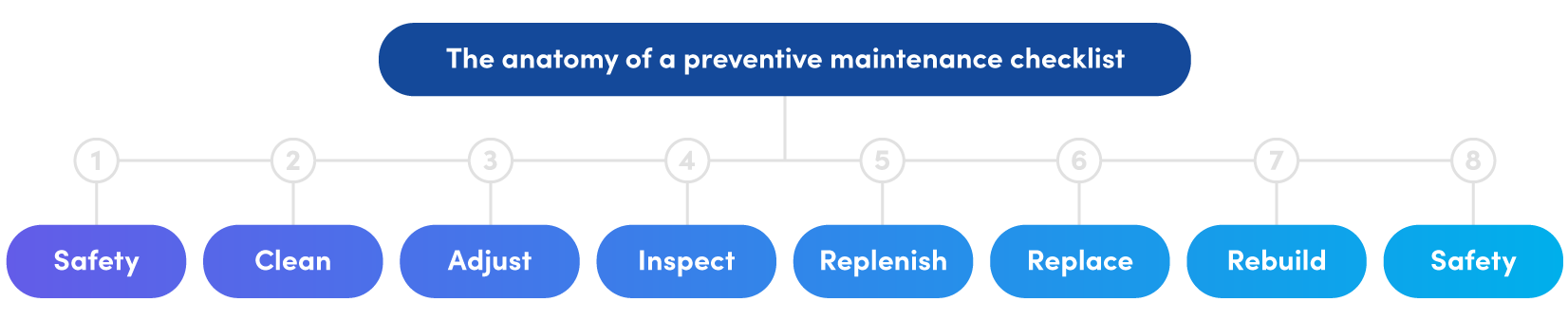
- PM Framework – Follow the standard 8‑step cycle: Safety, Clean, Adjust, Inspect, Replenish, Replace, Rebuild, Safety.
- Clear Detail – Provide enough information for a novice technician to complete the job, but avoid unnecessary verbosity.
- Visual Aids – Incorporate photos or diagrams to eliminate ambiguity.
- Conciseness – Each item should state a single action and its objective.
- Time Estimates – Include total duration or per‑task timing so technicians can plan accurately.
Managing Preventive Maintenance Checklists
Creating checklists is only the first step; managing them effectively ensures ongoing relevance and accuracy.
"The best practice is a collaborative effort among the maintenance manager, planner, and supervisor," says Fiix solutions engineer Jason Afara. Afara recommends that the planner drafts the checklist with input from senior technicians, while the manager reviews for completeness and compliance.
Consistent checklists establish a baseline for measuring maintenance activity, enabling confident reporting and continuous improvement.
Review schedules should align with high‑turnover periods, production ramp‑ups, or recurring equipment failures—times when outdated procedures are most likely to cause issues.
Charting a Course to Better Maintenance with Checklists
Preventive maintenance checklists are indispensable to a robust PM program. They cut miscommunication, reduce human error, and allow your team to focus on tasks that truly add value. By following the steps above, you can develop checklists that deliver higher efficiency, lower costs, and safer operations across your facility.
Equipment Maintenance and Repair
- A Practical Guide to Building a Robust Predictive Maintenance Program
- Preventive Maintenance: How Proactive Care Drives Reliability & Saves Costs
- Preventive Maintenance: A Comprehensive Guide to Reliability, Cost Savings, and Equipment Longevity
- Total Preventive Maintenance: A Practical Guide to Boost Efficiency & Reliability
- Industrial Maintenance: Strategies, Careers, and Best Practices for Asset Reliability
- Condition‑Based Maintenance Explained: A Practical Guide for Reliable Asset Management
- Mastering Preventive Maintenance: Boost Equipment Lifespan & ROI in Manufacturing
- Mastering Preventive Maintenance: A Comprehensive Expert Guide
- Essential Maintenance Benchmarking: A Step-by-Step Guide
- Preventive Maintenance Made Easy: Build a Checklist (Infographic)