



Corrective Maintenance Mastery: Strategies, Benefits, and Practical Examples

In our previous posts we highlighted the advantages of proactive asset management. Today we turn the focus to corrective maintenance – the essential process that restores equipment to proper operation when a fault is detected.
We’ll define corrective maintenance, compare it to reactive approaches, explain how to embed it efficiently into your workflow, and finish with real‑world illustrations.
No fluff – straight to the point.
What Is Corrective Maintenance?
Corrective maintenance covers any task performed to bring a machine, system, or component back to its intended performance after a fault has been identified. Typical scenarios include:
- Discovery of an issue during routine or preventive work.
- Operator‑reported problem.
- Alert from a condition‑monitoring sensor.
- Unexpected breakdown.
Ideally, most corrective work should resolve minor issues on partially functioning equipment rather than full‑blown failures.
While often conflated with reactive or breakdown maintenance, corrective maintenance is a type of action – a subset of any maintenance strategy, not a standalone strategy itself.
Types of Corrective Maintenance
Before diving into best practices, it’s useful to understand the main classifications.
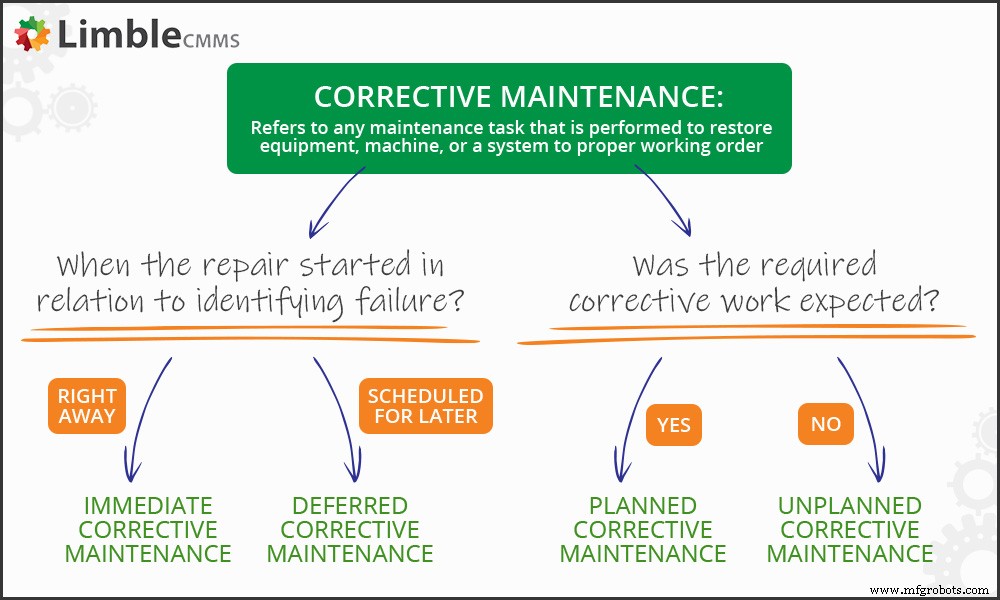
Immediate vs. Deferred Corrective Maintenance
Immediate actions are taken right after a fault is spotted, e.g., a technician fixes a leak during a routine inspection. Deferred actions are scheduled later due to resource constraints, part availability, or the need for specialist involvement.
Planned vs. Unplanned Corrective Maintenance
Planned corrective maintenance occurs when a failure is anticipated – for low‑priority assets or those with high fault tolerance. Unplanned corrective maintenance is triggered by unexpected breakdowns that demand rapid resolution.
Benefits of an Optimized Corrective Maintenance Process
- Shorter durations for both planned and unplanned work.
- Reduced emergency interventions, extending asset lifespan.
- Improved safety by keeping equipment in good operating condition.
Speed and effectiveness are the cornerstones of any maintenance team, especially when reacting to sudden failures.
How to Use Corrective Maintenance Effectively
If your organization relies heavily on reactive work, developing a pragmatic workflow is essential. Key capabilities include:
- Easy reporting mechanisms for operators and staff.
- Immediate access to problem descriptions, asset histories, and OEM guidance for technicians.
- Robust scheduling and progress tracking, with clear priority handling.
- Transparent communication across all stakeholders.
Even in proactive environments, occasional corrective tasks are inevitable. Below are five actionable steps to maximize value.
#1 Minimize the Need for Corrective Actions
Prevent major breakdowns by:
- Operating within design limits.
- Using OEM‑approved spare parts and materials.
- Adhering to recommended process inputs.
- Deploying autonomous or condition‑monitoring technology for early fault detection.
#2 Streamline the Ticketing Process
Efficient ticketing ensures that every corrective request is captured, prioritized, and acted upon. Options for manual systems include:
- Work request boxes checked regularly by maintenance staff.
- Designating a single point of contact who filters requests and logs them in spreadsheets.
Without a clear process, technicians may receive ad‑hoc calls, causing friction and missed issues.
Digital ticketing—especially with a CMMS—eliminates lost or duplicated tickets and provides a clear audit trail.
How to streamline ticketing with a CMMS
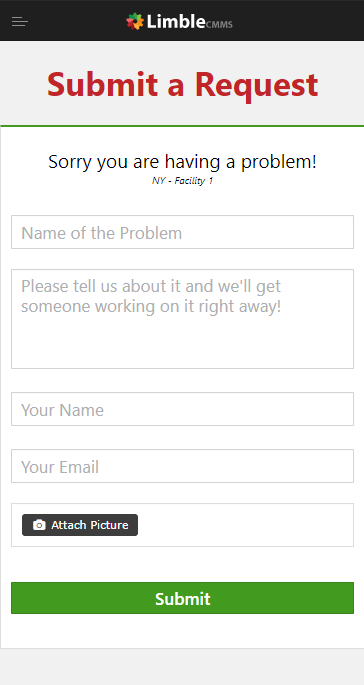
If your software offers a work‑request portal, any employee can submit and track requests. QR codes can further accelerate the workflow.
#3 Tune Your Workflow
Speed hinges on information availability. Enhance the process by:
- Training staff to provide detailed problem descriptions and useful supplementary data.
- Ensuring technicians can access OEM instructions, fault patterns, and asset logs.
- Establishing standard procedures and checklists for common corrective tasks.
- Maintaining an up‑to‑date spare‑parts inventory to avoid improvisation.
- Providing continuous training to match task complexity.
How a mobile CMMS can tune your workflow
Modern CMMS platforms offer features such as:
- Instant access to maintenance logs and reports.
- Centralized asset cards with all relevant information.
- Integrated spare‑part management to control inventory.
#4 Manage Scheduling
Successful departments rely on a clear maintenance strategy paired with efficient scheduling. Essential information to track includes:
- Active corrective tasks.
- Pending tasks awaiting scheduling.
- Technician assignments.
- Availability of personnel.
For small teams, a whiteboard can suffice. Larger teams benefit from a centralized database. Legacy solutions like Outlook and spreadsheets are still used, but modern CMMS systems provide superior functionality.
Priority management is critical: assign priority levels to assets so the team knows which tasks take precedence.
How CMMS improves scheduling
Research shows that scheduling is the most requested CMMS feature. With a digital system you can:
- Import assets and technicians.
- Assign tasks to available personnel.
- Track progress and reallocate resources on the fly.
- Reschedule as conditions change.
#5 Ensure Proper Communication Channels
Real‑time communication is vital. Use mobile CMMS to keep all parties—operators, line managers, and technicians—in sync. Features include:
- Work‑request portal for quick ticket submission and status updates.
- In‑app and email notifications for priority changes.
- Comment and photo uploads for collaborative troubleshooting.
Clients report a 30% improvement in organization, communication, accountability, and productivity after adopting our Android and iOS mobile apps.
To experience these benefits, try a free 30‑day trial, request a demo, or explore our self‑demo environment.
Corrective Maintenance Examples
Real‑world scenarios illustrate how corrective maintenance is applied.
Example #1 – Post‑Breakdown Repair
In a production plant, a machine fails, halting the line. A technician is dispatched, diagnoses the fault, replaces the defective part, and restores operation. This is an unplanned corrective task.
Example #2 – Issue Found During Preventive Work
During a scheduled oil change and visual inspection, a technician discovers a worn bearing. With spare parts on hand, he performs an immediate corrective replacement.
Example #3 – Sensor‑Triggered Misalignment
A condition‑based program feeds real‑time data from sensors on a pump. The sensor reports a 5 mm shaft misalignment—above the 3 mm safe threshold—yet the pump is still operational. Prompt corrective action, such as tightening or replacing cracked components, prevents a future failure.
This example shows corrective maintenance triggered before a fault occurs, made possible by condition monitoring and predictive analytics.
Staying Ahead
Corrective maintenance cannot be eliminated, but its impact can be minimized through proactive strategies. This guide equips you with the knowledge to optimize corrective processes, handle unexpected work swiftly, and accelerate planned repairs.
Have questions? Drop a comment or contact us directly through our form.
Equipment Maintenance and Repair
- Manufacturing KPI Mastery: 20 Proven Metrics to Drive Efficiency & Profit
- Condition‑Based Maintenance: The Definitive Guide to Predictive Asset Care
- Comprehensive Guide to Heavy Equipment Maintenance: Boost Reliability, Safety, and ROI
- Total Preventive Maintenance: A Practical Guide to Boost Efficiency & Reliability
- The Comprehensive Guide to Golf Course Maintenance
- Your Comprehensive Guide to Expert Property Maintenance
- Routine Maintenance: A Practical Guide to Extending Asset Life
- Industrial Maintenance: Strategies, Careers, and Best Practices for Asset Reliability
- Condition‑Based Maintenance Explained: A Practical Guide for Reliable Asset Management
- Understanding Corrective Maintenance: Its Impact on Facility Efficiency