



Routine Maintenance: A Practical Guide to Extending Asset Life
Routine maintenance keeps assets operating smoothly and minimizes unexpected breakdowns.
Whether it’s a truck, a building, a CNC machine, or a forklift, every asset endures daily wear and tear. Routine maintenance addresses deterioration before it escalates.
But is routine maintenance the best strategy for all assets? What are its benefits and drawbacks? How can a CMMS amplify its effectiveness?
Read further to find out.
What is routine maintenance?
Routine maintenance refers to scheduled activities that spot and fix issues before they trigger equipment failure.
Depending on the asset and task, routine maintenance follows a time‑based schedule (daily, weekly, monthly) or a usage‑based schedule (cycles, miles, hours). Time‑based plans are more common.
Routine maintenance typically involves simple, low‑skill tasks. Operators often perform these jobs, freeing technicians for more complex work—a core principle of autonomous maintenance.
(Dis)advantages of routine maintenance
In a preventive maintenance program, routine tasks occupy a significant portion of your calendar—highlighted in blue in the example below.
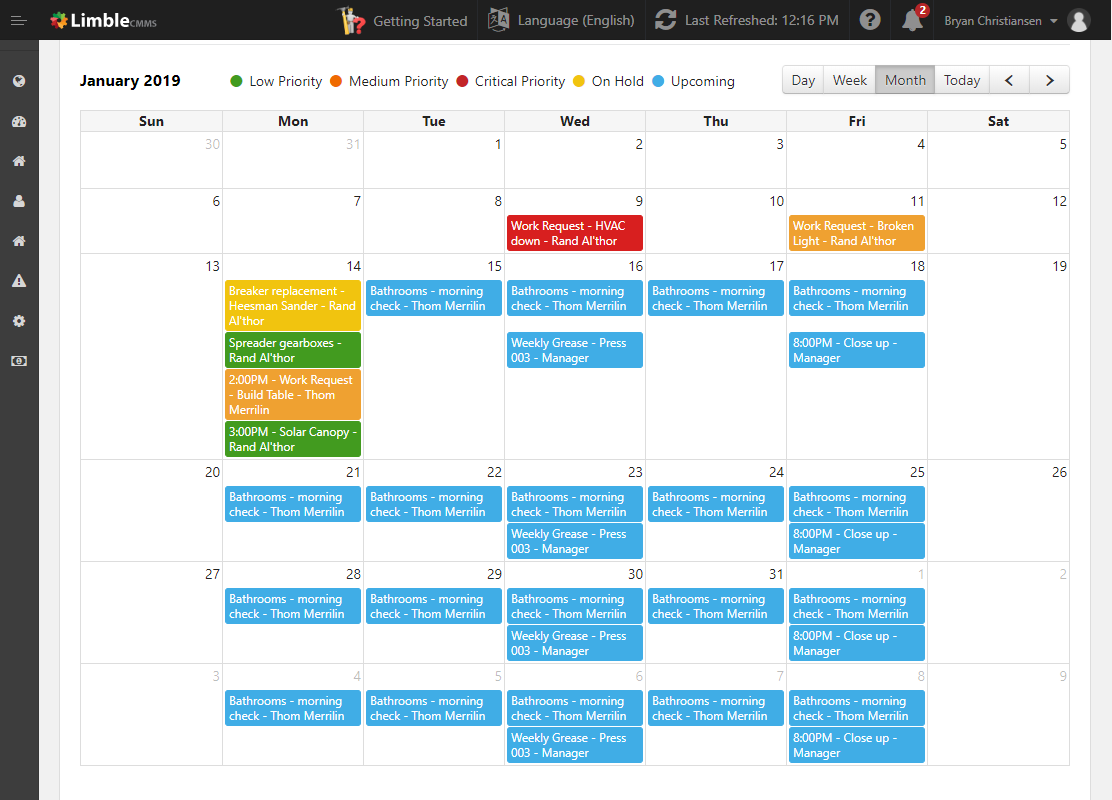
Because routine maintenance is a core component of preventive programs, it delivers the following benefits:
- It improves asset lifespan.
- It reduces the number of unexpected equipment failures.
- It keeps assets in good operating condition.
- It helps you better estimate your spare parts inventory needs.
- It is a type of maintenance work that can be standardized and optimized.
Although routine maintenance helps prevent breakdowns, it has one notable drawback.
The main criticism of preventive—and by extension, routine—maintenance is that it can consume resources on tasks that may not yet be necessary.
While valid, this concern can be mitigated by fine‑tuning your maintenance schedule.
When drafting a PM plan, you’ll usually follow the OEM manual. However, factors such as the manual’s accuracy, operating conditions, part quality, and usage intensity can mean the actual need for routine tasks differs from recommendations.
Using a CMMS such as Limble lets you log every job and monitor metrics like MTBF, revealing whether an asset requires more or fewer routine interventions.
Not familiar with CMMS? Check out our guide, “What is a CMMS System and How Does it Work.”
Reduce Reactive Maintenance by 73.2%
See the Results Red Hawk Enjoys With Limble
Read OurCase Study

Examples of routine maintenance
Typical routine maintenance tasks include:
- Equipment inspections.
- Simple maintenance tasks such as lubrication, filter changes, and parts replacements.
- Cleaning tasks (floor mopping, equipment cleaning, window washing, lawn mowing, etc.; especially important in property maintenance).
- Testing safety equipment.
These examples illustrate the breadth of routine maintenance, but are not exhaustive.
How Limble CMMS supports routine maintenance
Scheduling and tracking routine work is most effective when combined with a mobile‑enabled CMMS.
Mobile CMMS supports routine maintenance in these key ways:
#1) Scheduling & managing maintenance work
To keep your routine schedule on track, each task must meet three criteria:
- It must be assigned to a specific person.
- It must have a due date.
- There must be an easy way to track if tasks are finished on time.
Mobile CMMS meets these needs by enabling:
- Balanced maintenance schedules.
- Push notifications for quick task reassignments and priority changes.
- Instant access to all active and finished maintenance tasks (requires internet).
- Optimization of schedules using detailed logs and reports.
#2) Controlling spare parts inventory
Even the best inspections fall short without the right tools or parts. Ad‑hoc fixes are only a stopgap.
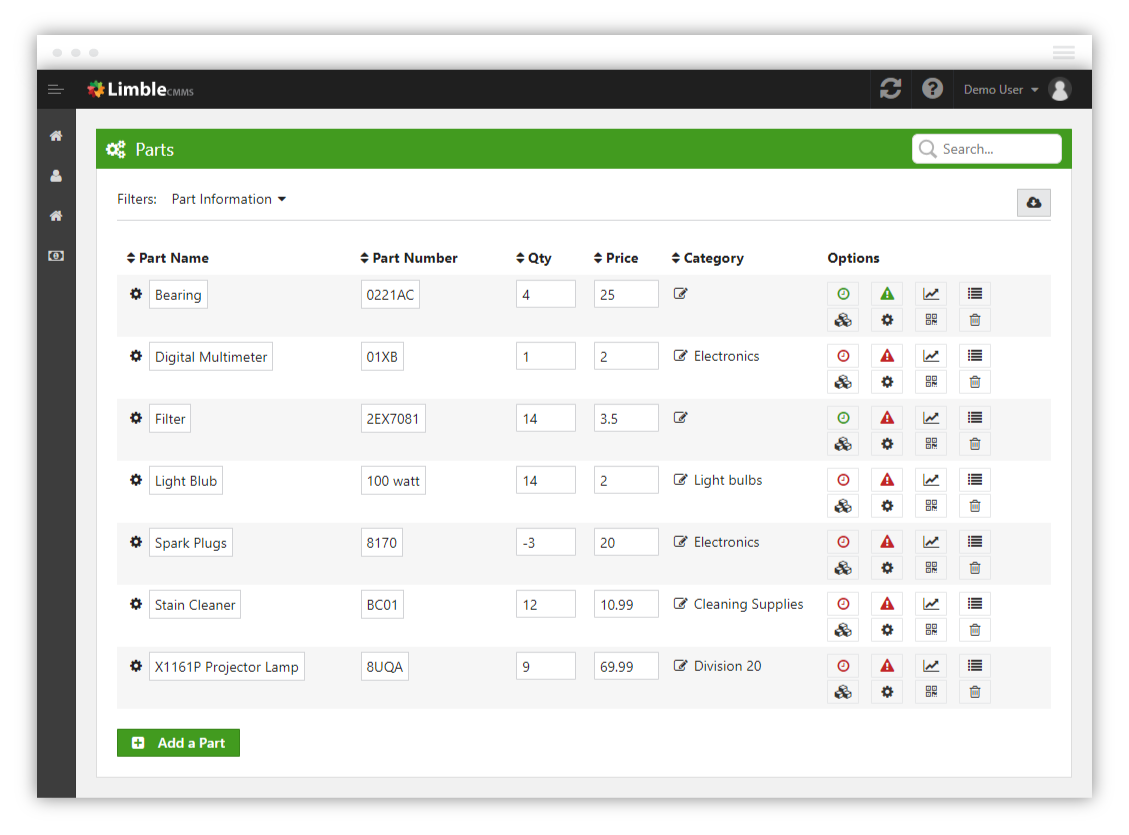
Limble’s spare‑parts module lets you:
- Set up email notifications when stock quantity for a part is low.
- Automatically track part usage by making them a required item on every Work Order and PM.
- Accurately forecast parts usage and budget for the next quarter/year.
#3) Storing maintenance data
By capturing detailed data, a CMMS helps you fine‑tune the frequency of routine tasks.
If routine maintenance fails to stop frequent breakdowns, it usually points to one of three issues:
- Routine maintenance tasks are too far apart.
- The routine work performed is subpar.
- The machine is being misused.
With a CMMS, you can analyze history and reports to identify root causes—often the simplest step toward a lasting fix.
When the issue is #1, add more routine visits. For #2, refine the checklist. For #3, verify correct operating conditions, OEM parts, and operator training.
Accurate diagnosis is the first step to the right solution.
Where to start?
Even companies stuck in reactive modes still perform a decent amount of routine work, as we’ve seen when introducing Limble.
Without a structured schedule, inventory control, and robust CMMS, businesses face lower productivity, uneven maintenance, a bloated backlog, and frequent unplanned breakdowns.
Facing similar challenges? Let’s discuss how we can help you transform your maintenance strategy.
Equipment Maintenance and Repair
- Manufacturing KPI Mastery: 20 Proven Metrics to Drive Efficiency & Profit
- Achieving Sustainable Maintenance Success: Short‑Term Wins vs. Long‑Term Processes
- Condition‑Based Maintenance: The Definitive Guide to Predictive Asset Care
- Industrial Generator Maintenance: Expert Guide & Checklist
- Comprehensive Guide to Heavy Equipment Maintenance: Boost Reliability, Safety, and ROI
- Total Preventive Maintenance: A Practical Guide to Boost Efficiency & Reliability
- Your Comprehensive Guide to Expert Property Maintenance
- Industrial Maintenance: Strategies, Careers, and Best Practices for Asset Reliability
- Corrective Maintenance Mastery: Strategies, Benefits, and Practical Examples
- Condition‑Based Maintenance Explained: A Practical Guide for Reliable Asset Management