



Total Preventive Maintenance: A Practical Guide to Boost Efficiency & Reliability
In a high‑performance organization, maintaining assets is a shared responsibility, not just the maintenance team’s. Total Preventive Maintenance (TPM) provides a proven framework that extends preventive duties to every production floor member.
More manufacturers are adopting TPM to cut operating costs, minimize downtime, and boost Overall Equipment Effectiveness (OEE). Here’s why.
The essence of total preventive maintenance (TPM)
TPM is a disciplined, standardized approach to preventive care that uniquely empowers machine operators to perform routine maintenance on the equipment they run.
TPM is often used interchangeably with Total Productive Maintenance; both share the same acronym.
Developed by Seiichi Nakajima in the late 1950s, TPM’s robust framework is built on the 5S foundation and eight pillars, illustrated below.
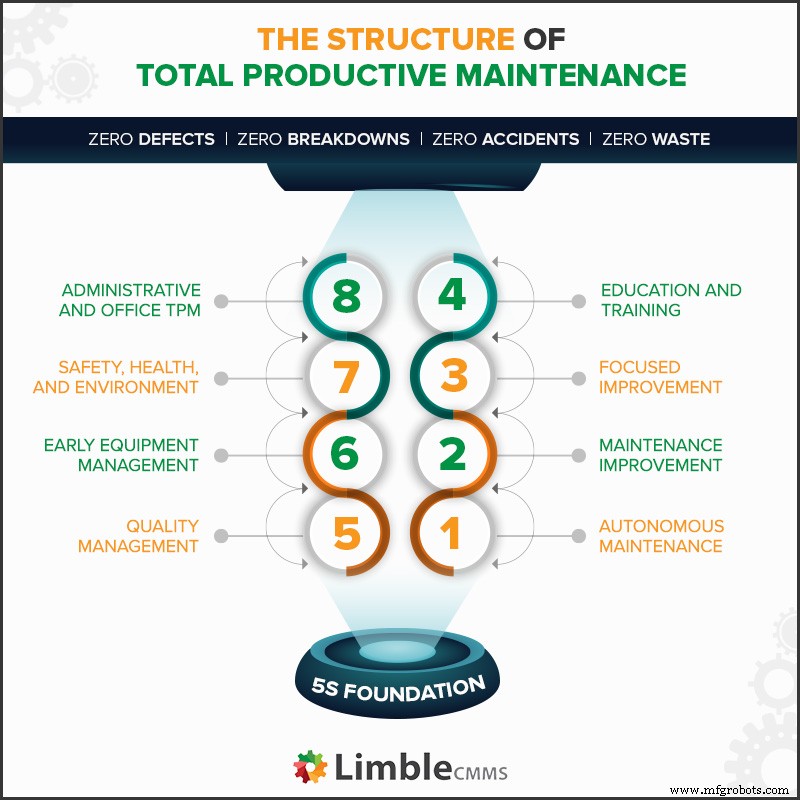
A TPM program will falter without a solid foundation—achieved through the 5S methodology.
5S prescribes best practices that eliminate waste, standardize procedures, and maintain a clean, organized workplace.
Once 5S is embedded, the organization can roll out the eight pillars. Each pillar targets a specific maintenance or quality area, fostering a company‑wide proactive culture and efficient preventive processes.
Stopping at autonomous maintenance
TPM’s ultimate aim is near‑perfect production—zero defects, zero breakdowns, zero accidents, zero waste. Achieving this requires sustained improvement over years.
Not every firm is ready for full TPM. Still, the core concept—engaging operators in equipment upkeep—can be realized through the first pillar: Autonomous Maintenance.
Autonomous Maintenance delegates basic tasks—visual inspections, safety checks, cleaning, lubrication—to operators, freeing technicians to tackle more complex work.
Explore our comprehensive guide to Autonomous Maintenance for step‑by‑step implementation.
Pros and cons of using TPM
Successful implementation of total preventive maintenance yields:
- reduces equipment breakdowns and production delays
- lowers defective product rates and boosts OEE
- standardizes work in line with industry best practices
- enables lean production and maintenance with minimal waste
- cuts operational and maintenance costs
- promotes knowledge sharing and best‑practice diffusion across the organization
Operator errors are the root cause of many equipment failures. Making machine operators responsible for the assets they work with leads to a significant reduction in breakdowns caused by equipment misuse.
However, realizing these benefits demands overcoming several challenges:
- a haphazard TPM rollout can disrupt operations and waste resources
- a clear, phased implementation plan with defined milestones and responsibilities is essential
- gaining buy‑in across the organization often requires robust change‑management efforts
- initial investment in training, software, and consulting may be necessary
The scope of total preventive maintenance training
A robust TPM training program must evolve alongside organizational changes.
Once processes are defined, update or create SOPs and include them in the operation‑and‑maintenance manual.
TPM training primarily targets operators and maintenance staff, blending classroom instruction with on‑the‑job practice for a balanced learning experience.
Managers may also need training. A wealth of online TPM courses—from fundamentals to advanced topics—can equip leaders and earn TPM certification.
Engaging TPM consultants can accelerate success; they facilitate seminars, train staff, and partner with internal teams to eliminate waste and refine maintenance processes.
Relying on total preventive maintenance software
Computerized Maintenance Management Systems (CMMS) are essential for orchestrating preventive maintenance, and modern solutions often integrate seamlessly with ERP systems for a holistic view.
In the context of TPM, CMMS can:
- schedule, track, and organize all maintenance resources (work, labor, tools)
- provide instant access to procedures, checklists, safety guidelines, and other essential documents
- maintain a detailed maintenance history for every asset, enabling data‑driven decisions
- track and forecast MRO inventory to keep stock levels optimal
- monitor maintenance expenditures
- integrate with condition‑monitoring sensors and predictive analytics for CBM or predictive maintenance
If you are interested in testing Limble CMMS, you have three options:
- START A FREE 30‑DAY TRIAL
- REQUEST A DEMO
- TRY OUR SELF‑DEMO (leads you to a testing environment where you can explore Limble’s features)
Standing behind continuous improvement
Organizations unwilling to evolve risk obsolescence. While TPM may not suit every context, its lean principles are universally valuable.
Continuous improvement is non‑negotiable. Whether you deploy a digital maintenance platform or simply refine SOPs, progress matters.
The quickest path to better maintenance is modern CMMS adoption. Discover how Limble CMMS can accelerate your department’s digital transformation—contact us today.
Equipment Maintenance and Repair
- Mastering Total Productive Maintenance: A Practical Guide to Zero Downtime and Peak Efficiency
- Preventive Maintenance: How Proactive Care Drives Reliability & Saves Costs
- Preventive Maintenance: A Comprehensive Guide to Reliability, Cost Savings, and Equipment Longevity
- How to Build Effective Preventive Maintenance Checklists: A Practical Guide
- Industrial Generator Maintenance: Expert Guide & Checklist
- Routine Maintenance: A Practical Guide to Extending Asset Life
- Preventive Maintenance: A Path to Higher Asset Availability & Lower Costs
- Preventive Maintenance Software: Boost Asset Longevity & Reduce Downtime
- Mastering Preventive Maintenance: Boost Equipment Lifespan & ROI in Manufacturing
- Mastering Preventive Maintenance: A Comprehensive Expert Guide