



A Practical Guide to Building a Robust Predictive Maintenance Program
Technology often takes the spotlight when we talk about predictive maintenance, but it’s only one piece of a larger puzzle. A successful program hinges on culture, refined processes, and expertly managed data.
Embark on a journey that may be gradual, but the payoff—reduced downtime, lower costs, and sustained reliability—is well worth the effort.
This article walks you through the six foundational pillars of a durable predictive maintenance program, how to nurture each area, and how to integrate them into a cohesive strategy.
The Maintenance Professional’s Guide to Industry 4.0
Read more
Table of contents
- A brief refresher on predictive maintenance
- The six pillars of a predictive maintenance program
- How to build a predictive maintenance program
- Predictive maintenance: part of a balanced strategy
A brief refresher on predictive maintenance
Predictive maintenance (PdM) shares its proactive spirit with preventive maintenance, but it differs in how you anticipate and schedule work. While preventive maintenance relies on fixed intervals, PdM uses real‑time condition monitoring and historical data to forecast failures before they occur.
By pinpointing the optimal window for intervention, PdM can cut maintenance time, reduce production loss, and lower spare‑part expenses. Below, we outline where PdM fits into a broader maintenance strategy.
The six pillars of a predictive maintenance program
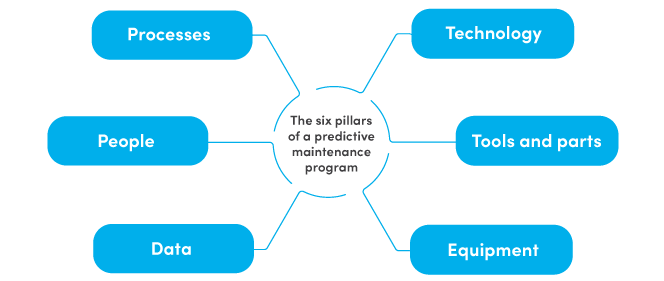
Any robust PdM program rests on six interdependent pillars: People, Data, Processes, Tools & Parts, Equipment, and Technology. Neglecting even one can jeopardize the entire initiative.
People: Culture fuels strategy
The journey to PdM starts with the people who will drive it. As Fiix solutions engineer Jason Afara notes, “It doesn’t matter if your plan looks perfect on paper if the team isn’t on board.”
Everyone—operators, maintenance technicians, managers—must grasp PdM’s purpose, benefits, and their role in its success. Building this culture often involves change‑management practices, clear communication, and shared ownership.
Technology is the seasoning that ties the ingredients together, making the whole program shine.
Data: The bridge from past to future
Data is the lifeblood of PdM. Without a reliable baseline for each asset—what’s normal and what’s abnormal—you can’t predict anomalies. SensrTrx CEO Bryan Sapot emphasizes, “Without data, prediction is impossible.”
Equally important is data quality. Accurate, consistent information across systems prevents misinterpretation and costly mistakes. Jared Evans, COO of MAJiK Systems, warns, “Bad data is like a weather forecast that says it’s sunny when it’s raining.”
Processes: The operational backbone
Clear processes define how maintenance teams plan, execute, and review tasks. They should cover both people interactions—roles, responsibilities, communication—and equipment interactions—data capture, performance mapping, and escalation protocols.
Effective processes reduce uncertainty and ensure that PdM actions are timely and consistent.
Tools & Parts: Essential enablers
Modern PdM relies on advanced diagnostic tools—infrared cameras, vibration analyzers, ultrasonic detectors—and the right spare parts that match asset specifications. Jason highlights that today’s tools and parts make PdM more efficient and cost‑effective than ever.
Equipment: Selecting the right assets
Not all machinery is equally suited for PdM. Assets that provide rich, actionable condition data and sufficient lead time before failure are prime candidates. Focus initially on critical equipment with clear failure modes.
For guidance on selecting assets, explore resources on PF tracking, P‑F curves, and condition‑based maintenance best practices.
Technology: The connective tissue
Technology integrates data, processes, and tools. From ERPs and MES to CMMS and advanced analytics platforms, a combination of solutions is usually required to capture, store, and interpret the vast amount of information generated.
“Predictive maintenance requires a mosaic of technologies to pull together data from sensors, maintenance logs, production schedules, and more,” says Jared.
Check out the four secrets to better inventory management
Watch the video
How to build a predictive maintenance program

Predictive maintenance: part of a balanced strategy
Think of PdM as a component of a balanced breakfast—essential but not the sole dish. It complements other maintenance strategies, such as preventive and corrective approaches.
Jason reminds us, “Predictive maintenance will never replace all other forms of maintenance.” Building a PdM program is a long‑term journey; it may take years to reach even modest coverage.
When grounded in strong fundamentals—people, data, processes, tools, equipment, and technology—a PdM program delivers a more reliable operation that fuels growth and efficiency.
Equipment Maintenance and Repair
- Mastering Lean Maintenance: Build, Measure, and Sustain a Waste‑Free Strategy
- Eight‑Step Blueprint for a Robust Preventive Maintenance Program
- Key Metrics for Demonstrating Predictive Maintenance Success
- Launching Predictive Maintenance: Key Questions and Practical Steps
- How to Build Effective Preventive Maintenance Checklists: A Practical Guide
- Industrial Maintenance: Strategies, Careers, and Best Practices for Asset Reliability
- How to Build a Robust Equipment Maintenance Program to Cut Downtime
- Condition‑Based Maintenance Explained: A Practical Guide for Reliable Asset Management
- Essential Maintenance Benchmarking: A Step-by-Step Guide
- Predictive Maintenance Software: A Comprehensive Guide for Smart Asset Management