



Mastering Spare Parts Management: A Practical, Data‑Driven Guide for Plant & Supply Chain Leaders

Efficient spare‑parts inventory is the backbone of any reliable manufacturing operation. Yet many organisations hesitate to stock spares, fearing it will inflate operating costs. As plant or supply‑chain managers, recognising how to manage spares strategically is essential to sustain uptime and control expenses.
In this guide we translate industry best practices into actionable steps that help you decide which parts to keep on hand, how to control inventory levels, and how to mitigate downtime risks—all while keeping costs under control.
How to Excel at Spare Parts Management
The following seven pillars form a proven framework for high‑performance spare‑parts systems. Implementing them together reduces carrying costs, limits production interruptions, and boosts overall efficiency.
- Define an operation strategy that balances reactive and predictive maintenance.
- Standardise the work‑order process for consistency and traceability.
- Exercise rigorous inventory control to prevent stockouts and excess.
- Gain a deep understanding of lead times for every part type.
- Quantify downtime risk for each piece of equipment.
- Stock parts for new equipment to avoid early failures.
- Enforce robust security measures to protect inventory integrity.
Below, we delve into each pillar in detail.
Operation Strategy
Adopting a predictive maintenance approach allows you to anticipate and prevent failures before they occur. While reactive interventions remain necessary, the core of successful spare‑parts management lies in shifting the focus from “fix‑once‑it‑fails” to “prevent‑once‑it‑fails.”
Key considerations:
- Collect and analyse operational data to inform your strategy.
- Map the entire lifecycle of parts—acquisition, usage, and disposition.
- Identify recurring failure patterns that may be masked by surface symptoms.
- Leverage predictive analytics to allocate resources efficiently and reduce response time.
Standardising the Work‑Order Process
A streamlined work‑order workflow ensures accurate inventory tracking and prevents unauthorized part issuance. Every step—from request to release—must be documented and enforceable.
Things to focus on:
- Eliminate ad‑hoc part retrieval that bypasses the work‑order system.
- Identify staff who deviate from the prescribed workflow and provide corrective training.
- Implement priority‑based work‑order creation for high‑impact repairs.
- Synchronise work‑orders with purchase orders to minimise wait times.
Standardising your workflow is most effective when supported by mobile maintenance software that enforces best practices on the plant floor.
Effective Parts Inventory Control
Control is not about holding every spare in bulk; it’s about storing the right parts in the right place, and ensuring every movement is recorded.
Control tactics:
- Define clear classification criteria—label parts as “critical,” “intermediate,” or “non‑critical” to prioritise handling.
- Periodically review stock levels, accounting for time‑based obsolescence and replacement cycles.
- Identify and eliminate excess inventory to free up working capital.
Integrating a CMMS with a parts‑inventory module automates stock updates and reduces the need for manual cycle counts, provided users enter data consistently.
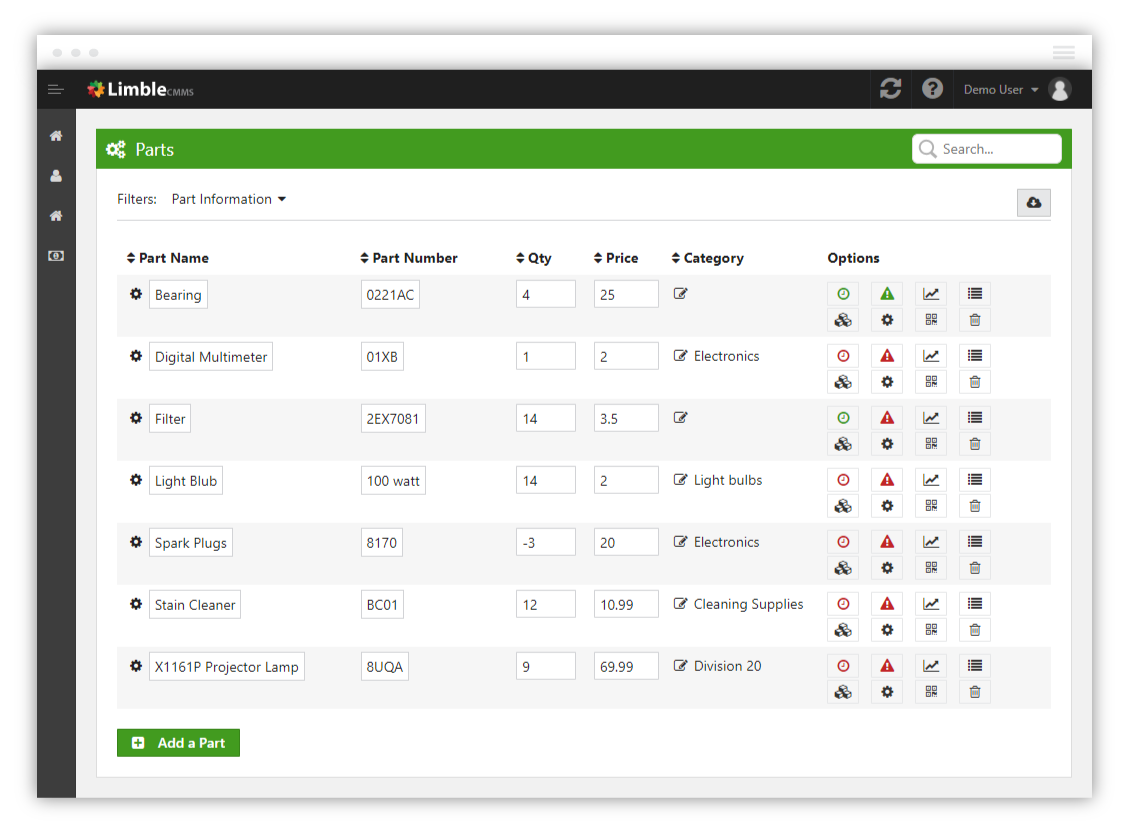
For a deeper dive into CMMS benefits, see our guide: What is a CMMS System and How Does it Work?
Understanding Lead Times
Accurate lead‑time data informs stocking decisions and prevents costly downtime. For non‑critical items, you can safely defer stocking, whereas critical components with short lead times should be kept on hand.
Approach:
- Use make‑to‑order for high‑lead‑time items, avoiding expedited shipping whenever possible.
- Maintain a list of readily available, off‑brand substitutes that can be deployed during a crisis.
Stocking Parts for New Equipment
Assuming that new machinery arrives faultless is risky. Even the most robust equipment can suffer early‑stage failures that demand spare parts.
Strategies:
- Collaborate with operations to budget for initial spare‑parts inventory.
- Request vendor‑recommended critical parts lists during procurement.
- Leverage available performance data to tailor stocking decisions.
Calculating Equipment Risk
Quantifying downtime risk equips you to prioritise parts procurement and maintenance scheduling.
- Determine the cost of one‑hour downtime for your facility.
- Combine this with lead‑time data to calculate the financial impact of delays.
- Analyse root causes and failure rates to refine risk profiles.
- Compare costs of new versus refurbished or salvaged parts to inform purchasing.
Adopting Better Security Measures
Restricting access to the parts warehouse reduces inventory inaccuracies and theft.
- Implement access controls that limit inventory view and movement to authorised personnel.
- Install physical safeguards such as parts counters and secure storage bins.
- Deploy CCTV and badge‑based entry systems for audit trails.
- Train staff on proper part handling and conduct regular reviews of critical items.
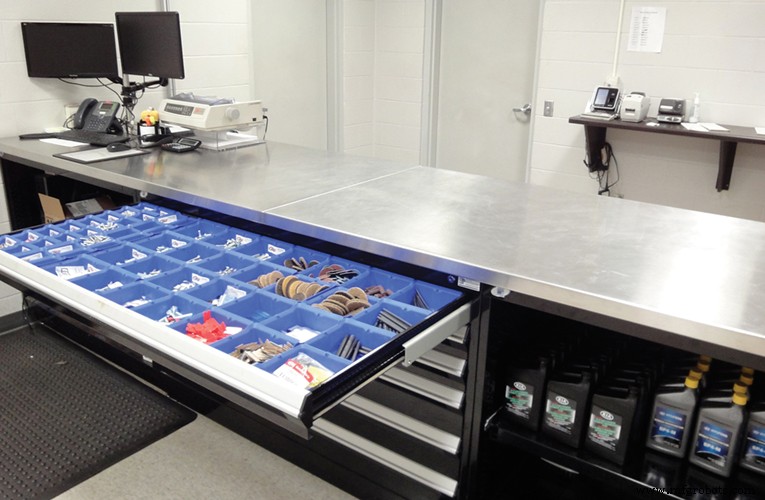 Metric parts counter example – Image source
Key Takeaway
Spare‑parts inventory often receives less attention than it deserves—until inventory costs balloon or recurring downtime becomes a headline issue. A robust, data‑driven inventory system transforms spare‑parts usage from reactive to proactive, allowing you to stock precisely what your operations need and avoid unnecessary capital ties.
Bottom line: a disciplined approach to spare‑parts management delivers measurable cost savings, shorter repair times, and higher plant reliability.
Dr. Muddassir Ahmed earned a Ph.D. in Management Science from Lancaster University Management School, an MSc in Management of Production from Chalmers University of Technology, Göteborg, Sweden. He is a Six Sigma Black Belt and founder of SCMDOJO—a resource hub offering e‑books, guides, training, courses, videos, and self‑assessment tools for supply‑chain professionals.
5 Comments
-
unracking May 14, 2020, 1:50 am
This article is very well written. I hope I can continue to share such good articles in the future.
-
Rajesh January 21, 2021, 11:07 pm
How I calculate range and depth of spares , pl explain
-
Senko January 25, 2021, 12:53 am
I’m afraid this is not in my wheelhouse. The post above was written by a guest contributor. Maybe one of the future readers of this post will have a tip or two for you.
-
AutoParts Miles April 8, 2021, 1:18 am
Nice article and thank you for this valuable information
-
DB Computer Solutions September 21, 2021, 12:08 am
Fantastic. I like your post and I share my social Networks!
Equipment Maintenance and Repair
- Just‑in‑Time Management: A Manufacturer’s Blueprint for Lean, Cost‑Effective Inventory
- Fiix Parts Forecaster: AI-Driven Inventory Management for Accurate Parts Forecasting
- Revolutionizing MRO: Four Emerging Spare‑Part Trends
- Mastering Integrated Inventory Management for Optimal MRO Efficiency
- The Hidden Costs of Spare Parts Inventory: A Guide to Reducing Carrying Expenses
- Integrating Spare Parts Management into Your CMMS: Boost Efficiency & Reduce Costs
- The Definitive Guide to Managing Planned Downtime for Reliable Production
- 4 Critical Reasons Spare Parts Management Drives Business Efficiency
- Master IoT Inventory Management: The Complete Guide
- Mastering Inventory Management: Proven Strategies for Every Business