



Optimizing Work Management: Planning, Scheduling, and Reliability
Effective maintenance hinges on meticulous planning and precise scheduling. These two pillars, often conflated, form the backbone of any robust maintenance strategy. Understanding the distinction is essential, especially in environments where scheduled shutdowns are routine.
In a plant with 16 identical production lines that shut down every five weeks, improved basic planning and scheduling could shave an hour off each shutdown. That simple change would unlock 160 extra hours of production per year.
Despite this clear benefit, many organizations still struggle with weekly and daily planning. The root cause? A relaxed performance expectation for ad‑hoc work compared to planned downtime.
Planning vs. Scheduling
Planning involves preparing every element needed for the job: scope, safety requirements, tools, parts, documentation, scaffolding, skill sets, and whether a shutdown is necessary. It answers what, how, and how long the task will take.
Scheduling follows planning. It sets the exact date and time for the job and assigns the personnel who will execute it.
Best practice dictates that you plan first, then schedule the work, and finally assign people.
All work can be planned, but not all work can be scheduled.
Planning is straightforward when you have dedicated planners focused solely on this task. Even a breakdown can, in theory, be planned because you anticipate the work that will be required. However, scheduling remains uncertain because you cannot predict when a breakdown will occur.
Zero failure theory is an utopia; zero breakdown theory is achievable.
Breakdowns can be prevented, but not all failures can. A failure’s “developing period” – the time from detection to breakdown – may be too short for planned corrective action, especially with electronic components. Early troubleshooting is therefore critical.
In aviation, redundant systems are employed to avoid failures that could endanger lives. For instance, a plane’s landing gear is actuated by multiple backup systems—manual, hydraulic, pneumatic—to ensure safe operation even if the primary system fails. The pilot reports the fault, and maintenance repairs it post‑flight, preventing a catastrophic breakdown.
Work Management Process
Without a documented, reinforced work‑management process, organizations risk falling into a “Circle of Despair.” A comprehensive process should map responsibilities across operations, maintenance coordination, prioritization, planning, scheduling, and KPIs. While the full scope can seem daunting, start with a clear, high‑level overview.
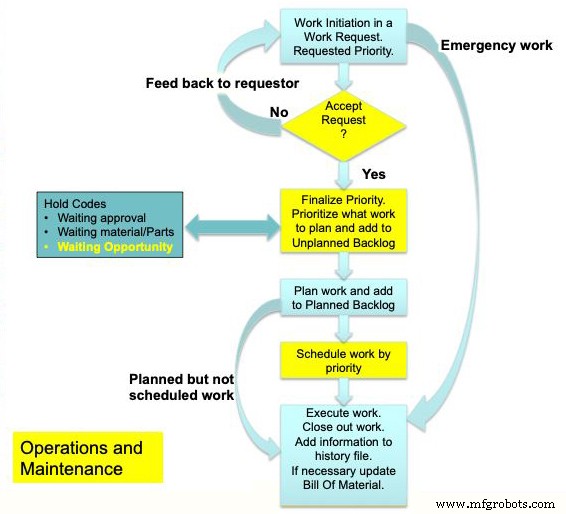
The model begins with a work request, which receives a priority. It is then approved or rejected. Rejected work returns to the requester; approved work enters the unplanned backlog, where it is further prioritized and eventually scheduled.
During planning, work may be held for reasons such as:
- Waiting for materials
- Awaiting approval
- Waiting for an opportunity—scheduled or unscheduled shutdown. Work marked as “Next Opportunity” is planned but not yet scheduled.
Hold codes must be cleared before the job can be moved into the planned backlog. Emergency work bypasses the backlog, moving directly from initiation to execution, but excessive emergencies can erode the entire system’s reliability.
Clear rules for prioritization, approval levels, and role definitions are vital. A frequent obstacle is planners being diverted to other tasks, leaving insufficient time for true planning. In fact, a recent IDCON survey of 1,400 participants revealed that 90% spend less than 60% of their time on planning, and 70% spend less than 30% on it.
When planners are pulled away, shutdowns—often involving many people and significant cost—become less efficient, immediately impacting production throughput. Plant executives will then scrutinize the deviation from the scheduled shutdown, holding planners accountable.
Key reasons planners under‑plan include emotional priorities, equipment breakdowns, lack of operational support, inadequate training, poor bill of materials, and top‑management indifference. These issues persist across industries and geographies.
Unclear prioritization rules lead to unsafe work and wasted effort. Setting the right priority on a work request is one of the most critical steps. As Saint Francis of Assisi famously said: “Start by doing what is necessary, then do what is possible, and suddenly you are doing the impossible.”
Emotional prioritization—decisions driven by feelings rather than facts—creates expensive bottlenecks. It forces maintenance teams to tackle less critical tasks before the truly important ones, disrupting the planned schedule.
When operations and maintenance view each other as customers and providers, trust deteriorates. In a reliability‑focused partnership, maintenance delivers equipment reliability, while operations ensures process reliability. Shared goals of continuous improvement foster mutual trust.
A practical approach is to convene key stakeholders from both sides to agree on prioritization criteria. Questions to guide the discussion include:
- What situations demand immediate action that overrides other work?
- What tasks can wait one day to one week?
Early identification and disciplined prioritization are the foundation of safe, efficient maintenance. Ignoring early signs forces an organization into reactive mode—an undesirable state.
Reviewing backlogs worldwide shows that many high‑priority tasks remain open for over two years. This often stems from maintenance being seen as a service provider, with requesters assigning the highest priority to guarantee action.
Re‑envision the relationship: maintenance as an equal partner focusing on equipment reliability; operations focusing on process reliability. Agreement on priority criteria—risk of injury, cost of quality loss, maintenance cost—creates a robust foundation for reliability culture.
In my experience as a consultant, the most effective partnership emerges when both operators and engineers understand each other's roles—mirroring the mindset of a ship’s motorman who simultaneously operates and maintains the vessel.
______________________
Christer Idhammar is the founder of IDCON, Inc., a management consulting firm (idcon.com). This article is an excerpt from his book Knocking Bolts. For more information, visit IDCON reliability & maintenance books.
Equipment Maintenance and Repair
- Work Execution Management: The Cornerstone of Successful Maintenance Programs
- Maintenance Management 101: How CMMS Drives Efficiency, Cost Control, and Asset Longevity
- Mastering Integrated Inventory Management for Optimal MRO Efficiency
- How to Persuade Top Management to Invest in Maintenance
- Fiix CMMS Update: New Login, QR Codes, Navigation Enhancements and Upcoming Features
- Industries We Serve: Expertise in Food, Defense, Automotive, Mining, Agriculture, and Energy
- Mastering Change Management for Remote Work Success
- Top 50 Work Order Management Software Solutions for Efficient Operations
- 3 Key Benefits of Mobile Building Maintenance Management
- Streamline Work Order Management Using CMMS for Greater Efficiency