



Understanding the Four Primary Maintenance Strategies: Which One Fits Your Operations?
Maintenance Strategies: Choosing the Right Fit for Your Operations
Industry analysts agree that predictive maintenance is gaining traction, fueled by the Industrial Internet of Things (IIoT) and data‑driven tools. Yet, it’s only one option in a spectrum of proven approaches that can suit anything from small workshops to enterprise‑grade facilities.
Below we compare the four most widely used maintenance strategies, outline their advantages and pitfalls, and explain when each is most effective.
Table of Contents
- What Are the Four Types of Maintenance?
- Comparing Maintenance Management Strategies
- How to Develop a Maintenance Strategy
While preventive maintenance often receives the most praise, the optimal solution depends on your assets, industry, and maintenance team maturity. Below we break down each strategy’s core principles, pros, cons, and best‑practice scenarios.
For additional insights, explore our maintenance strategies and planning resources page.
What Are the Four Types of Maintenance?
1. Reactive Maintenance (Run‑to‑Failure)
Reactive maintenance—also known as breakdown or run‑to‑failure—addresses equipment only after it fails. It is most appropriate for non‑critical or low‑cost assets where the cost of downtime is acceptable.
Example: A $1,000 belt feeder whose life can be extended by 10% with quarterly servicing. If the equipment is inexpensive, the marginal benefit of preventive care may not justify the effort.
Key Considerations:
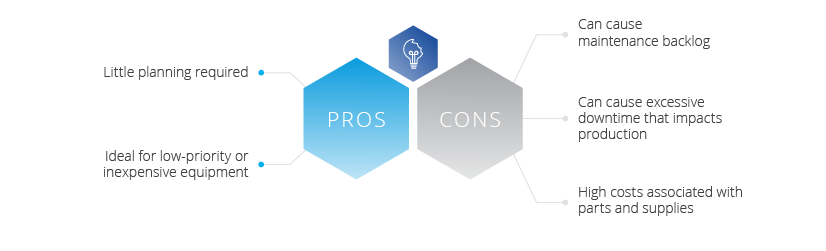
- Minimal planning required.
- Ideal for low‑priority or inexpensive equipment.
- Can create maintenance backlogs and increase downtime.
- Rushed parts orders can inflate costs.
2. Preventive Maintenance (Scheduled)
Preventive maintenance (PM) involves periodic, scheduled inspections or repairs—typically based on time or usage triggers—to extend asset life and avoid breakdowns. CMMS platforms can automate work orders, ensuring parts and resources are on hand.
Potential Drawbacks:
- PM creep—unnecessary tasks that erode productivity.
- Post‑PM failures if tasks are incomplete or poorly executed.
Mitigation: Regularly audit and optimize PM schedules.

3. Predictive Maintenance (PdM)
Predictive maintenance uses real‑time sensor data—such as vibration, temperature, or vibration analysis—to forecast failures before they occur. When conditions indicate impending failure, maintenance is scheduled precisely, reducing unnecessary downtime.
Benefits:
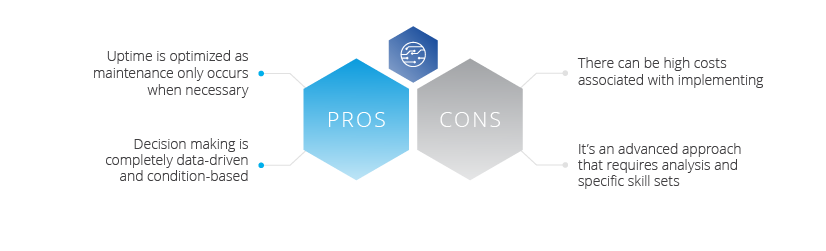
- Optimized uptime through condition‑based actions.
- Data‑driven decisions replace guesswork.
Challenges:
- High upfront investment in sensors and analytics.
- Requires skilled personnel to interpret data.
- Organizations starting from manual processes must first build a solid preventive foundation.
4. Reliability‑Centered Maintenance (RCM)
RCM is a systematic, asset‑specific approach that analyzes all potential failure modes and tailors a maintenance strategy to each machine. The goal is to maximize reliability and availability by prioritizing critical assets.
RCM Complexity:
- Requires detailed failure‑mode analysis and criticality assessment.
- Can result in a unique maintenance plan for every piece of equipment.
- Demands mature maintenance teams and comprehensive asset data.
Benefits:
- Highest reliability through customized plans.
- Risk reduction by aligning maintenance with asset criticality.
Cons:
- Significant time and capital investment.
- Not all organizations have the resources to implement fully.
Maintenance Management Strategies Comparison Chart
Use the table below to quickly evaluate each strategy’s cost, pros, and cons.
| Strategy | Summary | Cost to Implement | Pros | Cons |
|---|---|---|---|---|
| Reactive | Fix it when it breaks | Low | Low planning; suits low‑priority equipment | Can cause runaway repair costs and downtime |
| Preventive | Scheduled maintenance on predetermined intervals | Average | Reduces unexpected failures; easy to audit | PM creep; post‑maintenance failures if not optimized |
| Predictive | Condition‑based monitoring triggers work orders | High | Timely interventions; deeper insight into root causes | High upfront cost; requires skilled analytics |
| RCM | Failure‑mode analysis for tailored strategies | Highest | Maximizes reliability; risk‑aligned prioritization | Time‑consuming; resource intensive |
How to Develop a Maintenance Strategy
There is no one‑size‑fits‑all approach. Begin by assessing your asset criticality, reliability maturity, and downtime impact. Choose the strategy that aligns with your resources, then incrementally incorporate additional methods as expertise grows.
Our recommendation: Start with the simplest approach that meets your needs and evolve toward a balanced program that leverages preventive, predictive, and, where feasible, RCM techniques.
Ready to refine your maintenance plan? Contact our experts for a tailored assessment.
Equipment Maintenance and Repair
- Types of Actuators: How to Pick the Right One for Your Industrial Machinery
- Common Maintenance Ladder Types: Features & Uses
- Types of Maintenance Workers: Roles, Responsibilities, and Collar Color Explained
- Understanding CNC Machine Types: A Comprehensive Guide
- Plant Maintenance Explained: Types, Objectives, and Key Benefits
- Key Objectives & Functions of Maintenance Management
- Reactive Maintenance: Types, Benefits, and Best Practices
- Key Benefits and Functions of Preventive Maintenance
- Exploring the 7 Core Types of Technology
- Understanding the Various Types of Prototyping: A Guide for Founders