



Maximizing the Impact of Condition‑Based Maintenance: A Practical Guide
This article offers a comprehensive roadmap for elevating condition‑based maintenance (CBM). It explains what CBM is, outlines its various forms, and shows how to deploy it for the highest return on investment.
Table of contents
- What is condition‑based maintenance?
- When is condition‑based maintenance used?
- What are the benefits of condition‑based maintenance?
- Different types of condition‑based monitoring
- How to use condition‑based maintenance more effectively
Equipment failure is rarely a single event; it’s a gradual process. Recognizing that breakdowns are a journey—rather than a destination—has become a cornerstone of modern maintenance best practices. Condition‑based maintenance serves as a reliable roadmap that guides you from the early signs of trouble back to full reliability.
Below you’ll find practical insights, actionable tools, and proven techniques to help you master CBM and keep your operations running smoothly.
What is condition‑based maintenance?
Condition‑based maintenance is a predictive strategy that relies on continuous observation of key asset parameters. By collecting and analyzing data over time, CBM identifies early signs of deterioration and schedules interventions only when the data indicates a genuine need. Unlike preventive maintenance, which follows a fixed calendar, CBM responds to real‑world performance trends.
The primary goal is to prevent failure before it occurs, allowing maintenance to be performed precisely when required. Data‑driven insights enable informed decisions about scheduling, labor allocation, and budgeting. For example, monitoring pressure in a water‑distribution system can reveal leaks long before they become critical.
When is condition‑based maintenance used?
CBM is effective for most assets that satisfy three key conditions:
- Observable metrics: There must be a measurable indicator—temperature, vibration, pressure, etc.—that reflects the asset’s health.
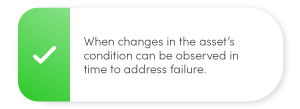
- Predictable degradation: The chosen metric should change sufficiently in advance of a failure, giving maintenance time to act.
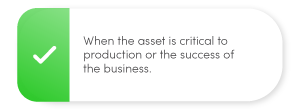
- Criticality alignment: CBM delivers the greatest ROI on assets whose failure would most severely impact operations. A criticality analysis helps identify these high‑value machines.
Equipment failure is not a single event – it is a process. Condition‑based maintenance can act as a guide on the road to failure and back.
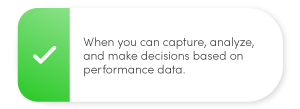
Once you’ve identified candidates, ensure your organization has the processes and systems to capture, analyze, and act on performance data in a timely manner.
When is condition‑based maintenance used?

What are the benefits of condition‑based maintenance?
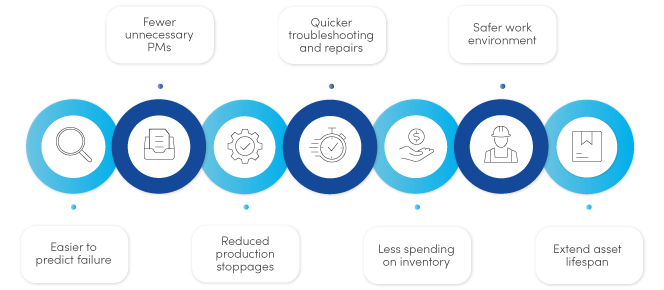
- Predict failures before they happen, reducing unplanned downtime and labor hours while boosting throughput.
- Extend intervals between interventions, lowering backlog and overall costs.
- Operate while equipment remains running, eliminating unnecessary shutdowns.
- Accelerate diagnosis during unexpected breakdowns, cutting repair expenses.
- Optimize spare‑part inventory, decreasing the need for emergency orders.
- Create a safer work environment by minimizing the risk of catastrophic failures.
- Prevent over‑maintenance, preserving asset life by applying only the necessary amount of work.
Different types of condition‑based monitoring
Condition‑based monitoring is the backbone of CBM. It involves non‑invasive measurement of an asset’s state—via sensors, visual inspection, or performance logs—either at set intervals or continuously.
Key monitoring techniques include:

Vibration analysis
Vibration signatures change in amplitude, frequency, and intensity when components become misaligned or wear out. Sensors detect these deviations, enabling proactive interventions before catastrophic failure.

Infrared and thermal analysis
Thermal cameras and sensors identify hotspots that indicate excessive heat—an early warning for insulation failure, electrical faults, or mechanical wear, especially in energized equipment.

Ultrasonic analysis
By converting inaudible sound waves into audible frequencies, ultrasonic testing reveals subsurface defects such as bearing wear or crack initiation that are otherwise invisible.

Acoustic analysis
Similar to vibration, acoustic sensors capture sounds that reveal leaks or abnormal flow in gas, liquid, or vacuum systems—critical for energy and mining plants.

Oil analysis
Testing lubricants for wear metals, contaminants, viscosity, and other parameters offers a “blood test” for machinery that depends on oil, fuel, or coolant.

Electrical analysis
Clamp‑on ammeters and other electrical sensors monitor current and voltage, flagging overloads or imbalances that could lead to costly failures.

Pressure analysis
Maintaining optimal pressure in pipelines or hydraulic systems is vital. Real‑time pressure monitoring alerts teams to drops that signal leaks or spikes that warn of impending rupture.
Combining multiple monitoring methods provides a holistic view of asset health, ensuring no critical parameter is overlooked.
How to use condition‑based maintenance more effectively
Effective CBM hinges on robust processes, data infrastructure, and a skilled workforce. Follow these four steps to embed CBM into your maintenance culture.
Step 1: Map your assets, failure modes, and baselines
Begin with a detailed inventory of all equipment and its potential failure modes. Verify that each asset can be monitored—if it lacks a measurable condition, it’s unsuitable for CBM.
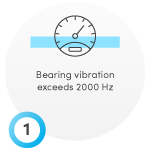
Next, establish baselines that represent healthy operating ranges. Baselines can come from manufacturer data, historical trends, or calibrated sensor readings. For example, a bearing’s normal vibration may range from 1,000 Hz to 2,000 Hz; values outside this window trigger investigation.
Over‑maintenance can accelerate wear. CBM prescribes the optimal amount of work, reducing collateral damage.
Use the asset criticality analysis template to prioritize the machines that offer the greatest ROI.
Step 2: Understand and use the P‑F curve
The Potential‑Failure (P‑F) curve illustrates the relationship between an asset’s condition, the cost of failure, and the window for preventive action. The horizontal axis tracks time from potential failure to actual breakdown; the vertical axis shows health status.
The P‑F interval—the gap between detection and functional failure—defines the maximum interval between inspections. Scheduling inspections shorter than this interval ensures that problems are addressed before they become critical.
Accurately mapping the P‑F curve for each asset lets you fine‑tune maintenance intervals, balancing cost and reliability.
Step 3: Leverage maintenance technology
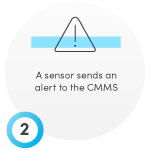
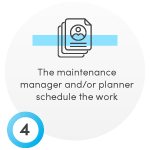
Integrate sensor data with a Computerized Maintenance Management System (CMMS) or other asset‑management platform. This integration automates data capture, analysis, and work‑order generation.
For instance, configure your CMMS to auto‑create a maintenance ticket when a filter’s differential pressure exceeds 20 psi, ensuring the filter is replaced at the optimal time.

Maintenance software also streamlines inventory management. By tracking parts usage and work‑order history, you can maintain just‑in‑time stock levels, cutting holding costs while ensuring critical spares are always on hand.
Step 4: Create a robust training program
Technology is only as effective as the people who use it. Provide comprehensive training that covers CBM fundamentals, the specific monitoring techniques employed, and the interpretation of sensor data.
Encourage a culture of ownership: every technician should understand how their actions affect asset health. A clear asset‑management policy reinforces this mindset across the organization.
Equipment Maintenance and Repair
- Lean Maintenance: Boost Facility Efficiency with Proven Techniques
- Mastering Maintenance Planning: From Reactive Fixes to Proactive Success
- Condition‑Based Maintenance: The Definitive Guide to Predictive Asset Care
- Building a Seamless Partnership Between Maintenance Planning and Storeroom Operations
- Building a High-Performance Maintenance Plan: A Practical Guide
- Elevating Maintenance: Aligning Strategy, Building Trust, and Driving Business Value
- Build a High-Impact Maintenance Training Program: A Practical Guide
- The Evolving Role of Maintenance Managers in the Digital Age
- Optimize Your Maintenance Supply Chain with Data-Driven Automation
- Boost Your Log Splitter’s Power: Proven Strategies for Heavy‑Duty Performance