



Proactive vs. Reactive Maintenance: How Both Can Drive Reliability
Think of your favourite meal – the one you’d never refuse. While it’s a personal favorite, it’s not the only dish you’ll ever want. Similarly, maintenance managers have a range of strategies. Some lean toward preventive approaches, others toward predictive programs, but the most successful teams blend multiple tactics instead of sticking rigidly to one.
In this article we examine two approaches that might appear opposed: proactive and reactive maintenance. When applied in the right circumstances, they can complement each other and form a balanced reliability strategy.
Match your assets with the perfect maintenance strategy
Start matching by evaluating each asset’s criticality, failure mode, and cost of downtime.
Proactive maintenance
Proactive maintenance – often used interchangeably with preventive – is a forward‑looking strategy that seeks to anticipate failures before they happen. While traditional preventive programs schedule work by time or usage, proactive maintenance refines those triggers using data from a CMMS, condition‑based monitoring, and real‑time sensor feeds. The goal is to intervene at the root cause of a potential failure.
For example, a rotating machine might have a preventive schedule to replace cylindrical bearings every 2,400 operating hours. By analysing vibration data, you may discover that bearings tend to fail once the vibration amplitude consistently exceeds a baseline threshold set at installation. In that case you would set the maintenance trigger to occur within the “predictive‑failure” window defined by that vibration indicator.
Successful proactive repair depends on a skilled workforce, reliable machine‑health tracking, and software capable of collecting, analysing and scheduling work based on the data.
An 8‑step guide to preventive maintenance
Get the guide
Reactive maintenance
Reactive maintenance happens after a failure has already occurred. Unlike proactive work, it doesn’t rely on prior analysis or anticipation; it simply responds to a breakdown.
Many organizations associate reactive maintenance with inefficiency, especially when it stems from legacy systems like paper logs or Excel spreadsheets that make failure prediction impossible. In a 2017 Fiix survey, 25 % of respondents were still operating reactively, yet none planned to keep that approach. A more recent Plant Engineering report found that 33 % of participants aim to reduce downtime by shifting from reactive to preventive practices.
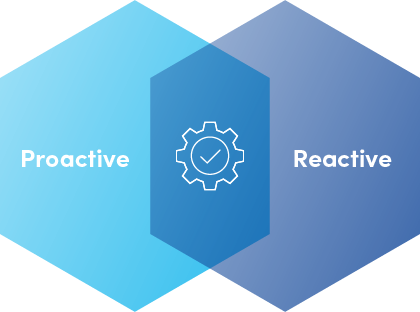
Reactive vs. proactive
Reactive maintenance is only problematic when it is unplanned. With the right analysis and planning, a reactive strategy can be a deliberate component of a reliability‑centered maintenance program.
Even though reactive work appears ad‑hoc, it often follows a rigorous cost‑benefit analysis. For instance, sensor data and CMMS history may reveal that replacing a component is cheaper than maintaining it over its remaining life. In that scenario, you schedule a planned response rather than a routine service. Similarly, if historical data shows that a particular machine’s failure would have negligible impact on production, a reactive approach may be the most efficient choice.
The bottom line: All maintenance types belong in a reliability‑centered approach
Context is everything. The modern reliability toolbox offers a spectrum of strategies, and the key is to understand how each can serve your specific assets and business goals. Relying on a single approach forever rarely delivers the best results; instead, blend proactive, preventive, predictive and reactive tactics to maximize uptime and value.
Equipment Maintenance and Repair
- Eliminate Unplanned Maintenance: How a CMMS Provides the Solution
- Why Autonomous Operator Maintenance Drives Efficiency and Workforce Empowerment
- Harnessing Reactive Maintenance: When It Drives Cost Savings
- Optimizing Maintenance Contracts: Long‑Term Strategies for Reliability
- When Is It Acceptable to Deviate From a Maintenance Schedule?
- Reevaluating Maintenance Supervisors: From Desk to Floor
- Can All Maintenance Work Be Planned? A Proven Approach to Efficiency
- Mastering Proactive Maintenance: Elevate Reliability and Reduce Downtime
- Mobile EAM: A Real‑Time Maintenance App for Field Technicians
- Balancing Proactive and Reactive Maintenance for Optimal Asset Reliability