



Harnessing Reactive Maintenance: When It Drives Cost Savings

Maintenance teams often face tough conversations when they lean heavily on reactive maintenance. Even seasoned professionals view it as an ad‑hoc approach. Yet, when paired strategically with preventive and predictive tactics, reactive maintenance can reduce costs and elevate the overall maintenance program.
What Is Reactive Maintenance?
Reactive maintenance—also called breakdown or run‑to‑failure—refers to repairs executed after equipment has failed. Because the work is unplanned, it is typically reserved for non‑critical assets or items that are inexpensive to replace.
Using reactive maintenance exclusively has its pros and cons. It demands less standby labor, fewer upfront planning resources, and lower initial costs. However, it also creates budgeting headaches, disrupts workflow, and can lead to lost production, poor time management, and workplace chaos.
While it may be cheaper to wait for a failure than to perform routine upkeep, a long‑term strategy that relies solely on reactive maintenance is shortsighted. It is suitable for emergency situations but should not dominate your maintenance plan. For critical assets—those that impact production, quality, safety, or service delivery—an integrated approach that includes preventive and predictive maintenance delivers the best results.
Preventive Maintenance as a Strategy
Preventive maintenance schedules assets offline at regular intervals for inspection or repair. The goal is to extend asset life and preempt breakdowns. Benefits include predictable budgeting and minimized production loss. The main drawback is the repetitive nature of the tasks, which can lead to employee fatigue, oversight, and a vicious cycle of missed maintenance.
Predictive Maintenance as a Strategy
Predictive maintenance uses sensors and data analytics to anticipate failures before they occur, allowing maintenance to be performed on a condition‑based basis. Advantages include cost savings from reduced man‑hours and deeper insight into equipment performance. The main challenges are the high upfront costs of software and sensors, and the need to train staff to adopt the technology.
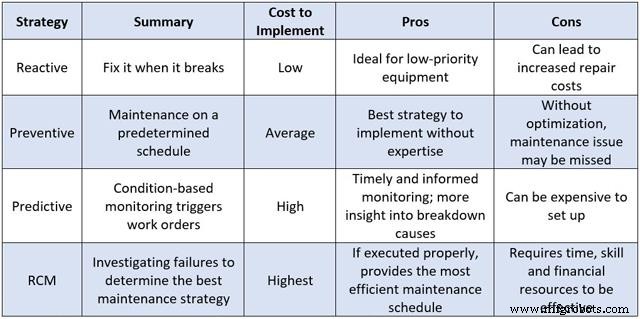
Below is a comparison chart from Fiix Software illustrating the pros and cons of each maintenance type.
Integrating Reactive, Preventive, and Predictive Maintenance
Each maintenance type offers unique benefits and limitations that depend on asset type, reliability maturity, and downtime impact. While many organizations shift from reactive to preventive practices, reactive maintenance can never be eliminated entirely. Unexpected failures—especially in complex, sensitive, or aging equipment—still occur and require rapid response.
Historically, maintenance professionals blended qualitative and quantitative methods to detect failures and reduce downtime. The current challenge is choosing the right mix: balancing asset longevity, minimizing machine downtime, and leveraging past experience to predict breakdowns. Connected technology now allows machines to self‑monitor, generate alerts, and schedule parts without manual intervention, streamlining the entire process.
This is where Reliability‑Centered Maintenance (RCM) comes into play. RCM is a comprehensive methodology that analyzes every potential failure mode for each piece of equipment and tailors a maintenance plan accordingly. According to RCM principles, reactive maintenance should account for less than 10 % of the total, preventive 25‑30 %, and predictive 45‑55 %. Enterprise Asset Management (EAM) or Computerized Maintenance Management System (CMMS) tools can help identify the optimal mix for your facility.
Inadequate maintenance strategies can cut plant capacity by 5‑20 %. Recent studies show that unplanned downtime costs industrial manufacturers an estimated $50 billion annually. Determining the ideal service interval and weighing production loss against potential failure risk is complex, but a blended approach offers real‑time data flow, enabling data‑driven decisions across all equipment types.
About the Author
Prasanna Kulkarni is the founder and product architect of Comparesoft.
Equipment Maintenance and Repair
- Is Reactive Maintenance Right for Your Facility? Balancing Cost, Safety, and Reliability
- How Weyerhaeuser’s Infrared Thermography Saved $30,000 and Boosted Reliability
- Why Preventive Maintenance Doesn’t Always Stop Equipment Failures (And How to Fix It)
- Building a High-Performance Maintenance Plan: A Practical Guide
- 12 Pillars of Effective Reliability Management
- Why Backlogs Matter: Key to Efficient Maintenance Planning
- The Hidden Costs of Reactive Pump Maintenance
- Effective Preventive Maintenance Scheduling Cuts Downtime: A Proven Strategy
- Reactive, Preventive, and Predictive Maintenance: Choosing the Right Strategy
- Deferred Maintenance: Why It Can Harm Your Organization