



Mastering Proactive Maintenance: Elevate Reliability and Reduce Downtime

In the early days of industrial production, maintenance was straightforward: machines were large, rugged, and largely free from frequent breakdowns. Production schedules were forgiving, and downtime was a low‑priority concern.
Today’s manufacturing landscape is vastly more complex. Machines are increasingly sophisticated, packed with moving parts that are prone to wear and unexpected failures.
Proactive maintenance is the modern answer.
By marrying cutting‑edge tools with forward‑looking strategies, most failures can be predicted and averted before they disrupt operations.
In this article, we explore the meaning of proactive maintenance and how it can be applied for world‑class asset management.
What is proactive maintenance?
Proactive maintenance is not a single technique; it is an umbrella term that encompasses a spectrum of strategies developed over time.
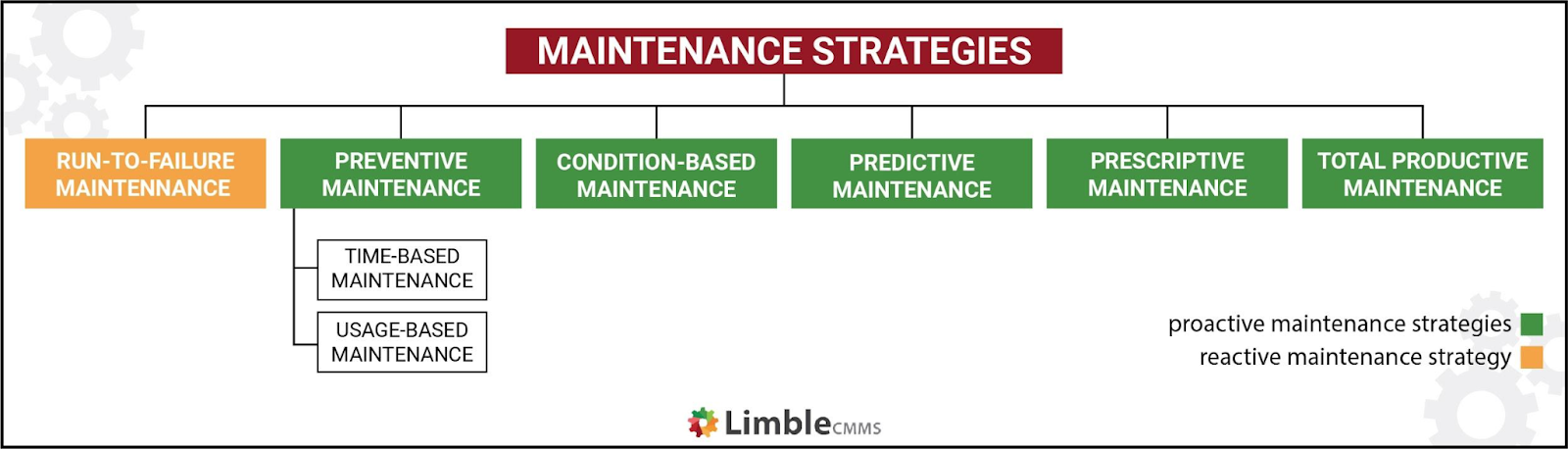
The long‑standing default was reactive maintenance, which accepts failure as inevitable and repairs equipment only after a breakdown occurs. Downtime is almost certain, and the focus is on quick, emergency fixes.
In contrast, proactive maintenance seeks to eliminate failures and minimize downtime by diagnosing root causes and addressing them before symptoms emerge.
Options for proactive maintenance management
The following strategies range from the simplest to the most advanced:
- Preventive maintenance (PM) – scheduled work at regular intervals, based on calendar or usage metrics.
- Condition‑based maintenance (CBM) – continuous monitoring of asset health via sensors or handheld diagnostics, triggering service when indicators show a problem.
- Predictive maintenance (PdM) – combines condition data with machine‑learning models to forecast failures and provide advance warnings.
- Prescriptive maintenance – extends PdM by offering data‑driven recommendations for specific corrective actions.
Organizations seeking leaner maintenance departments often add concepts such as autonomous maintenance and total productive maintenance (TPM) on top of these core strategies.
Addressing root causes of equipment failures
Proactive maintenance starts with identifying the root causes of breakdowns. In modern plants, common culprits include:
- Substandard spares and supplies.
- Operator errors or equipment misuse.
- Skipped or poorly adhered maintenance schedules.
- Inadequate training for maintenance staff.
- Over‑use of equipment during peak periods.
- Assets nearing the end of their useful life.
Many of these issues are straightforward to resolve: proper training, high‑quality parts, disciplined scheduling, and timely equipment replacement can dramatically reduce failure rates. Proactive maintenance forces organizations to tackle these root causes rather than merely patching symptoms.
Advantages and disadvantages of proactive maintenance
Shifting to a proactive model yields several benefits:
- Significantly reduced downtime and fewer breakdowns.
- Higher equipment reliability, availability, and overall uptime.
- Lower long‑term maintenance costs, including repairs and labor.
- Improved safety and productivity.
- Extended asset lifespan, yielding further savings.
While the long‑term payoff is clear, the initial investment in planning, training, and technology can be substantial. Different strategies demand varying levels of commitment.
Basic requirements for implementing proactive maintenance
Adopting proactive maintenance is most challenging during the transition phase, especially when staff are accustomed to reactive practices.
Key success factors include:
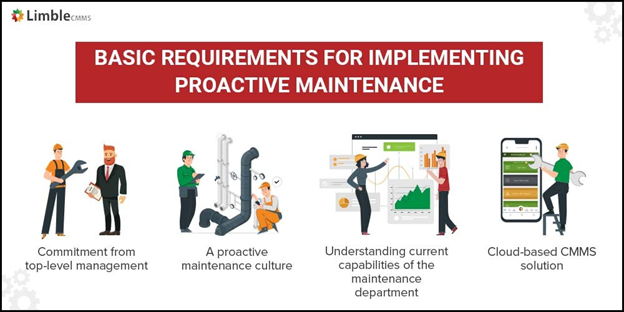
Commitment from top‑level management
A proactive strategy consumes budget for training, new hires, CMMS licensing, and condition‑monitoring equipment. Leadership must champion the shift and allocate resources accordingly.
If budget constraints exist, starting with preventive maintenance is a cost‑effective entry point.
A proactive maintenance culture
Transitioning requires a cultural shift. Teams must see the value in new technologies and processes. Broad stakeholder engagement is essential for buy‑in.
Understanding current maintenance capabilities
Assess existing processes, technologies, and skill levels to plan the transition. Accurate performance data and metrics—often sourced from a CMMS—are vital for success.
Cloud‑based CMMS solution
Data‑driven maintenance hinges on a robust CMMS. It tracks schedules, failure patterns, service history, and key performance indicators, enabling automated and streamlined workflows. If a CMMS is absent, its implementation should be the first priority.
Reduce Reactive Maintenance by 73.2%
See the Results Red Hawk Enjoys With Limble
Read Our
Case Study

Core steps for setting up an effective proactive maintenance program
Once foundational elements are in place, a systematic approach is required to implement proactive maintenance.
1. Select a project leader
Appoint a senior supervisor, maintenance manager, or planning lead who understands your organization’s equipment and processes. This individual will steer planning and execution.
2. Build a comprehensive asset registry
Catalog all critical assets. A CMMS can maintain an up‑to‑date registry, simplifying planning and providing quick access to service histories.
3. Consult all stakeholders
Engage frontline technicians, operators, engineers, safety managers, and OEM vendors to gather insights on asset performance and maintenance needs.
4. Identify critical assets
Determine which assets have the highest impact on production. For larger facilities, conduct risk‑based maintenance (RbM) analyses to prioritize focus.
5. Tailor the maintenance strategy per asset
Create individualized schedules that reflect each asset’s criticality. Where data are sparse, rely on manufacturer guidelines and seasoned staff input. In larger organizations, reliability‑centered maintenance (RCM) can identify the most common failure modes.
6. Invest in appropriate tools and technologies
Technology requirements vary by strategy:
- PM – CMMS alone suffices.
- CBM – sensors and IIoT devices for real‑time monitoring.
- PdM – advanced analytics and predictive algorithms.
- Prescriptive – complex model‑based recommendations.
Advanced strategies may require industrial sensors, IoT connectivity, or custom solutions.
7. Document processes thoroughly
Develop standard operating procedures (SOPs) and maintain detailed records of planned maintenance. Continuous improvement relies on clear, step‑by‑step guidance.
8. Implement the proactive maintenance schedule
Deploy the schedule for at least one full year, accounting for production peaks, troughs, and planned shutdowns. Adjust duration based on facility size and complexity.
Implementation timelines vary from days to months, depending on scale.
Proactivity reduces unpredictability
Stability and predictability are business lifelines. Unexpected downtime inflates operating costs and hampers productivity. Proactive maintenance breaks the cycle of reactive repairs, delivering measurable savings and efficiency gains.
While upfront costs—time, training, technology—are real, the return on investment is achieved quickly through reduced failures and improved output.
A CMMS system is a critical enabler for a smooth transition.
Contact us to learn how Limble CMMS can support your proactive maintenance initiatives.
Equipment Maintenance and Repair
- How Industrial Maintenance Has Evolved: From Reactive to Predictive
- Your Comprehensive Predictive Maintenance Checklist: Boost Efficiency, Cut Downtime & Drive ROI
- How Predictive Maintenance Drives Efficiency and Cuts Downtime
- The Evolution of Maintenance Practice: From Reactive Fixes to Proactive, Risk‑Based Strategies
- Keep Maintenance Proactive: Lessons from Sisyphus on Continuous Improvement
- Optimizing Maintenance: Cost‑Effective Predictive Strategies for Manufacturing Leaders
- What Maintenance & Reliability Leaders Are Prioritizing Right Now
- How Maintenance KPIs Drive Asset Reliability and Business Value
- Unlocking Reliability: How Condition‑Based Maintenance Drives Predictive Success
- Proactive Maintenance Explained: Prevent Downtime and Save Costs