



Unlocking Real-Time Value with Predictive Maintenance
What’s the cost of machine downtime in the factory environment? It depends on how you calculate it.

Lost production, labor costs for idled workers, and inventory expenses are direct costs. Indirect costs—such as loss of customer confidence—can be even more damaging. While each company’s circumstances differ, manufacturing leaders agree that keeping machine downtime to a minimum is essential. For decades, preventive maintenance (PM) has been the standard approach to avoiding costly downtime.
What is preventive maintenance?
Preventive maintenance is a scheduled service based on time or usage. For example, “Parts ABC will be replaced on the XYZ machine after 1,000 operating hours or every six months.” The goal is to replace components before they fail, reducing the risk of unplanned outages. Yet, PM itself incurs costs: downtime for scheduled work and labor for maintenance crews. The question becomes: is a time‑or‑usage‑based schedule still the best strategy?
When data was scarce, a time‑based schedule made sense. Today, however, manufacturers have real‑time visibility into machine health. That data enables a more advanced strategy: predictive maintenance (PdM). By detecting and anticipating potential failures, PdM protects worker safety, maintains uptime, and supports production targets.
Predictive maintenance tools
A predictive maintenance strategy relies on several technologies:
- Sensors: Embedded sensors monitor temperature, vibration, balance, lubricant, and fluid flow. Changes in vibration or temperature often precede equipment failure, but each component may require unique parameters.
- Ultrasound devices: These detect leaks in pressurized systems by capturing sounds beyond human hearing. Early leak detection prevents costly damage.
- Thermography: Infrared imaging tracks heat flow through electrical components. Rising temperatures signal increasing resistance and impending wear, allowing timely intervention.
- Fluid analysis: Regular oil testing—visual, chemical, and wear particle inspection—determines exactly when an oil change is needed. This eliminates unnecessary replacements, reduces waste, and extends equipment life.
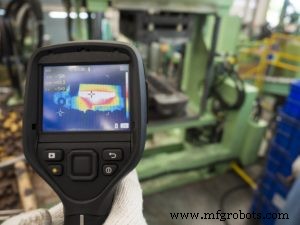
These tools give manufacturers a clear picture of machine performance and enable accurate failure prediction.
How does PdM improve operations compared to traditional PM?
- It reduces unscheduled downtime and avoids unnecessary part replacements.
- Resources previously devoted to routine PM can be redirected to strategic initiatives, fostering continuous improvement and higher overall efficiency.
Other advantages include better work‑order management, enhanced safety, lower liability exposure, and smarter equipment replacement planning. As companies adopt data‑driven practices across marketing, sales, product development, and supply chain, modernizing maintenance with data is a logical next step.
If you’re ready to explore a transition to predictive maintenance, download our white paper or contact us today to discover how much money you could save.
Equipment Maintenance and Repair
- Your Comprehensive Predictive Maintenance Checklist: Boost Efficiency, Cut Downtime & Drive ROI
- How Preventive Maintenance Paves the Way for Predictive Maintenance Success
- How Predictive Maintenance Drives Efficiency and Cuts Downtime
- Why Autonomous Operator Maintenance Drives Efficiency and Workforce Empowerment
- Optimizing Maintenance: Cost‑Effective Predictive Strategies for Manufacturing Leaders
- Why Reliability as a Service (RaaS) Is Driving Smarter Predictive Maintenance
- From Scheduled to Predictive Maintenance: A Step‑by‑Step Transformation Roadmap
- Verdantix Confirms Senseye’s AI‑Driven Predictive Maintenance Delivers Real Asset Savings
- Predictive Maintenance Evolution: From Reactive Failures to Proactive Success
- Overcoming the 3 Biggest Obstacles to Successful Predictive Maintenance