



How Maintenance KPIs Drive Asset Reliability and Business Value
 Managing maintenance is as strategic as any other business function. To deliver the expected value of reliable assets after allocating repair and maintenance (R&M) dollars, you need objective data, not gut instinct. Key performance indicators (KPIs) supply that data, guiding decisions toward measurable outcomes.
Ground Rules for Effective KPIs
KPIs can range from highly specific task metrics to company‑wide performance measures, and they can be leading or lagging, simple counts or complex ratios. Regardless of scope, they must adhere to these essential principles:
- Business Value Alignment: Every metric should link directly to a tangible benefit for the organization.
- Current State Relevance: Avoid misleading percentages—e.g., the share of proactive work is meaningless if only half of all work orders are tracked.
- Automation: Manual counting invites errors and neglect; automate wherever possible.
- Process Integrity: Do not create activities solely to satisfy a KPI; metrics should reinforce existing processes.
- Realistic Targets: Set clear, achievable goals and watch for diminishing returns.
- Accountability: Monitor results and tie performance to responsibilities, objectives, and incentives.
Alignment to the Maintenance Business Process
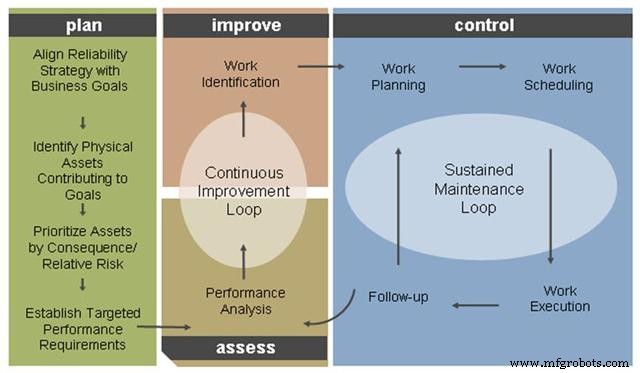
Successful maintenance hinges on a well‑defined business process that delivers the desired outcomes. Below is ArcelorMittal’s maintenance framework, illustrating how each component feeds into the next while being measured by standardized KPIs.
Plan
The planning phase establishes the foundation for all subsequent activities. It involves understanding business objectives, identifying the supporting assets, assessing risks, and defining performance requirements.
Typical KPIs in this phase include the % of assets with completed prioritization analysis and the maintenance budget as a % of replacement asset value.
Improve
Improvement focuses on work identification. Using methods such as reliability‑centered maintenance, maintenance task analysis, and root‑cause analysis, you pinpoint tasks that mitigate failure consequences most effectively.
Key KPIs here are the number of failure modes identified, % of maintenance action plans implemented, and the number of condition inspections conducted.
Control
The control stage executes the maintenance program developed in the improve phase. Tasks are planned, scheduled, and executed, followed by reviews that refine future plans—a cycle often called the "sustained maintenance loop."
Metrics monitor planning quality, scheduling efficiency, and execution effectiveness, such as % backlog ready to work, planned vs. actual man‑hours, % of scheduled outage work orders completed, and preventive maintenance compliance.
Assess
Assessment compares performance against targets to identify improvement opportunities. Lagging KPIs dominate this stage and vary by process type.
- Continuous processes: Mean time between failures (MTBF) is critical when each line stop incurs significant yield loss.
- Batch processes: Focus on delay rates, production metrics like working ratio, heats per day, budget vs. actual repair and maintenance spend, and prime yield.
Calculation and Reporting
Automated KPI calculations feed real‑time dashboards within reliability software. Data sources include the reliability system, the computerized maintenance management system (CMMS), operational feeds, and financial reports.
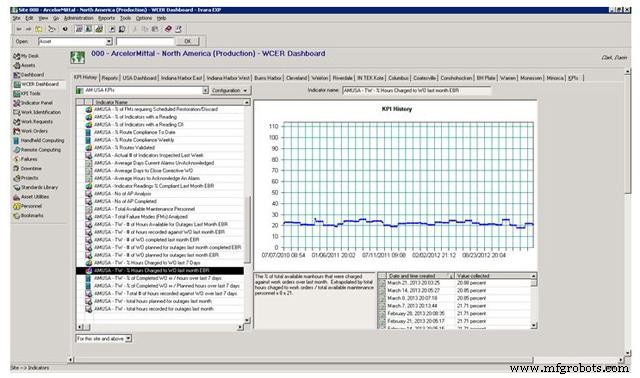
A standardized KPI set should be deployed across corporate, plant, and individual business units, enabling instant access to real‑time data.
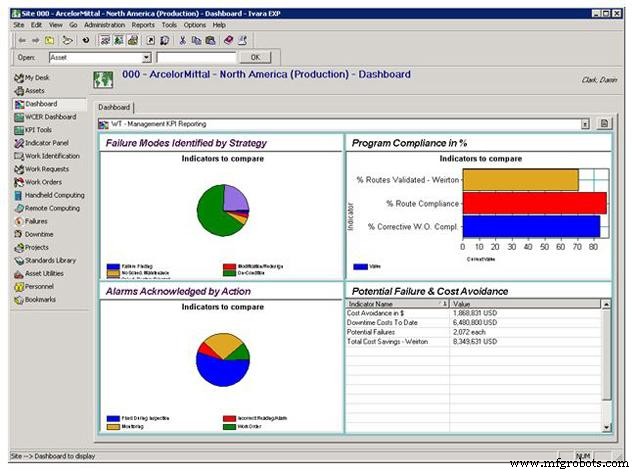
Dashboards can be tailored to specific roles—plant managers, maintenance managers, planners—while KPI data is also compiled into monthly reports for executive review.
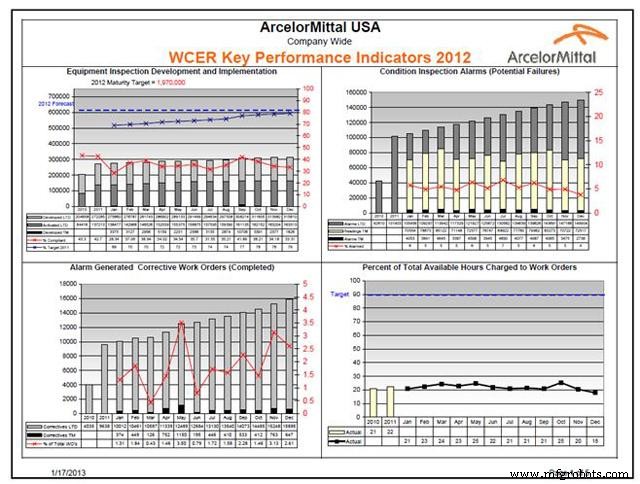
By defining, communicating, and continuously refining KPIs, organizations empower data‑driven decisions that move them toward strategic goals.
Equipment Maintenance and Repair
- How Industrial Maintenance Has Evolved: From Reactive to Predictive
- Unlocking Operational Excellence: The Strategic Advantage of Optimized Maintenance Scheduling
- Optimizing Maintenance: Cost‑Effective Predictive Strategies for Manufacturing Leaders
- The Power of a Clear, Concise Vision: Driving Leadership Success
- What Maintenance & Reliability Leaders Are Prioritizing Right Now
- Harnessing a Clear Vision to Drive Maintenance & Reliability Success
- Maximize CMMS Value: Technology, Processes, and People Aligned
- Unlocking Reliability: How Condition‑Based Maintenance Drives Predictive Success
- Harnessing Pareto Analysis to Optimize Maintenance Efficiency
- Mastering Proactive Maintenance: Elevate Reliability and Reduce Downtime