



Unlocking Operational Excellence: The Strategic Advantage of Optimized Maintenance Scheduling
Maintenance managers are masters at making existing schedules work, but that does not mean the schedule is optimal. In many facilities, staffing plans are inherited, copied from a neighboring site, or created after production demands are already set. An effective schedule must balance business priorities, employee preferences, and safety requirements. It starts with a clear definition of what a schedule truly is—and what it isn’t.
Defining the Schedule
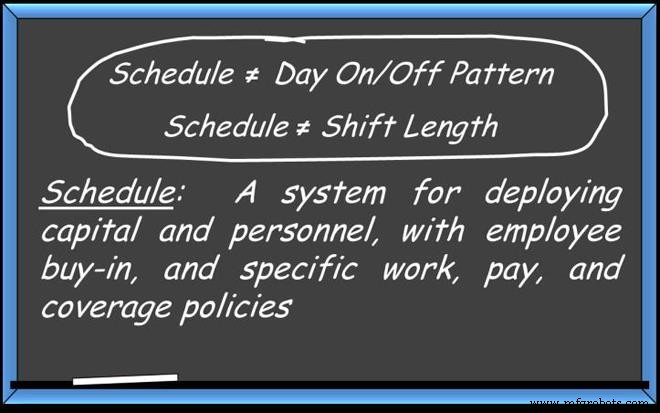
Many leaders equate a schedule with shift length or days of coverage. While those elements matter, a schedule is fundamentally a system for deploying capital and personnel. To succeed, it must earn employee buy‑in and reflect real work, pay, and coverage rules. A Monday‑to‑Friday schedule that excludes weekends differs dramatically from one that forces workers to cover Saturdays and half of Sundays—although they may look identical on paper.
Consider a plant where technicians work 40 hours a week only to log overtime every weekend. The problem is twofold: during the week, equipment is in use by operators, leaving maintenance crews idle, and on weekends they are stretched thin. Even in a 24/7 operation, such a pattern is unsustainable. A more strategic approach is to align staffing with operational tempo—fully staffed during shutdowns and leaner during peak production, yet never overburdening crews when the most critical work occurs.
Pitstop Maintenance
Think of a pitstop: a highly trained crew works under tight timelines to get a race car back on track. The same principle applies to manufacturing. By concentrating a dedicated maintenance team on specific areas each day, you can achieve rapid, focused work that restores production swiftly.
For example, a Midwest bottling plant with five production lines and several support zones needed roughly a day of maintenance weekly. With leadership support, they established a pitstop crew that visited each area once a week, Monday through Saturday. Ten hours per week covered most issues, while Sundays and planned shutdowns addressed larger jobs.
Work packages were pre‑prepared; tools and parts were staged. If Line #2 required maintenance on Tuesday, the night shift shut it down early, and the pitstop team was ready to begin immediately. OEMs were reachable by phone, and supervisors stayed on call to approve additional time. This approach kept production running at full capacity while minimizing downtime.
The crew comprised 36 technicians—18 mechanical, 18 electrical/instrumentation. By allocating 18 to the pitstop team and deploying the remaining 18 across three shifts, the plant maintained full coverage during weekdays while allowing the pitstop crew to operate with full resources during scheduled maintenance windows.
Surveys showed managers rated the pitstop crew’s effectiveness 25‑75% higher than technicians working during normal shifts. With a fully loaded wage of $46.96 per hour, this productivity boost translated into $400,000 to $1 million in annual savings, whether through improved maintenance outcomes or reduced staffing needs.
Employees benefited too. By rotating staff through the pitstop crew, workers earned more days off and longer weekends. Daily shifts were worked at least 50% of the time, enabling cross‑training and maintaining a pool of well‑trained personnel for back‑shift coverage.
For lines with capacity constraints, the process was even more targeted. Bottling lines were shut down sequentially: packaging continued while the filler was serviced, and pre‑filler equipment came online while packaging maintenance wrapped up. This sequencing maximized operational uptime.
Other Considerations
Longer shifts can boost labor efficiency by reducing starts and stops, tool changes, and other downtime. Typical efficiency gains of 15‑20% are reported when moving to longer shifts, provided baseline productivity metrics are in place to justify the change.
Shift design must also account for the higher likelihood of equipment failure during start‑up and shutdown periods. Understanding these patterns is critical for scheduling maintenance that aligns with production demands.
Avoid rigidly scheduling maintenance on arbitrary calendars. For instance, a 10‑day maintenance interval performed weekly results in 52 events per year—15 more than necessary—leading to unnecessary labor and parts costs. Advanced analysis using Weibull curves can identify optimal maintenance windows, as demonstrated by a Southwestern mine that saved over $600,000 annually by adjusting liner replacement schedules.
Effective maintenance managers ask more questions than they receive answers. Many schedules are a patchwork of legacy rules—overtime, weekend coverage, shift rotations—that may no longer serve their original purpose. The goal is to match workforce capacity with workload demand.
This article was previously published in the Reliable Plant 2019 Conference Proceedings.
Equipment Maintenance and Repair
- Designing an Effective Maintenance Strategy: A Practical Roadmap
- The Power of a Clear, Concise Vision: Driving Leadership Success
- When Is It Acceptable to Deviate From a Maintenance Schedule?
- Harnessing a Clear Vision to Drive Maintenance & Reliability Success
- Maximize CMMS Value: Technology, Processes, and People Aligned
- How Maintenance KPIs Drive Asset Reliability and Business Value
- Harnessing Pareto Analysis to Optimize Maintenance Efficiency
- Choosing the Right LED Power Supply: A Comprehensive Guide
- Prescriptive Maintenance: The Proactive Solution for Superior Asset Management
- How to Choose the Perfect Power Generator for Your Business