



Global Landscape of Maintenance: Trends, Practices, and Future Directions
Below is a comprehensive overview of how maintenance is evolving across the globe, the key regional strengths and challenges, and a proven framework for continuous improvement.
- Regional strengths and weaknesses in maintenance
- Current trends in maintenance management
- The value of maintenance associations worldwide
- The future of maintenance societies and certification programs
- Effective practices in maintenance and maintenance management
- The future of asset management and its distinction from maintenance management
- Ten practical tips for successfully implementing improvements and change in your organization
Introduction
Maintenance is no longer a reactive, siloed function. New methods, processes, and technologies are being developed, tested, and adopted at a rapid pace. Every organization seeks to maximize output, minimize cost, and achieve high reliability—all while safeguarding its assets. As companies evolve, so do the societies that support maintenance professionals, offering networking, education, and the latest industry insights. The shift from traditional maintenance management toward holistic asset management is now underway, and understanding this transition is critical for success.
A View of Maintenance by Region
The world can be divided into seven key regions: North America, South America, Europe, Australia, Asia, Africa, and the Middle East.
North America
North America is making notable progress, with maintenance programs gaining traction and sophistication. However, roughly 75% of companies still rely on reactive maintenance, and many focus on cutting production costs without investing in people or processes. Reliability engineering dominates discussions, while planning and scheduling lag. Large firms are recognizing the need for a unified system across all plants, and industry groups like the Society for Maintenance & Reliability Professionals (SMRP) are championing asset‑management education.
South America
Brazil, Colombia, and Venezuela illustrate the region’s trajectory. Brazil’s manufacturing sector shows strong interest in maintenance improvement, evident in the rapid growth of Abraman. Companies such as Wood Group and leading oil firms are adopting global best practices, signaling a promising shift.
Europe
Europe pioneered national maintenance societies, yet consulting services remain scarce outside the UK. While many professionals engage with maintenance theory, actionable improvement often stalls. A heavy emphasis on craftspeople sometimes masks poor maintenance planning. Though cost‑cutting began later than in the U.S., competitiveness is now a major concern.
Australia
Australia’s maintenance culture is advanced, driven by limited spare‑part availability and strong university programs. The booming natural‑resource economy prioritizes construction over maintenance, stretching resources and reducing focus on improvement.
Asia
Discrete manufacturing in Asia widely adopts Total Productive Maintenance. China’s vast manufacturing base, however, shows limited interest in maintenance improvement, largely due to new plants and inexpensive labor. India faces similar challenges, while Russia—centered on mining—demonstrates a robust interest in maintenance programs.
Middle East
National oil companies boast sophisticated plants, yet maintenance practices are generally weak, with equipment often replaced rather than maintained. Western engineering influence is rising, which should elevate maintenance focus over time.
Africa
North Africa’s manufacturing is petrochemical‑centric, learning from national oil companies. South Africa mirrors Australia: supply lines are long, and maintenance receives attention, but educational gaps for black professionals must be addressed to unlock full potential.
Current Trends in Maintenance & Asset Management
Organizations worldwide are experiencing a "re‑centralization" of maintenance functions. Workforce shortages, cost‑cutting, and the retirement of the Baby Boomer generation are compelling companies to hire skilled workers and extend equipment life. Consequently, global, common systems are becoming essential.
Traditional maintenance councils are shifting from democratic structures to decisive leadership. The ultimate goal is a transition from maintenance management to total asset management—an approach that integrates operations, maintenance, logistics, and engineering for sustained performance.
Maintenance Societies
Maintenance societies worldwide continue to evolve, providing education, training, and networking opportunities. Key players include SMRP (North America), Abraman (Brazil), and MESA (Australia). SMRP is expanding internationally, partnering with global entities to promote the Certified Maintenance and Reliability Professional (CMRP) credential. Abraman remains a leader with robust education programs and industry reach.
Conversely, the European National Federation of Maintenance Societies (ENFMS) has struggled to represent most businesses and remains resistant to change.
The future lies in collaborative world congresses, unified certification programs, and the creation of asset‑management societies that transcend traditional maintenance boundaries.
Effective Practice in Maintenance Improvement
We have distilled a model that consistently delivers results: the SAMI Closed‑Loop Improvement Process (see Figure I).
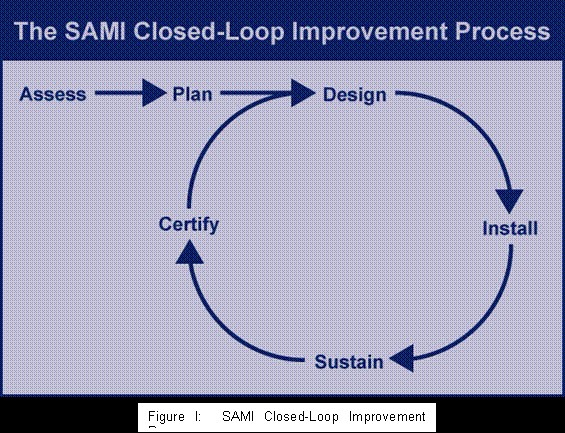
Assess & Plan—the first step engages stakeholders, builds an emotional gap, and aligns leadership around a shared vision. Outcomes include a multi‑year roadmap, detailed delivery plans, and quantified expected value.
Motivation comes from passion: pride, collaboration, and a genuine love for the business. By fostering a shared emotional bond, middle managers drive change from the bottom up.
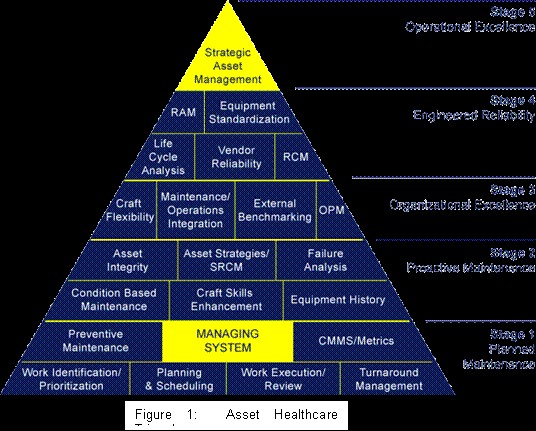
Design—the Asset Healthcare Triangle (Figure II) clarifies the foundation for change. Teams of field leaders refine processes, ensuring they are realistic and executable. The result is a passionate, committed team ready to champion the new system.
Install—implementation begins with training and coaching. Coaching is critical; it embeds new behaviors, resolves resistance, and ensures that the new processes become standard practice.
Sustain—continuous measurement of KPIs, ongoing coaching, and regular governance reviews keep momentum alive. The Owners Group, line management, and champions maintain accountability.
Certify—this final stage confirms that behaviors are sustained. Peer evaluation, rather than a punitive audit, fosters a culture of continuous improvement.
For a visual representation, see the SAMI Pyramid.
Illusions of Change to Avoid
- Standalone training without behavioral change is destructive.
- Skipping the emotional alignment phase leads to short‑lived results.
- Focusing solely on numbers ignores real behavioral compliance.
Difference Between Maintenance Management & Asset Management
Table 1 contrasts the Functional Excellence Model with the Asset Management Excellence Model.
Functional Excellence Model
- Operations owns production; maintenance owns equipment.
- Focus on efficient repair, with little emphasis on preventive planning.
- Goals are set by functional managers, often leading to conflicting incentives.
- Metrics are primarily lagging indicators.
Asset Management Excellence Model
- Operations owns equipment and ensures health.
- Maintenance partners with operations for preventive measures.
- Breakdowns trigger root‑cause analysis.
- Goals are cascaded top‑down, balancing lagging and leading indicators.
- Parts procurement focuses on service level and mean time between failure.
As James W. Davis notes in “Strategic Planning for Asset Management” (2004), reliability initiatives often fail to scale across sites due to cultural differences and inconsistent processes. Strategic Asset Management (SAM) programs address these gaps, delivering sustained financial performance.
Benefits of a Successful Asset Management Strategy
- Accurate analysis of maintenance, repair, and replacement records.
- Higher equipment availability and fewer unplanned outages.
- Improved product quality and reduced reprocessing costs.
- Lower maintenance, spare‑part, and capital replacement costs.
- Enhanced morale among management and workforce.
- Increased operational capacity and sustained performance.
- Higher profits through reduced conversion costs and increased production.
Conclusion
Every region is advancing, maintenance societies are expanding their roles, and the industry must unify certification efforts globally. By applying the ten improvement tips outlined below, organizations can navigate the transition to asset‑centric management successfully.
- Commit to a multi‑year improvement plan.
- Continuously monitor and evaluate results.
- Secure senior leadership endorsement.
- Empower operators and craftspeople with ownership.
- Build an overwhelming business case.
- Foster cross‑functional cooperation.
- Hold teams accountable for monthly targets.
- Regularly assess behaviors, attitudes, and KPIs.
- Make the initiative a top‑three priority each year.
- Follow a single, coherent roadmap.
About the Author
Brad Peterson, CMRP, is the founder of Strategic Asset Management Inc. For more information, email bpeterson@samicorp.com or visit www.samicorp.com.
References
- James W. Davis, "Strategic Planning for Asset Management," 2004.
Equipment Maintenance and Repair
- 10 Real-World Maintenance Truths Every Technician Should Know
- Optimizing Maintenance: Cost‑Effective Predictive Strategies for Manufacturing Leaders
- What Maintenance & Reliability Leaders Are Prioritizing Right Now
- How Maintenance KPIs Drive Asset Reliability and Business Value
- Unlocking Reliability: How Condition‑Based Maintenance Drives Predictive Success
- How Maintenance Drives a Sustainable Circular Economy
- CN Tower Maintenance: Inside the Engineering Behind Toronto’s Iconic Landmark
- Mastering Proactive Maintenance: Elevate Reliability and Reduce Downtime
- Predictive Maintenance: Harnessing Industry 4.0 for Uninterrupted Production
- How IoT is Revolutionizing Everyday Life