



Jaw‑in‑Shear Couplings: Reduce Downtime, Save Time, and Cut Inventory Costs
Fact: The manufacturing sector has always been concerned about the amount of downtime incurred for scheduled and unscheduled maintenance. The dollars lost to unscheduled maintenance can be quite substantial.
Fact: All industrial facilities use some type of flexible coupling for pumps, compressors, conveyors, and other machinery. These flexible couplings all require some measure of maintenance.
PROBLEMS AND SOLUTIONS
What are your coupling and related maintenance options?
Gear‑ and grid‑type flexible couplings require lubrication. To lubricate these types of couplings, the lubrication plugs must first be removed and the coupling filled with grease.
Various elastomeric‑type flexible couplings require periodic replacement of the elastomeric element. The difficulty level for different types of elastomeric couplings can vary widely. Some, like the standard jaw product, require that one of the hubs be moved back on the shaft to allow for the element to be changed out. Machinery may need to be moved to allow for this hub movement, which can be very time‑consuming. Other elastomeric designs have many fasteners and parts to be disassembled for element change‑out.
In either case, the time it takes to change this element is critical for maintenance personnel. This is where the advantages of a jaw‑in‑shear design can provide a solution to plant downtime.
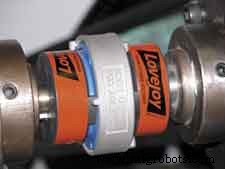
Photo 1. The jaw‑in‑shear element can be changed without moving either hub.
BREAKING IT DOWN
The basic components of a jaw‑in‑shear coupling are two standard jaw hubs, a jaw‑in‑shear element, and a retaining ring. The jaw‑in‑shear element is designed to be changed without moving either hub, as would be required with a standard jaw coupling. Additionally, there are no fasteners to worry about because of the jaw‑in‑shear retaining ring. The ring can simply be removed and the element replaced in minutes, saving a substantial amount of time. Not only is the element a “pit stop”‑style change‑out, it eliminates the need to move either hub or the equipment the coupling connects. The time savings compared with other elastomeric‑type couplings is at least 50 %.
Because of the ease of assembly and disassembly with the jaw‑in‑shear design, anyone can perform the required coupling maintenance. Another benefit is that it offers twice the amount of angular misalignment compensation over standard jaw products. The urethane element has 1.5 times the torque rating of the standard Buna‑N rubber element, providing an additional service factor for applications that originally used the standard rubber spider.
To reiterate, the jaw‑in‑shear design offers advantages in time for element change‑out, ease of assembly (no specialized personnel required), double the misalignment capacity over the standard jaw product, and 1.5 times the torque rating of the standard Buna‑N spider material.
BANG FOR THE BUCK
Excess inventory is a concern for manufacturers. Companies always look for ways to economize inventory and get the most bang for the buck. Any time a facility can reduce or minimize the number of stock‑keeping units (SKUs) or Universal Product Code (UPC) numbers it inventories, it saves inventory space and money.
The jaw‑in‑shear coupling allows plants to benefit from using the industry‑standard jaw coupling hub with a wrapping elastomeric spider and retaining ring. This means adding only two new SKUs or UPC numbers for plants that already use the industry‑standard jaw product. The result is less additional inventory dollars and space to allow for the upgrade from the industry‑standard jaw product.
CONCLUSION
The jaw‑in‑shear design gives plant maintenance personnel a solution that addresses plant downtime. By utilizing both economy of inventory and the advantages of the jaw‑in‑shear design, substantial savings can be realized in many applications plant‑wide.
With the cost of plant downtime increasing every day, this solution gives maintenance personnel a way to save resources without sacrificing response time.
Krister K. Meister is the marketing manager for Lovejoy Inc., a manufacturer of heavy‑duty couplings. To learn more, visit www.lovejoy-inc.com, call 630‑852‑0500 or e‑mail info@lovejoy-inc.com.
Equipment Maintenance and Repair
- How Short‑Run Manufacturing Drives Innovation and Efficiency
- Why Custom-Molded Parts Are Essential for High-Performance Machinery
- Why Non‑Ferrous Metals Matter: Key Advantages for Industry
- Living Hinges: The Rust‑Proof, Silent, and Customizable Advantage Over Metal
- Why Vulcanized Seals Deliver Superior Performance
- How Predictive Maintenance Drives Efficiency and Cuts Downtime
- Cloud Maintenance: Unlocking Efficiency, Reliability, and Cost Savings
- Why Refurbished Robots Deliver Cost Savings & Competitive Edge
- Unlocking Profitability: The Business Value of Regular Equipment Inspections
- Why Hydraulic Systems Are Essential for Modern Engineering