



Maximizing Roller Chain Longevity: Expert Strategies for Extended Wear Life
Roller chain drives are the backbone of industrial power transmission and product conveyance. Their performance directly impacts productivity, and premature chain stretch can drive up operating costs.
While lubrication and routine maintenance are well‑known ways to prolong chain life, this article explores additional critical factors—fabrication, preparation, and assembly—that underpin maximum wear resistance.
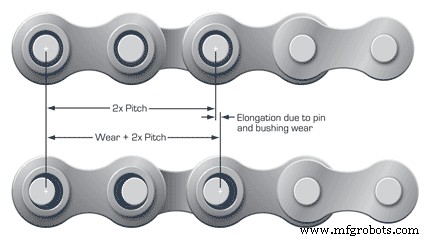
Figure 1. Wear diagram.
Lubrication and Maintenance: Selecting the correct lubricant type and applying it according to the drive’s specifications is essential. Proper lubrication reduces wear, cushions impact loads, and dissipates heat. However, lubrication is only one piece of the puzzle; the chain’s intrinsic quality is equally decisive.
Chain Wear Mechanics: A roller chain consists of journal bearings that rotate through the sprocket teeth. This articulation causes progressive wear on pins and bushings, leading to chain elongation (see Figure 1).
Elongation is normal but varies with lubrication quality, load, and the frequency of pin‑bushing articulation. The pins and bushings must be manufactured with stringent tolerances—starting with raw material selection, precise machining, and meticulous preparation—to ensure long‑term performance. Even the best maintenance cannot compensate for sub‑par wear components.
Measuring Wear Elongation: Accurate chain length must be measured under tension. When the chain is removed from the sprockets, apply the ANSI‑specified load to eliminate slack. Measure between the centers of two pins; the more pitches counted, the greater the precision. If the measured length exceeds the nominal by more than the allowed percentage, replacement is warranted. For most industrial drives, the maximum permissible wear is ~3%. For large sprockets (68 teeth or more) the limit is 200 / N (N = teeth). Drives with fixed center distances or requiring smoother operation should restrict wear to ~1.5%.
Example: A 12‑pitch measurement of a #80 chain that reads 12.360 in or more (exceeding 3%) signals that the chain should be replaced. Readings below 12.360 in remain acceptable under typical industrial standards.

Figures 2 and 3. Pin with a shallow case depth (right) versus a proper case depth (left).
Fabrication Excellence: Pins are cold‑drawn to achieve tight dimensional tolerances, then centerless ground to a mirror‑like finish that distributes load evenly along the pin’s length, thereby prolonging wear life. Bushings undergo identical grinding to guarantee a uniform bearing surface and strict dimensional roundness, maximizing pin‑bushing contact area and preventing accelerated wear.
Heat Treatment: Proper case hardening is vital. Carburizing or case hardening hardens the outer shell for wear resistance while preserving a tough, ductile core that absorbs shock loads. The case hardness depth must strike a balance: too deep renders the part brittle; too shallow causes premature wear. Manufacturers often operate in‑house heat‑treatment facilities with metallurgists and lab personnel to ensure precise control over these parameters.
Figure 2 shows a microscopic view of a pin’s case depth, highlighted by the lighter gray ring. Shallow case depth leads to rapid wear and accelerated chain elongation.
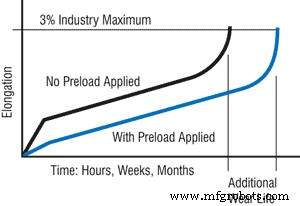
Figure 4. Preload chart.
Preload Application: After assembly, manufacturers apply a controlled preload—either statically or dynamically—to align pins, bushings, and link plates. This initial load simulates maximum operating conditions, eliminates the early elongation seen in lower‑quality chains, and extends usable service life. The preload chart illustrates how proper preload mitigates initial elongation and yields a steadier wear trajectory.
Cost Benefits: A high‑quality, meticulously fabricated and preloaded roller chain delivers superior performance, reduces downtime, and keeps long‑term costs low.
This article was provided by Diamond Chain Company. For more information, visit www.diamondchain.com or call 800‑872‑4246.
Equipment Maintenance and Repair
- Maximizing Chain Longevity: Expert Tips for Maintenance and Replacement
- How Digital Transformation is Reshaping Supply Chains: Lessons from COVID-19 and the Future
- 3 Proven Strategies to Extend Your CNC Machine’s Longevity
- How to Prolong Your Power Supply’s Lifespan: 6 Expert Tips
- 3 Proven Tips to Prolong the Life of Your Printed Circuit Boards
- Prolonging PCB Lifespan: Proven Strategies to Reduce Repairs
- Extend Your End Mill's Lifespan: Proven Strategies to Reduce Breakage and Save Costs
- The Shift Toward Smarter Supply Chains: Driving Efficiency and Innovation in Manufacturing
- Maximize the Longevity of Your Used Machinery: 5 Proven Maintenance Strategies
- Prolong the Life of Your Heavy Equipment Attachments: Proven Maintenance Tips