



Optimizing Bolt Tightening with Torque Tools – Proven Strategies for Reliable Preload
Below are expert guidelines designed to help you avoid common pitfalls when tightening bolted joints.
Choose the right tool: Always use a calibrated torque tool and ensure that the tightening specification includes a defined torque value. Automatic tools such as impact wrenches can introduce large variations in torque and preload, so reserve them for rough tightening only. Reserve a calibrated torque wrench for the final tightening or inspection step.
Specify the correct tightening torque: Whenever possible, base the torque value on experimental data rather than theory. Determine the appropriate torque by measuring bolt extension and strain with calibrated gauges, or by integrating a load cell into the joint. This approach guarantees that the specified torque delivers the intended preload.
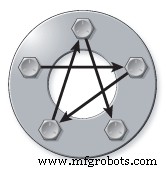
Figure 1. Criss‑cross tightening sequence.
Define a tightening sequence: Multi‑bolt joints and non‑flat mating surfaces mean that the order of tightening has a significant impact on preload distribution. Tightening one bolt next to another compresses the joint surface, altering the preload of the first bolt. A carefully planned sequence – such as a criss‑cross pattern for circular arrangements or a spiral that starts at the center for non‑circular layouts – ensures an even distribution of tension (see Figures 1 and 2). For critical joints, a double‑pass tightening pattern may be warranted to lock in the desired preload.
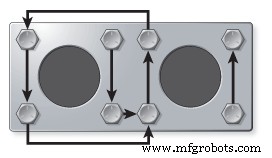
Figure 2. Spiral tightening sequence.
Beware of plain washers: A gap between the bolt shank and the washer hole allows lateral movement, which can shift the friction surface from the nut–washer interface to the washer–joint interface during tightening. This shift disrupts the torque‑tension relationship and can lead to significant preload variability. When plain washers are required – for slot covering or to reduce head‑surface pressure – select washers that are thick, hard, and a close fit to the bolt shank.
Use flange‑headed bolts when appropriate: On soft substrates or when high‑tensile bolts are employed, flange‑headed fasteners distribute the bearing load over a larger area, reducing local pressure and the loss of preload due to embedding. Note that the larger bearing face requires a higher tightening torque because more torque is consumed by friction.
Consider gasket behavior: Conventional, non‑elastic gaskets tend to compress and then relax, reducing bolt preload shortly after installation. Mitigate this by retightening after a suitable dwell period to re‑establish the desired preload.
Embedment concerns: Plastic deformation of threads and joint material—known as embedment—occurs under the high stresses of tightening. Typical preload loss due to embedment is about 10 %, and it increases with the number of clamped surfaces and their roughness. Excessive head‑surface pressure, often caused by high‑tensile fasteners in soft materials, can exacerbate embedment. Hardened washers or flanged fasteners help reduce this effect.
Short bolts used to clamp multiple interfaces should be approached with caution, as the limited bolt extension can be disproportionately lost to embedment.
This article was provided by Mountz Inc., a manufacturer of torque tools. For more information, visit www.etorque.com.
Equipment Maintenance and Repair
- Enhanced CNC Reliability: Modern Milling Tools Deliver Speed, Accuracy, and Lower Costs
- Boeing Saves Hundreds of Thousands by Tightening Torque Standards
- Eliminate Production Bottlenecks: 5 Proven Tools for Manufacturing Efficiency
- Smart Door Access System with Facial Recognition Unlocking
- Universal Robots Teams Up with Phillips Machine Tools India to Boost Manufacturing Productivity
- Mastering Miniature Slotting: Tips for Precision and Longevity
- SPRINT 20 Linear Lathe: Rapid, Automated Turning for High-Precision Parts
- Why a Premium Torque Limiter Is Worth the Investment: 3 Key Advantages
- Top Hardware Prototyping Tools for Startups: Build, Test, and Iterate Faster
- Top 10 Precision Components Crafted by CNC Machine Tools