



Wireless Technology Transforms Condition Monitoring for Industrial Reliability
For decades, condition monitoring has been pivotal in optimizing maintenance and production, preventing unplanned downtime and boosting overall productivity. Vibration analysis remains the most widely used metric because it directly reflects the state of rotating machinery and delivers actionable diagnostic insight.
Data collection traditionally relies on either portable hand‑held units for walk‑around programs or permanently installed online systems that automatically gather and store measurements. While the latter is commonplace in critical production equipment, several obstacles slow broader adoption:
- High installation costs, especially in hazardous zones.
- Lack of clear ROI for balance‑of‑plant machines.
- Impossibility of fixed cabling on mobile or traversing equipment.
Advantages of Wireless Technology
SKF has harnessed wireless connectivity to eliminate hardwired links and dramatically shorten sensor cable runs. The resulting benefits include lower installation costs, increased mobility, untethered operation, greater convenience, and higher reliability.
Challenges to Wireless Vibration Monitoring
Vibration monitoring imposes demanding requirements on wireless devices, networks, and associated components. High bandwidth is essential to transmit the sizable data sets; a wide dynamic range, low noise floor, and advanced on‑board processing are also critical. Battery‑powered units must deliver extended service life, while all equipment must withstand harsh industrial conditions—water ingress, high temperatures, electrical interference, hazardous‑area classification, and physical obstructions. Robust security protocols are non‑negotiable.
Current State of Wireless Technology
Multiple wireless standards exist, but Wi‑Fi 802.11 b/g remains the most suitable for condition‑monitoring applications. This same technology powers consumer laptops and office LANs, yet it also meets the high‑bandwidth demands of vibration data and offers proven network security, familiarity to IT teams, multi‑use capabilities, and cost efficiency. Power consumption is moderate; in typical deployments, batteries can last one to two years.
SKF Solution
The SKF Wireless Monitoring System is a compact, battery‑powered device that leverages Wi‑Fi. It captures up to four vibration channels, four 4‑20 mA process inputs, and a tachometer. The system can be scheduled to wake at fixed intervals or triggered remotely by a PLC. Standard accelerometers—including temperature‑compensated units—are used. The device records dynamic data (FFT or time‑domain) for diagnostics and stores the data locally. Analysis is performed in SKF @ptitude software, which also aggregates data from other SKF portable or online monitoring units.
Case Study: Avoiding Catastrophic Bearing Failure
In a paper mill, the SKF wireless system was deployed to monitor a triple‑ring bearing in the press section. Routine handheld checks had revealed damage on the inner‑inner ring raceway. With a scheduled stop only weeks away, the bearing’s remaining life was uncertain. A wireless unit (Figure 2) was installed to provide continuous 24‑hour monitoring and real‑time data display for operators.
Hourly monitoring exposed severe deterioration (Figure 3), prompting an immediate replacement rather than waiting for the scheduled stop. Subsequent inspection confirmed the bearing was beyond service life (Figure 4). The proactive action avoided extended downtime and prevented damage to the roll shell and hydraulic beam, saving an estimated several hundred thousand dollars.
Case Study: Innovative Solution to a Unique Problem
A major retail distribution center relied on a stacker crane—an automated track‑based robot—to move inventory. Track wear manifested as loud noises during operation. Because the crane moves along the track, fixed cabling was infeasible. SKF’s wireless system was mounted on the crane to collect vibration data as it traversed the track. The resulting spikes in the time signal (Figure 6) were correlated with crane position, pinpointing worn track sections (Figure 5).
Targeted repairs replaced a total track replacement, and follow‑up testing confirmed the effectiveness of the intervention.
Conclusion
Wi‑Fi 802.11 b/g offers a practical, cost‑effective solution for both technical and financial considerations, and its adoption is poised to accelerate. Wireless connectivity removes barriers—cost, practicality, and mobility—enabling more widespread use of condition monitoring. SKF remains committed to leading the way with innovative, reliable wireless monitoring solutions that deliver tangible benefits across new and legacy applications.
Wireless capabilities expanded for use in hazardous areas
SKF Multilog WMx is a compact, eight‑channel field‑mounted monitoring device that captures acceleration, velocity, temperature, and bearing‑condition data safely and accurately in hazardous environments.
This latest model is ATEX 2/IEC Zone 2 certified, allowing deployment in most hydrocarbon processing areas where non‑certified systems are prohibited. Battery‑powered operation is supported, and it is compatible with standard hazardous‑area sensors. The WMx also supports WEP, WPA, or WPA2 encryption for enhanced security.
Ideal for semi‑critical or balance‑of‑plant machines in hazardous zones, troubleshooting, and remote monitoring, the WMx offers a cost‑effective solution by accelerating deployment and eliminating expensive cabling.
By applying Wi‑Fi technology—commonly used for internet access—SKF has delivered a powerful new tool for condition monitoring, making the technology practical, affordable, and highly mobile.
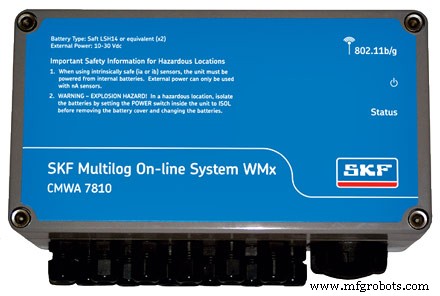
Figure 1. SKF Wireless Monitoring System – SKF Multilog WMx
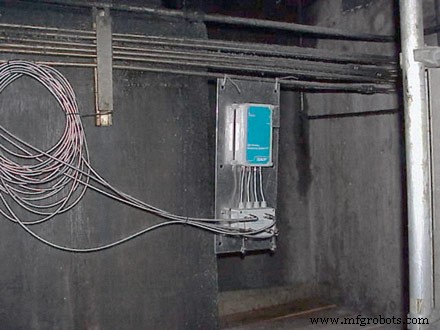
Figure 2. Temporary installation of wireless system for monitoring critical bearing
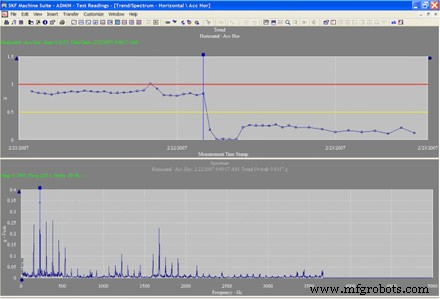
Figure 3. Condition monitoring results

Figure 4. Damaged bearing

Figure 5. Tracks for stacker crane
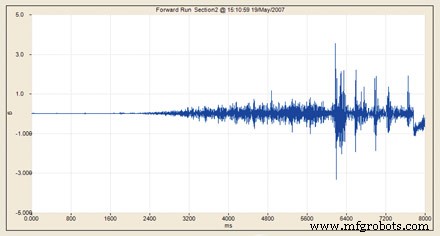
Figure 6. Time signal showing sections with high vibrations (damaged tracks)
Equipment Maintenance and Repair
- 2021 Industrial IoT Trends: Remote Monitoring, Predictive Maintenance, and Worker Safety
- Emerging Wireless Technologies of 2015: A Guide for M2M & IoT
- Global Condition Monitoring Market to Hit $3.9 B by 2025, Fueled by Predictive Maintenance
- Condition Monitoring: A Catalyst for Predictive Maintenance Success
- Wireless Condition Monitoring: Boost Production & Cut Downtime
- Mastering Multi-Technology Condition Monitoring for Large Mining Operations
- 5G Testing: A New Paradigm for Reliability and Performance
- B&R Showcases Advanced Mobile Automation Condition Monitoring at Agritechnica
- Proactive Condition Monitoring for Industrial Equipment: Prevent Downtime & Boost Efficiency
- Advanced Machine Condition Monitoring: Boosting Health & OEE