



Why Dowel Pins Aren’t the Best Choice for Machine Foot Positioning – Alternatives and Practical Solutions
The concept of dowel‑pinning machinery originated in the U.S. Navy over a century ago. It was created to counter the extreme stresses that rotating equipment on ships and submarines endured from hull deflection, temperature swings, storms, and the forces generated by firing shells or depth charges. The central concern was positional security.
Because adding weight to a vessel is costly, Navy engineers devised a base that was only three to five times the machinery’s mass, producing lighter, more flexible foundations. This trade‑off made dowel‑pinning a practical solution, and the practice spread across the Navy.
After WWII, many U.S. industrial maintenance crews were veterans trained in naval practices. The habit of indiscriminately dowel‑pinning all rotating machinery was carried over to land‑based plants, even though the technical justification had largely vanished.
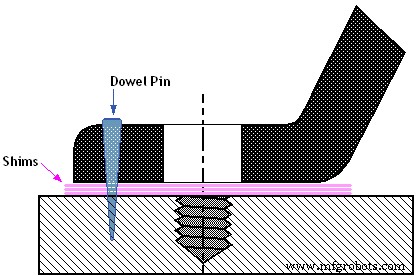
Positional security: Technical considerations
Modern design assumes that a properly engineered base, correctly sized anchor bolts or studs, and appropriate torque will keep a machine in place under all expected loads. When these conditions are met, additional dowel pins are unnecessary, especially for vertical forces. Horizontal movements are normal and are handled by the mounting system and the flexibility of couplings.
The remaining concern is horizontal stability. Dowel pins, however, are ill‑suited for this purpose for several reasons, the first being the physics of the mechanism itself.
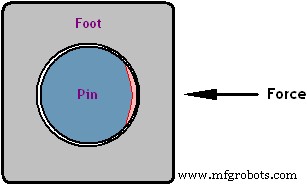
A lateral force concentrates on a single point of contact between the tapered pin and the anchor hole. Because a smaller circle inside a larger one touches at only one point, the pin offers little resistance and will compress. This distortion turns the pin elliptical, increasing the contact area until the pin’s strength is exceeded, after which it bends.
This behavior can be demonstrated by attaching a dial indicator to one side of a dowel‑pinned foot and applying a lateral load with a jackscrew. The indicator will register 0.010–0.015 inches of free movement, proving that the pin cannot restrain lateral motion. Such failure disqualifies the dowel pin as a positional security device.
If the applied forces exceed the pin’s capacity, the initial crushing will be followed by bending of the entire pin.
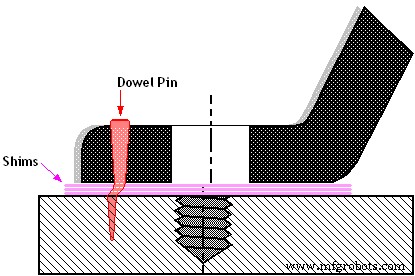
The distortion is exacerbated because the pin is supported only by interference fits at the foot and base; between these points, there is no support, so the pin can adopt an S‑shaped or dog‑legged configuration that is difficult to remove and complicates millwright work.
Positional security: Alternative solutions
When a machine truly requires extra horizontal restraint, the best approach is to use well‑designed horizontal and axial jackscrews that are snug against the machine feet. Care must be taken to avoid over‑constraint; any positional change under load can cause buckling or twisting, creating more problems than the uncontrolled movement they replace.
Installing dowel pins at multiple points would similarly over‑constrain the system. Flexibility in couplings and in the machinery itself permits the normal thermal and load‑induced movements that occur between cold and hot operating conditions. By intentionally misaligning the machine during the cold, stopped state, designers can accommodate the expected shift when the machine is running.
Additional considerations: Positional repeatability
If the goal is repeatability rather than security, dowel pins are also unsuitable. After a satisfactory final alignment, it is preferable to tack‑weld two small key‑stock pieces to diagonally opposed corners of the machine. This provides a reliable reference that will return the machine to its original position after removal. Dowel pins rarely reproduce their exact fit, leading to skew and the temptation to drill new holes or crudely modify the pin, practices that compromise quality.
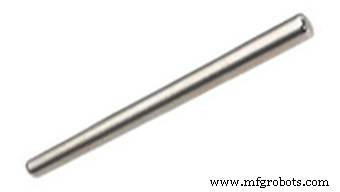
Conclusions
Considering the points above, dowel pins should not be used to guarantee positional security or repeatability of rotating machinery. More effective alternatives—such as properly torqued anchor bolts, jackscrews, and tack‑welding—offer reliable performance.
About the author: Alan Luedeking is the manager of alignment technical support and training for Ludeca Inc. He can be reached at 305-591-8935 or alan.luedeking@ludeca.com. For more information on Ludeca, visit www.ludeca.com.
Equipment Maintenance and Repair
- Materials That Make Up Dowel Pins: Wood, Metal, and Plastic Explained
- The Rolling Pin: From Etruscan Origins to Modern Craftsmanship
- The Evolution and Craftsmanship of Modern Bowling Pins
- From Ancient Fibulae to Modern Manufacturing: The Safety Pin Explained
- Understanding Machinery Vibration: Causes, Symptoms, and Rapid Diagnosis with the Fluke 810
- The Evolution of CNC Machinery: A Milestone in Manufacturing
- Ensuring Drive and Machine Safety: Engineering Controls & Protective Measures
- Maximize Your Profit: Setting the Best Price for Used Machinery
- Shipping Heavy Machinery Internationally: Tips for a Smooth Process
- Top 3 Benefits of Buying Used Machinery for Your Shop