



From Ancient Fibulae to Modern Manufacturing: The Safety Pin Explained
Background
The modern safety pin—an elegant coiled steel wire sharpened at one end and fitted with a catch plate—originated in New York City around 1825.
Inventor Walter Hunt, indebted to a $15 loan, engineered the first “safe pin” to secure clothing while protecting the wearer’s fingers. He patented the design in 1849 and sold it for $400. Although the basic concept has remained unchanged, advances in steel metallurgy and automated manufacturing have refined its production.
In 1864, E.J. Manville introduced the first automatic four‑slide machine, a direct ancestor of the high‑speed production lines used today.
Despite its modern appearance, the safety pin’s ancestry stretches back to antiquity. Coiled bronze pins, often gilded, have been unearthed in Egyptian tombs. The Greeks and Romans called them fibulae (Latin for brooch) and employed them both for fastening garments and as ornamental jewelry.
Dating from the 7th century B.C., elaborately decorated fibulae featured lions, sphinxes, and other motifs. An Iranian pin from the same era resembled a human hand with two lions positioned head‑to‑tail, while an Etruscan fibula from the 8th century displayed ducks. As the Roman Empire expanded, the fibula spread throughout the ancient world.
During the Middle Ages the design reverted to a simple straight pin. Commoners used wooden skewers, whereas the affluent fashioned pins from bone, ivory, silver, gold, or brass. By the 15th century, drawn‑wire production—still the foundation of modern safety pins—emerged.
Today, the retail sewing notions market is the largest consumer of safety pins, while the laundry and cleaning industry dominates commercial usage.
Raw Materials
The most common metals used in safety pins are spring steel, brass, and stainless steel.
Spring steel—an alloy of iron with a high carbon content (exceeding 0.5%)—provides the tensile strength and resilience needed for frequent flexing and returning to its original shape.
Brass is an alloy of approximately two‑thirds copper and one‑third zinc. Though pricier than spring steel, brass offers a high luster, is nonmagnetic, and can be easily shaped; its strength is adequate for most safety pin applications.
Stainless steel contains chromium and nickel (or manganese as a substitute). With a mirror‑like finish, it resists corrosion, withstands high temperatures, and delivers superior strength. In some cases, low‑carbon ferritic stainless steel—cheaper than full stainless—serves as a cost‑effective alternative.
Other raw materials include coatings and platings. The most frequent finish on spring‑steel pins is chrome, followed by a final wax coat. For pins destined for damp environments, chromate treatments are applied to prevent corrosion. Brass pins often receive nickel coatings, while gilding—a tumbling process that removes the top brass layer—creates a bright, gold‑like surface.
The Manufacturing Process
Modern safety pin production is fully automated. Specialized machines perform multiple steps, eliminating the need for manual labor and boosting efficiency. A single factory can produce over 3 million pins per day—roughly 1 billion annually. While only two U.S. companies manufacture safety pins, dozens operate worldwide.
Making the Wire
- Steel wire is refined from pig iron, an early stage of iron production. The ore still contains impurities, including carbon, which makes iron brittle. In a converter—a high‑temperature furnace—oxygen is pumped into molten pig iron to oxidize the carbon. The resulting molten steel is cast into slabs via continuous casting, poured into molds, and rapidly cooled by water jets. Straightening rollers form the mass into a billet. The billet is pickled in acid to remove oxide scale, passed through rollers, heat‑treated, and slowly cooled (annealing). The cold metal is then drawn through progressively smaller dies to achieve the desired gauge, with periodic annealing to maintain ductility.
Cutting the Wire
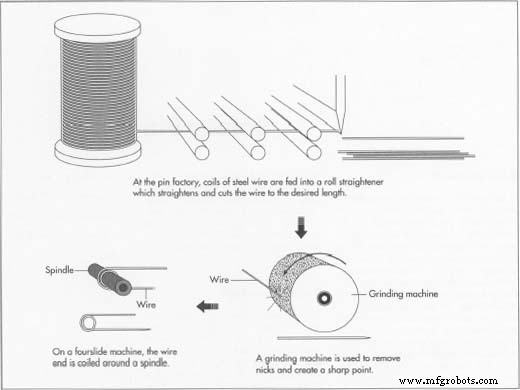
- Coils of high‑carbon spring‑steel wire are loaded onto spools and fed into a roll straightener. The machine both straightens and cuts the wire to lengths ranging from one inch to a foot, accommodating various diameters.
Forming
- Cut wire segments are conveyed to grinding machines where one end is sharpened to a point and burrs are removed.
- In the four‑slide machine, wire segments are fed onto a chain and coiled around a spindle. The unsharpened end is bent into a hook to receive the cap.
- Simultaneously, steel sheets are fed into the machine from the opposite side. They are stamped into two‑dimensional shapes that will become the doughnut‑shaped cap.
- Stamping transforms the flat pieces into three‑dimensional caps.
- The sharpened, hooked wire aligns with the cap; the cap is then crimped over the hooked end, completing the pin.
- For pins sold ready to use, a mechanical device opens the pins, a process that requires smaller batch handling to prevent tangling.
Finishing and Packaging
- Finished pins are loaded into perforated plastic baskets. If plating is required, steel pins receive chrome plating while brass pins receive nickel plating. In electroplating, pins are submerged in a chemically charged tank; the solution deposits a uniform metal layer.
- After plating, pins are rinsed, then placed in a chemical bath for final polishing.
- They are washed in detergent, given a wax finish, and inspected.
- Completed pins are packaged: industrial packs typically contain 10 gross per box, while consumer products appear in retail polybags or blister packs.
The Future
Although modern fasteners such as Velcro were introduced in the 20th century, the safety pin remains indispensable. Its simplicity, reliability, and low cost ensure its continued relevance for the next century. In many developing regions—India, for instance—safety pins and sewing needles are treasured heirlooms passed down through generations, underscoring the enduring value of this humble fastener.
Manufacturing process
- The Rolling Pin: From Etruscan Origins to Modern Craftsmanship
- Steel Wool: History, Production, and Safety Insights
- The Evolution and Technology of Safety Razors
- Steel Pipe: Types, History, and Modern Manufacturing
- The Evolution and Craftsmanship of Modern Bowling Pins
- The Craft of Scissors: From Ancient Spring Blades to Modern Precision Tools
- The Evolution of Bathtubs: From Ancient Baths to Modern Manufacturing
- Zinc: Properties, Applications, and Production Process
- Stainless Steel: Properties, Manufacturing, and Future Applications
- DIY Arduino Snowflake: 30‑LED LED Display Project