



Who Owns Maintenance? How TPM Engages Every Employee
When a machine starts making an unusual noise, the first call often goes to the maintenance team. But how does that call travel from a line operator to a maintenance crew? What process ensures a timely response? The answer lies in shared responsibility.
The maintenance team can’t be everywhere at once, waiting for a breakdown to happen. That’s why many organizations have adopted Total Productive Maintenance (TPM)—a philosophy that places preventive and proactive maintenance in the hands of everyone who works with equipment.
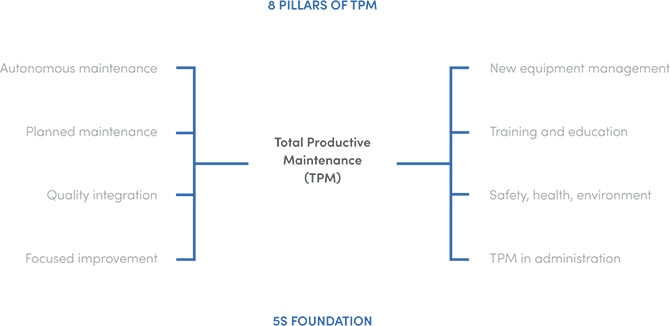
TPM was pioneered by Toyota and has since become a cornerstone of lean manufacturing. It combines a 5S foundation with eight supporting pillars, visualized here:
Using a CMMS to Drive TPM
The first step toward TPM is ensuring every employee can access and contribute to your computerized maintenance management system (CMMS). Even if your maintenance team is small, operators, engineers, and safety personnel should all be able to view equipment status, log issues, and schedule preventive tasks.
Four Critical Roles That Should Have CMMS Access
Operations
Plant managers, line supervisors, and machine operators interact with equipment daily and know what “normal” looks like. In a TPM framework, operators become the first line of defense, handling cleaning, inspection, and basic maintenance.
Key benefits include:
- Greater ownership of equipment.
- Deeper equipment knowledge.
- Consistent cleaning and lubrication.
- Early detection of potential failures.
- Reduced workload for maintenance staff.
With CMMS access, operators can view machine status, create to‑do lists, and complete daily preventive maintenance tasks, freeing up skilled technicians for more complex work.
Tool Crib Operators / Inventory Managers
Managing rotating inventory is critical for smooth operations. Most CMMS platforms include built‑in inventory or rotating asset modules, eliminating the need for a separate, costly system.
Health and Safety
Safety is a core TPM pillar. A CMMS can track the location and condition of safety equipment and schedule inspection rounds, ensuring a safer workplace.
Reliability Engineers
Reliability engineers sift through the data collected by everyone in the organization. By analyzing maintenance metrics, they uncover trends, predict failures, and translate raw data into actionable business insights.
Other roles—such as quality, logistics, and procurement—can also benefit from CMMS access, depending on your industry and business model.
In short:
- Shared maintenance responsibility eases pressure on the maintenance team and frees them for high‑skill tasks.
- Capturing data from across the organization gives you a complete, real‑time view of facility performance, driving efficiency and productivity.
For a comprehensive breakdown of TPM, visit: www.leanproduction.com/tpm.html
Equipment Maintenance and Repair
- Eliminate Unplanned Maintenance: How a CMMS Provides the Solution
- Transforming Preventive Maintenance: Proven Tactics for Reliable Asset Management
- Essential CMMS Project Planning: Expert Tips for ROI and Efficiency
- How Well Your Preventive Maintenance Tasks Support Your Asset Care Strategy
- Who Should Own Lubrication: Choosing the Right Team for Peak Plant Reliability
- Unlock CMMS Potential: Systematic Follow‑Up Drives Efficiency
- 20 Proven Benefits of a CMMS: Boost Efficiency, Cut Costs, and Enhance Safety
- Why CMMS Training Is Crucial for Successful Implementation
- Paper vs CMMS: How Modern Maintenance Software Drives Efficiency
- Master Your CMMS Trial: 5 Expert Tips for a Seamless Evaluation