



Why Lockout/Tagout Procedures Are Crucial for Maintenance Safety
In 2011, two maintenance engineers in Arizona were completing repairs inside an 8‑ft‑diameter pipeline that carried hot oil from a pumping station to a secondary processing facility a mile away.
The technicians had correctly isolated the pipeline valves and pumping station. However, two supervisors bypassed the lockout/tagout (LO/TO) protocol to inspect the job. While the supervisors remained inside the pipeline, control room operators inadvertently released the valves, resulting in a fatal accident. This tragedy underscores the deadly consequences of neglecting LO/TO procedures.
In the U.S., preventable workplace accidents involving uncontrolled energy sources cause about 50,000 injuries and 120 deaths annually.1
What Is Lockout/Tagout?
Lockout/Tagout is a systematic approach to securing equipment or an area before maintenance to prevent accidental release or operation of hazardous energy. According to OSHA, “Lockout/Tagout is a complete program used to control hazardous energy during the servicing or maintenance of equipment, when the start‑up of the equipment or the release of stored energy could cause injury to employees.”2
The program is built on four core elements:
- Energy‑control procedures – standardized methods and detailed documentation
- Employee training – ensuring all staff are current, especially with turnover or new machinery
- Tags and lockout devices – visual and physical barriers that prevent unintended activation
- Inspection – regular reviews to verify procedures and training remain effective
Watch the OSHA video on LO/TO here: OSHA Video.
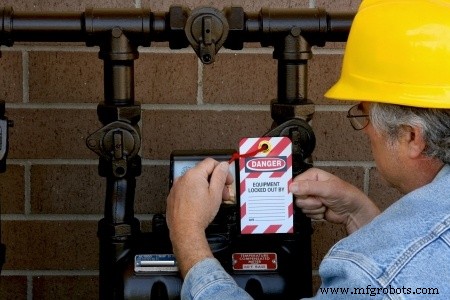
Sample LO/TO Procedure:
Why Integrate LO/TO into Your CMMS?
Incorporating lockout/tagout into your Computerized Maintenance Management System (CMMS) delivers several key benefits:
- Eliminates duplicate data entry across separate systems.
- Reduces training overhead—one integrated platform for both maintenance and safety.
- Provides a unified view—LO/TO records can be cross‑referenced with related maintenance tasks, offering a comprehensive audit trail.
- Elevates safety focus—by embedding LO/TO steps within the maintenance workflow, safety becomes an integral part of the repair process rather than an afterthought.
How Fiix Supports LO/TO Integration
Fiix offers three practical methods to weave LO/TO procedures into your maintenance operations:
- Attach the LO/TO procedure to a task list. Adding it to a work order requires only three clicks.
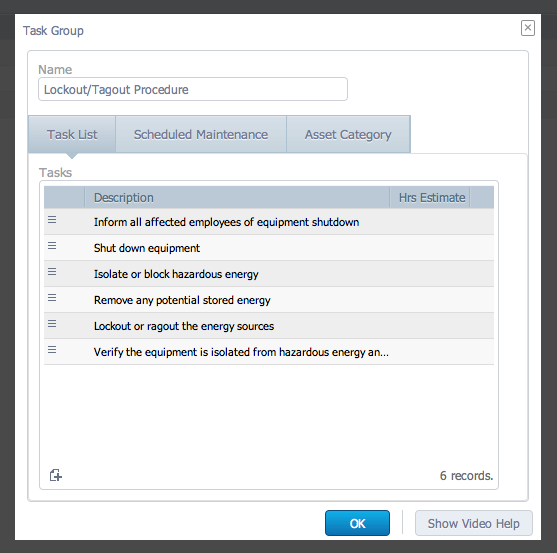
- Include the task list in a scheduled maintenance plan, ensuring the LO/TO steps appear automatically whenever a preventive maintenance job is triggered for that asset. You can also bind the task list to an asset category (e.g., HVAC) so every work order for that category includes the LO/TO steps.
- For complex procedures that don’t fit neatly into a task list, upload the LO/TO document directly to the asset record. The file can be accessed anytime from the asset’s detail page.
Learn more about OSHA’s guidance: Lockout/Tagout Factsheet and OSHA Publication 3120.
Equipment Maintenance and Repair
- Why Facility Management Drives Industrial Success
- Why Ground Testing Is Essential for Electrical Safety and Reliability
- Maximize Efficiency: The Critical Role of Routine CNC Machine Maintenance
- Why Proactive Equipment Maintenance Drives Manufacturing Efficiency & Cost Savings
- Mandatory Routine Maintenance: Boosting Equipment Safety and Longevity
- Why Regular Maintenance Is Critical for Construction Equipment Reliability
- Why Routine Hydraulic Hose Maintenance Keeps Your Equipment Running Smoothly
- Why Maintenance Management Matters: Key Benefits and Essential Practices
- Why Aircraft Maintenance Is Critical for Airlines: Key Benefits & Safety Impact
- Preventive Maintenance: The Key to Reliability and Longevity of Your Diesel Truck