



Monoblock Cutting Tool: Versatile Precision for Advanced Milling Applications
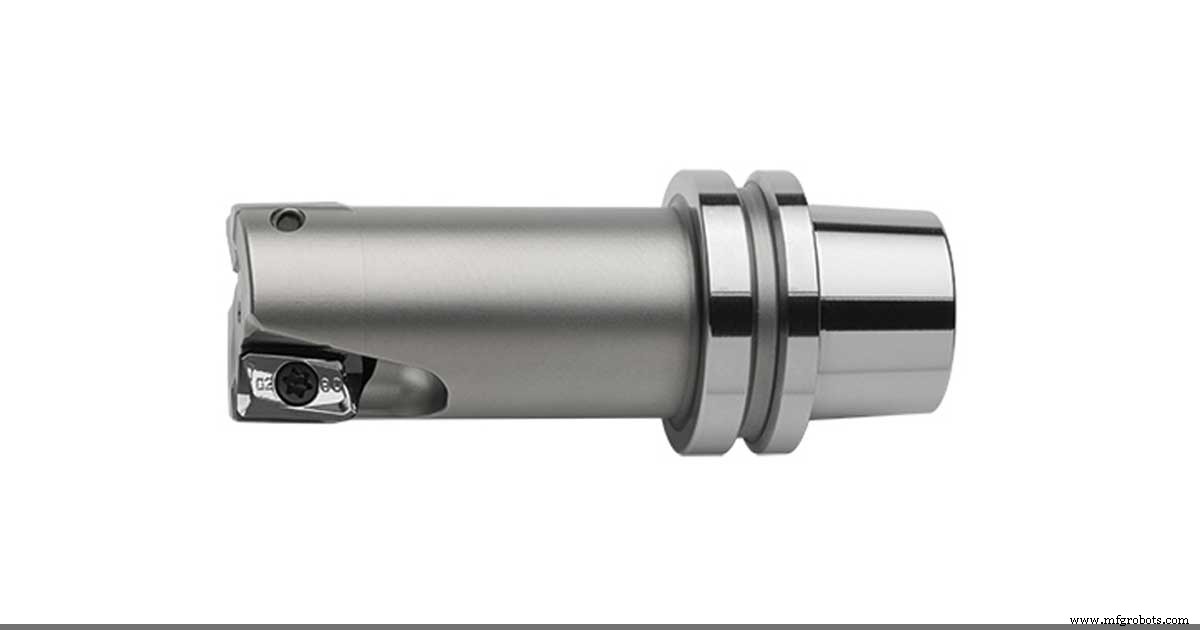
If you ask any DATRON application technician what their favorite cutting tool is, there’s a high probability that you’ll get this answer: The Monoblock Cutting Tool (aka. the Monoblock).
In our world of high RPM spindles, the Monoblock cutting tool is King. Co-Developed with industry leaders Big-Kaiser, the Monoblock is a 20mm, double-flute, indexable insert cutter, and is a tool of many talents.
What Sets the Monoblock Cutting Tool Apart?
1. Rigid design – The Monoblock cutting tool is different from our standard tooling in that there is no shank to clamp on – the tool and tool holder are one. By integrating the HSK-E25 taper into the tool itself, a very robust tool is provided.
2. Vibration free – Not only is it tough, but this clever design also allows for extremely minimal vibration, even at its recommended limit of 36,000 RPM! This allows for very smooth operation even under heavy load.
3. Clever cutter geometry – The cutting inserts have been engineered to provide a perfect all-around performer. A large edge radius and wiper flat provide excellent floor finish, while high radial and axial rake angles allow for lower cutting resistance for more efficient roughing.
4. Cost efficiency – The inserts for the Monoblock cutting tool come in two varieties – polished carbide for milling of plastics or non-ferrous metals, as well as specially treated inserts for milling of steel. Either way, the inserts are engineered to last, and can even be flipped 180 degrees for an entire second round of punishment. Once the inserts are depleted, simply replace them both and carry on.
What Can You Do With The Monoblock Cutting Tool?
Face milling – Combining three excellent characteristics: edge radius, wiper flat, and vibration free operation, results in some of the smoothest possible floor finishes.
Ramp/Helix milling – While the Monoblock isn’t center cutting (no straight plunging) you can accommodate a 3-5 degree ramp angle. Pair this with the high feed/speed capabilities of the DATRON and you can make quick work of most features.
Roughing – The previously mentioned cutter geometry allows for very aggressive depths of cut at very high feed rates, as can be seen clearly in one of our well-known demonstration videos. In this instance, a very heavy stepover was utilized (80% of tool diameter) with a smaller depth of cut (around 8% of tool diameter). You can also choose to utilize the entire 10mm of cutting flute to boost efficiency as seen in my Instagram post.
3D contouring – Since the edge radius on the Monoblock cutting tool is rather sizable (0.8mm) it can serve as a bull-nose cutter for doing some large scale 3D contours – and since the tool is rock-steady, the surface finish comes out gorgeous.
So, there you have it. Now you can understand why the Monoblock cutting tool is the King in the house of DATRON.
CNC Machine
- Choosing the Best Sheet Metal Cutting Tool: CNC Shears, Plasma, Waterjet, and Fiber Laser Options
- Beyond Trial and Error: A Proven Guide to Effective Maintenance Troubleshooting
- Master Acrylic Milling: 4 Proven Techniques to Reduce Chipping, Melting, and Bird Nesting
- Mastering CNC Turning Parameters for Precision Machining
- Maximize Productivity: Expert Guide to Selecting the Ideal Metal Cutting Tool
- Master Titanium Machining: Selecting the Best Milling Tools for Superalloys
- Beyond Metal: Advancing Production with Innovative Nonmetallic Materials
- Beyond Fundamentals: Mastering Advanced Hydraulics
- Dynamic Milling Toolpaths Propel Custom Part Growth for Soft‑Gel Contract Manufacturers
- Choosing the Optimal Tool Path Mode for CNC Milling: A Practical Guide