



Designing Clear Parts: Materials, Techniques, and Finishing for Transparent and Translucent Components
Clear parts and prototypes have a huge variety of applications. Fortunately, they’re also fairly easy to make, with a wide range of materials and prototyping technologies at your disposal.
This article goes over the basics of transparent and translucent parts: why you might need them, what materials you can use, which manufacturing technologies are available, and other considerations like polishing and tinting your clear parts.
Why use transparent and translucent parts?
Product designers can desire clear parts for any number of reasons. Look around you and you’ll probably see at least one transparent or translucent manmade object, be that a glass window, a see-through container, a plastic tumbler, or a piece of food packaging.
In general, however, there are three (sometimes overlapping) reasons for making clear parts, and we’ll explain them here.
Remember that transparency means fully clear, so that one can see exactly what is behind the material, while translucency means partially clear, so that one can see light coming through the material or a blurred representation of what is behind the material.
- Visibility: Firstly, there are those parts which are designed to be clear so that humans can see through them for functional reasons. These include things like windows, spectacles, food containers, ID card holders, and plastic boxes for office stationery. Parts of this category are typically fully transparent: they are designed so humans can see exactly what is behind the clear material.
- Light: Secondly, we have the category of parts that need to clear for functional reasons not related to human sight. These include any objects where light must pass through the clear material for a mechanical or practical purpose. Examples include solar panel windows, greenhouses, and terrariums. Items like flashlight and headlamp covers, although related to human sight, may also be considered here, since the purpose of the transparent plastic section is to let light out, not to reveal what is inside the part.
- Aesthetics: Thirdly, there are transparent or translucent parts whose clarity is purely for aesthetic reasons. Humans may look through the part or see light coming from behind it, but this serves no practical purpose. Such clear parts include clear video game and computer hardware, toys, plastic wristwatches, acrylic musical instruments, designer bags, and some tool/utensil handles.
What materials are available?
Several materials can be used to make transparent or translucent parts. These vary by the manufacturing process used.
|
Process |
Material |
Pros |
Cons |
|
SLA |
Clear resin |
|
|
|
CNC machining |
PMMA |
|
Brittle compared to PC |
|
PC |
|
|
|
|
ABS |
|
Harder to color than PC |
|
|
Injection molding |
PMMA |
|
|
|
PC |
|
|
|
|
ABS |
|
Harder to color than PC |
|
|
Urethane casting |
PX520 (PC-like) |
Higher impact resistance |
Inferior to true PC |
|
PX521 (PMMA-like) |
Higher level of clarity |
Inferior to true PMMA |
How to make transparent and translucent parts
There are four main techniques for making transparent and translucent plastic parts, all of which are offered by 3ERP. Each method has its own set of advantages and disadvantages, though CNC machining and rapid tooling / injection molding are generally better for end-use parts.
SLA
Stereolithography (SLA) is a 3D printing process that uses a focused laser to solidify layer of UV-curable resin. It is one of the fastest and most cost-efficient ways to make transparent parts, especially complex parts with undercuts.
Advantages:
- Very fast
- Cost-efficient
- Supports complex geometries
- High resolution
Disadvantages:
- Produces weak and brittle parts
- Support structures must be removed after printing
- Materials limited to brand-specific resin formulations
- Not practical or affordable for orders of multiple units
Urethane casting
Urethane casting, a process for making urethane parts using temporary silicone molds, is the best way to create 10–20 copies of a clear part, no matter its level of complexity. Like SLA, it does not produce strong parts, but it does produce excellent surface finishes.
Advantages:
- Cost-efficient
- Very easy to tint
- Simulate 2K molding
- Good appearance
Disadvantages:
- Transparency is not 100%
- Produces weak and brittle parts
- Molds only last about 20 shots
CNC machining
CNC machining, a subtractive manufacturing process in which material is selectively removed from a blank, is the only way to achieve a prototype with perfect transparency, and it can also be used to make milky translucent parts from materials like DF23. CNC machining also produces super fine details if small cutters (R0.1mm, R0.05mm etc.) are used.
Learn more about acrylic machining.
Advantages:
- High quality
- High level of clarity
- Several material options
Disadvantages:
- Costly in large quantities
- Less geometrical freedom than SLA
Injection molding
Injection molding, the process of injecting molten resin into a metal mold, is suitable for certain clear parts. Rapid tooling — making a low-cost aluminum mold — is suitable for 100+ parts, while production tooling is best when 10,000+ clear parts are required.
Advantages:
- High quality
- Cost-efficient in large quantities
- Wide range of materials
Disadvantages:
- Not suitable for low-volume (1–100) orders
- Some geometrical restrictions
Other methods
Laser cutting or water jet cutting allows us to make parts with simple geometry. With either of these methods, we can make parts from sheets of clear material which might be too expensive for CNC machining or urethane casting, or which aren’t mechanically suitable for injection molding.
Learn more about how to cut acrylic and PC sheets.
How to polish and add color to clear parts
Polish
When making clear parts, post-processing is necessary to achieve the required level of transparency. In general, polishing after manufacture is the best way to make SLA and CNC parts fully transparent.
For CNC machined materials, especially PMMA, polishing can greatly increase clarity, partly because acrylic is highly resistant to the small scratches that can otherwise be caused by polishing equipment. Polishing approaches include buffing, flame polishing (for standard / non-critical parts), and optical machining. PC is more vulnerable to scratches, so vapor polishing is used to increase clarity.
Polishing also improves the clarity of SLA parts. For these 3D printed clear parts, a three-part process of wet sanding, cork board cleaning, and polishing with a microfiber cloth can produce good results.
Color
In addition to polishing, we can introduce color to clear parts, usually for aesthetic reasons. With injection molded or urethane cast parts, we can facilitate self-texture and self-color during the molding stage by adding colorants and other additives. Alternatively (or additionally), we can add tints or coatings of paint after the molding process, which makes it possible to have two colors on the final part.
For CNC machined clear parts, we can use techniques like sandblasting, tinting, or texture painting to adjust the appearance. An excellent aspect can be achieved on many clear parts using a tinting process. Possible colors include red, yellow, blue, and orange. (Some colors like, gray, are harder to control.) Painting is another simple option, but it can produce issues such as orange peel: an undesirable bumpy surface texture.
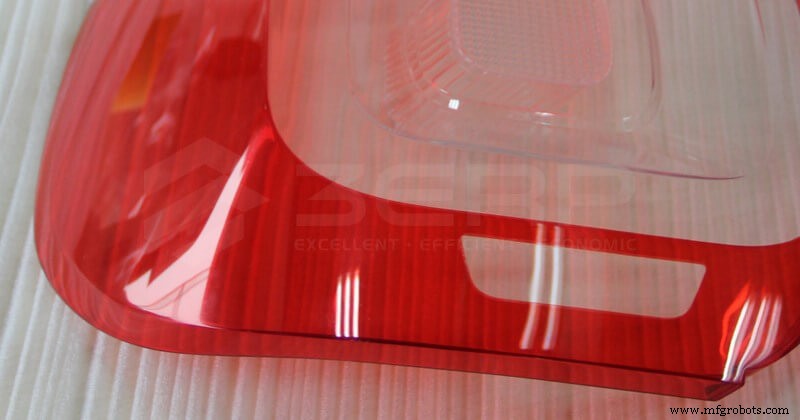 Learn more about how we tint PMMA and PC parts.
CNC Machine
- Designing Transparent Plastic Components for Optimal Performance
- Achieving Precision in Parts and Mold Cavities: A Practical Guide
- Achieving Tight Tolerances in CNC Machining: A 10-Year Proven Process
- How Grain Size and Orientation Affect Sheet Metal Performance
- Galvanization Explained: How Zinc Coatings Extend the Life of Metal Parts
- Custom Metal Parts Production: Expert Guide to Fabrication and Manufacturing
- Expert Guide to Creating ABS Juice, Glue, and Slurry
- DIY 12‑Volt Battery: Simple, Reliable Guide for Electronics Enthusiasts
- Elevate Your Ride: CNC Motorcycle Parts for a Cooler, Custom Look
- Expert Clear Plastic Injection-Molded Parts: Precision & Clarity