



Eliminate PVC Edge Banding Defects with Expert Machine Optimization
When operating an edge bander, two of the most common quality issues—peeling edges and thick glue lines—can quickly undermine the integrity of finished products. These defects typically arise when machine settings are out of sync with the adhesive’s characteristics. This guide explains five frequent glue problems, compares EVA and PUR adhesives, and provides actionable machine‑tuning solutions to restore flawless edge banding.
1. EVA vs. PUR Edge‑Banding Glue
Hot‑melt adhesives are the backbone of PVC edge banding. EVA (ethylene‑vinyl acetate) and PUR (polyurethane) are the industry’s most widely used options.

Below is a concise comparison of key attributes:
FeatureEVA GluePUR GlueWhich is betterBond StrengthGoodVery strongPURHeat ResistanceMediumHighPURMoisture ResistanceMediumHighPURGlue Line VisibilityMore visibleMinimal(Zero‑glue‑line)PURCostLowerHigherEVARepairabilityPhysical cooling; can be remeltedChemical curing; irreversibleEVAMachine RequirementStandard machinesPUR edge banderEVAApplicationStandard furniture (cabinets, wardrobes), mass productionHigh‑end furniture (kitchens, bathrooms), humid/hot climatesDepends on use case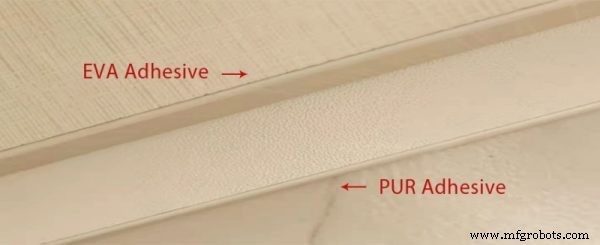
2. Five Common Glue Problems & Machine Solutions
Peeling edges, visible glue lines, weak bonds, heat‑induced delamination, and moisture damage are all symptoms of improper machine settings or adhesive choice. The following sections break down each issue, its root cause, and how to correct it through precise machine adjustments.
2.1 Edge Banding Peeling Off
Why it Happens: A weak adhesive bond caused by insufficient temperature or contaminated panels.
Machine Fixes:
- Stabilize Glue Pot Temperature: Keep EVA at 170–200 °C or PUR at 110–130 °C. Consistent heat ensures smooth flow and even spread.
- Clean Panel Edges: Use dust blowers or a pre‑milling cutter to expose a flat, dust‑free surface. Residual dust or moisture weakens adhesion.
- Control Panel Moisture: Activate the pre‑heating unit to dry surface moisture before gluing.
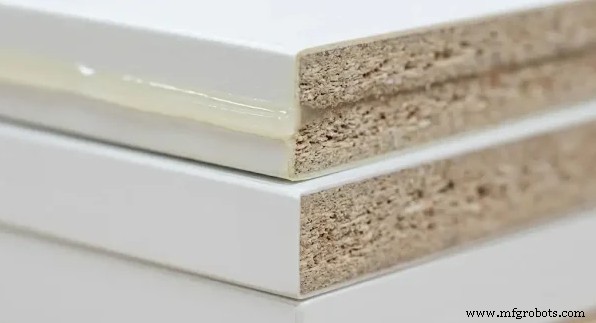
2.2 Visible Glue Lines
Why it Happens: Over‑application or uneven roller pressure, especially noticeable on light‑colored or high‑gloss panels.
Machine Fixes:
- Reduce Glue Thickness: Target 80–120 g/m² for EVA or 60–90 g/m² for PUR. Adequate coverage without excess prevents skinning and waste.
- Adjust Roller Pressure: Calibrate to 4–6 bar (EVA) or 5–7 bar (PUR) to remove surplus adhesive while maintaining full contact.
- Focus on High‑Visibility Panels: Apply extra scrutiny to light boards where glue lines stand out.
2.3 Poor Bond Strength & Pre‑Curing
Why it Happens: Slow feeding speeds allow hot‑melt glue to cool and harden before contact.
Machine Fixes:
- Increase Conveyor Speed: Run at 12–23 m/min to keep glue in its optimal tacky window.
- Match Ambient Temperature: Align conveyor speed with workshop conditions to prevent premature curing.
2.4 Edge Delamination in Hot Weather
Why EVA Fails: Elevated temperatures soften EVA, reducing bond strength and causing PVC edges to lift.
Machine Fixes:
- Switch to PUR Glue: PUR’s cross‑linked chemistry withstands high summer temperatures.
- Use a Sealed Melt System: Specialized PUR edge banders prevent air‑moisture interaction before application.
2.5 Water Damage & Swelling Around Edges
Why It Happens: Thick or porous glue layers allow moisture to penetrate the wood, causing swelling.
Machine Fixes:
- Use PUR for Kitchens & Bathrooms: PUR’s waterproof barrier blocks moisture ingress.
- Activate Pre‑Heater: Dry the board surface before gluing for a stronger bond.
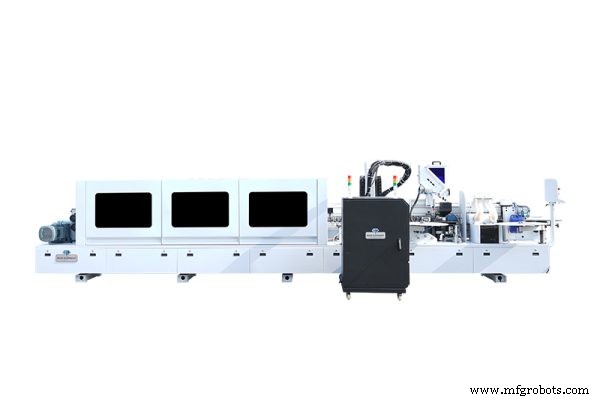
- Upgrade to Dual‑Glue‑Pot System: Machines like the E‑70JDSR Automatic PUR Edgebander let you switch between EVA and PUR on demand.
3. Quick Reference: Parameter Table & FAQs
3.1 Recommended Machine Settings
Optimal values vary by machine, panel type, and production goals. Use the table below as a baseline.
Machine SettingFunctionEVA ReferencePUR ReferenceOperator TipGlue Pot TemperatureControls glue flow170–200°C110–130°C (pre‑melt)Keep the temperature stable; large fluctuations degrade bond quality.Glue ApplicationControls coverage and thickness80–120 g/m²60–90 g/m²PUR usually requires a thinner layer for cleaner edges.Pressure Roller PressureEnsures contact4–6 bar5–7 barIncrease pressure for thick PVC or high‑gloss panels.Feeding SpeedControls bonding window12–23 m/min10–23 m/minMatch speed with adhesive, panel material, and edge thickness.3.2 FAQ
Q1. How do I adjust the glue roller gap?
Start with the machine’s standard gap, then incrementally tweak it until you achieve full edge coverage without excess squeeze‑out.
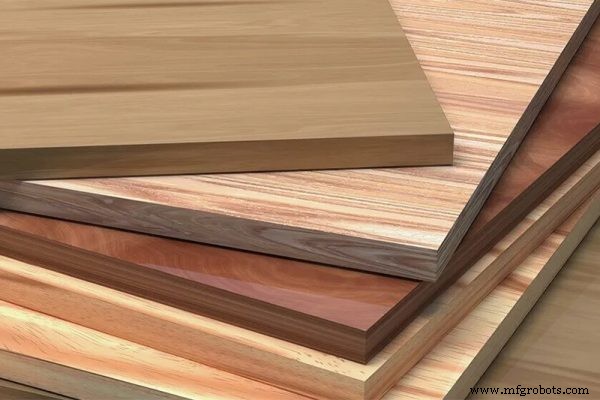
Q2. Which glue suits MDF, PET, or acrylic edges?
MDF Edges: Use EVA for standard furniture; switch to PUR in kitchens and bathrooms to prevent swelling. PET & Acrylic Edges: These smooth surfaces require PUR; ensure your machine has a flat‑scraping unit to avoid gloss scratches.
Q3. How to maintain a PUR system?
Flush with a compatible cleaner while warm, remove hardened residue, and keep moisture out. Regular cleaning prevents clogs.
Q4. How to test adhesion strength?
Perform a 90° peel test or tensile test. A strong bond pulls wood fibers from the panel; if the surface remains clean, the bond has failed.
Q5. Best methods for zero‑glue‑line edges?
Balance glue amount, temperature, roller pressure, and feeding speed. PUR is ideal for seamless edges on light or high‑gloss panels.
Q6. Why do PVC edges lift in hot or humid conditions?
Heat softens EVA, while moisture weakens the bond. In such environments, switch to PUR for superior adhesion.
4. Conclusion
Effective PVC edge banding hinges on selecting the right adhesive, calibrating machine settings, and maintaining clean panels. By tailoring your process to the glue’s properties and the production environment, you can eliminate peeling, visible glue lines, and moisture‑induced defects. If you’re considering a transition from EVA to PUR, invest in a machine with stable temperature control and a sealed glue system for hassle‑free operation.
Continue reading with these recommended posts:
- PVC vs ABS Edge Banding – Which One Should You Choose?
- How Furniture Factories Edge Band Plywood Efficiently
- 8 Ways to Make Money with an Edge Banding Machine
CNC Machine
- Master Machining & Acceleration Control on FangLing 2300A
- Download EMCO WinNC Software & Manuals – Simulate Fanuc, Fagor, Heidenhain, Sinumerik Controls
- Understanding Steel Hardenability: Depth of Hardening & Heat Treatment Effects
- 2024 Metal Laser Cutting Machine Buyer’s Guide: Expert Insights & Buying Tips
- Top CO2 Laser Cutting & CNC Woodworking Machines for Congo’s Advertising Industry – Reliable, High‑Performance Solutions
- Compact CNC Prototyping: Mastering Space Constraints for Fast, Independent Manufacturing
- Precision CNC Machining: Parts & Components That Demand Exacting Accuracy
- CNC Rapid Prototyping: Cutting-Edge Trends & Innovations Driving Industry Transformation
- Master 5-Axis CNC Programming with Tool Vectors: A Practical Guide
- Advanced 2030 Linear ATC CNC Router Delivered to Northern Ireland