



How Manufacturing Setup Delays Production: Strategies to Eliminate the Bottleneck
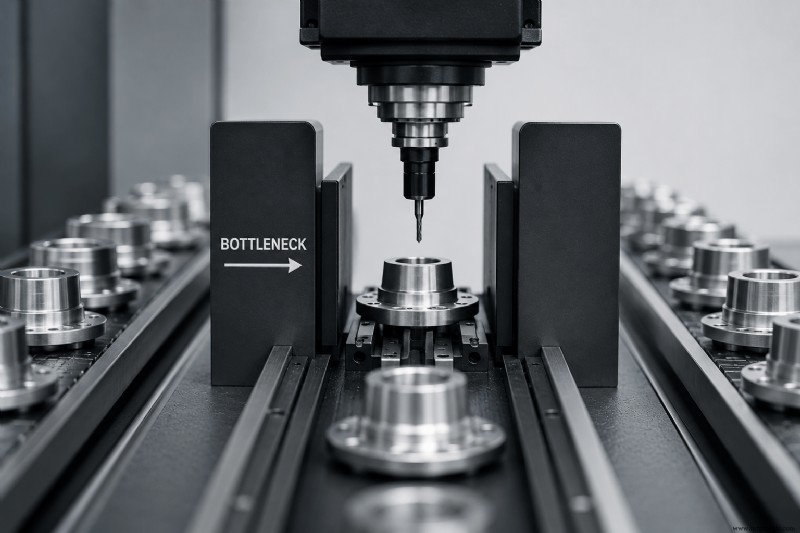
In aerospace and defense manufacturing, the greatest impediment to throughput is rarely cutting speed or tooling; it is the setup process that precedes every machining operation.
Setup—fixture installation, part indication, offset checks, and operator adjustments—often consumes the majority of machine time without producing any part.
Why Setup Is the Production Bottleneck
Walk through any modern machine shop and you’ll see idle machines, not because work is scarce but because the next job is not yet ready.
Spindles idle, operators busy with adjustments, and the clock ticks relentlessly—an overlooked constraint that silently caps output.
Complexity Drives Setup Time
As part designs grow in complexity and high‑mix, low‑volume production becomes the norm, each new job introduces:
- Unique geometries
- Different work‑holding requirements
- Tight tolerances
- New fixturing needs
Managing these variables typically requires highly customized, manual setups that depend heavily on operator experience.
Even in the most efficient shops, setup remains tailored to each job, creating variability and tribal knowledge that stifle scalability.
The Impact on Throughput
Every job change forces a production reset: machines stop, operators switch roles, and spindle uptime falls dramatically.
In high‑mix aerospace environments, this stop‑and‑go cycle is the norm, leaving actual cutting time as a small fraction of available machine hours.
Downtime between jobs is rarely factored into cycle‑time calculations or ROI assessments, yet it is one of the most critical yet neglected metrics.
Why Incremental Improvements Fail
Shops often implement small fixes—better fixtures, seasoned operators, improved documentation—yet these only shave minutes rather than eliminating complexity.
Without simplifying the setup itself, the bottleneck persists.
Modern controls like the DATRON Next can automatically compensate for fixture and material variation through intuitive probing routines, enabling vacuum fixtures for complex, multi‑operation parts without manual setup.
Operator Dependency and Scalability
Setup is where operator skill has the greatest impact. Experienced machinists align parts faster and troubleshoot on the fly, while less experienced staff require detailed SOPs and additional support.
This leads to inconsistent setup times, fluctuating quality, and unpredictable schedules—a serious liability in an industry already facing skilled labor shortages.
The Hidden Cost of Setup
Setup time is rarely visible in part pricing; it is absorbed into overhead and distributed across jobs. Yet it results in lost spindle hours, reduced throughput, delayed deliveries, and heightened team pressure.
When multiplied across dozens or hundreds of jobs, setup becomes one of the most expensive inefficiencies on the shop floor.
Rethinking Setup as a System Constraint
The issue is not that setup exists—it is how we approach it. Leading manufacturers are challenging the status quo by asking: What if setup could be completed in minutes, not hours, and embedded within production optimization?
Modern Setup Strategy
Reducing setup time means eliminating complexity, not merely speeding up tasks.
Standardized Workholding
Shops are shifting from one‑off fixtures to modular, repeatable systems. Zero‑point fixtures remove the need for multiple offsets, while next‑generation probing systems validate part setup in real time.
Simplified Alignment
Probing routines automatically correct for skewed parts or fixtures, turning alignment from a manual chore into a seamless, process‑driven step. Modern machine controls and HMIs provide these capabilities—yet many shops still do not use them.
Repeatable Processes
Workflow design now ensures consistent results regardless of operator. In‑process checks stop the flow of defective parts, and tools like the DATRON Next allow probing routines to be created via augmented‑reality cameras and inserted into programs effortlessly.
Reduced Touchpoints
Every step from raw material to machining is streamlined. The goal is not just speed but predictable, repeatable setups that require minimal human intervention.
When setup becomes faster and more consistent, the entire operation benefits: machines cut more often, job changeovers become routine, schedules tighten, and teams experience less pressure.
Most importantly, efficiency rises without increasing labor—freeing personnel to focus on innovation rather than micromanagement.
Shifting the Focus
Traditionally, machining optimization has centered on cutting speeds, feeds, tool life, and cycle time. Those factors remain important, but they are only part of the equation. If no part is produced during setup, even the fastest machine yields little output.
Optimizing toolpaths for a few parts is rarely justified when workflow improvements could save hours on every job.
The Real Opportunity
The next level of manufacturing efficiency comes from eliminating idle time. Setup is not a peripheral step; it is often the constraint that limits production output. Removing friction in setup unlocks the true potential of the shop floor.
Looking Ahead
Our next article will explore how modern workholding strategies are reshaping setup—making it faster, more repeatable, and far less dependent on operator experience.
When setup is no longer the bottleneck, everything downstream becomes smoother. Discover how our machines simplify setup, reduce operator dependency, and improve production consistency.
CNC Machine
- Why Rapid Machining Drives Efficiency in Modern Manufacturing
- Comprehensive CNC Milling Sample Program – G-Code Tutorial & Explanation
- Stecker Machine: Our Vision, Mission, and Core Values
- 7 Expert Tips for Selecting the Ideal Machine Shop
- Understanding Fanuc 6M/6T Alarm Codes: A Comprehensive Guide
- CNC Router Acrylic Cutting: Expert Guide to Precision & Finish
- Proven Tips for Maintaining Your Plasma Cutter: Extend Life & Performance
- Which Materials Can a CNC Router Cut? A Comprehensive Guide
- How CNC Technology Fuels a Lifelong Passion for Woodworking
- 5-Axis Machining Demystified: Why It’s Not as Intimidating as It Seems