



Digital Twins in Manufacturing: The Essential Layer for Predictive Production
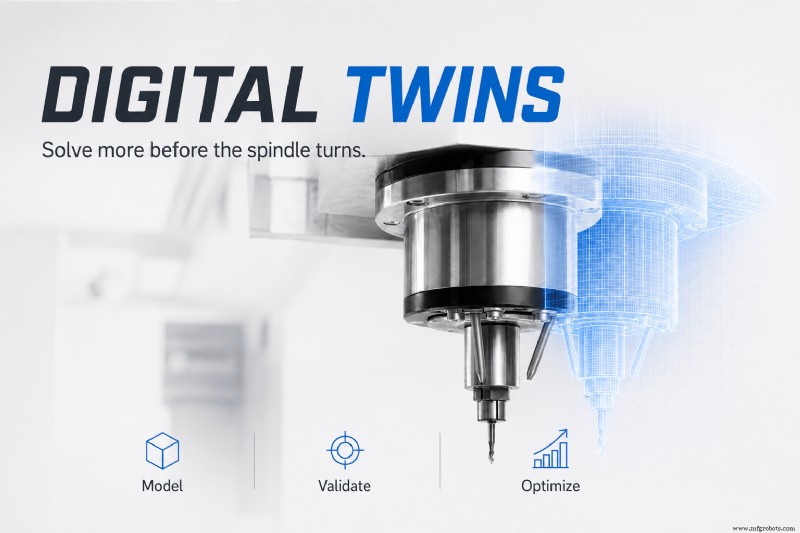
Digital twins have become a cornerstone of modern manufacturing, yet many still equate them with basic CAD/CAM simulation. In reality, a digital twin is the next evolution of machine and process modeling, allowing engineers to test every machining variable in a virtual environment before any material is cut.
Imagine a workflow where your CAM software automatically flags collisions, inefficient toolpaths, material removal gaps, and machine limits long before the first spindle spin. That is the promise of a true digital‑twin workflow.
The Gap Between Planning and Production
In most shops, the ideal plans created by engineers and programmers rarely match the reality on the machine. The disconnect shows up as:
- Unexpected collisions
- Tool deflection that wasn’t anticipated
- Workholding constraints discovered only after setup
- Cycle times that drift from estimates
- Insufficient clearance that leads to re‑work
- Quality issues that surface during final inspection
What a Digital Twin in Manufacturing Truly Is
A digital twin is more than a static simulation. It is a dynamic, physics‑based model that mirrors the real machining environment, capturing:
- Machine kinematics and limits
- Fixture, tool, and machine geometry
- Tool dynamics and deflection
- Material interaction and cutting forces
- Workholding constraints
- Process conditions such as spindle speed and feed rate
By validating these factors before a single chip is produced, manufacturers can predict outcomes, identify risks, and optimize the process early.
Why Digital Twins Matter Now
The manufacturing landscape has shifted dramatically: parts are more complex, materials demand tighter control, tolerances are razor‑thin, and delivery windows are shrinking. Under these pressures, trial‑and‑error is no longer viable. Every cycle on the shop floor carries time and risk costs that can quickly erode profit margins.
Digital twins shift uncertainty upstream, turning the shop floor into a predictable execution zone.
Eliminating Trial‑and‑Error Manufacturing
Traditional workflows iterate:
- Run the program
- Observe the result
- Adjust and re‑run
- Repeat until the part meets specifications
- Collision detection before tool‑path generation
- Tool‑path validation in a virtual run‑through
- Process optimization based on simulated outcomes
How Digital Twins Improve Throughput
When the process is validated ahead of time, the tangible benefits include:
- Faster setup as the machine geometry is already understood
- Fewer adjustments during the actual cut
- Higher operator confidence and reduced error rates
- More time spent cutting rather than idle or corrective work
- Reduced spindle idle time and lower maintenance costs
Reducing Operator Dependency
Experienced machinists often become the bridge between design intent and physical reality, using tacit knowledge to troubleshoot unexpected behavior. While valuable, this expertise is hard to scale and risks becoming a bottleneck.
Digital twins embed that expert insight into the simulation model, creating outcomes that are:
- More predictable and repeatable
- Less reliant on individual operator skill
- Easier to train new staff and maintain consistency across teams
Connecting the Digital and Physical
The true power of a digital twin lies in its fidelity to the physical system. When the virtual model matches the real machine, program translation becomes seamless, setup assumptions are accurate, and performance predictions are reliable. This alignment smooths the handoff between engineering and production, reducing friction and speeding time‑to‑market.
Where Most Shops Fall Short
Many manufacturers believe they are fully leveraging digital twins, but in practice they rely on incomplete simulations such as:
- Basic tool‑path verification without dynamic force modeling
- Limited collision checking that ignores tool deflection
- Simplified machine representations that omit spindle dynamics
Digital Twins as a Process Strategy
True value comes not from the technology itself but from the strategic shift it enables:
- From reactive to predictive decision‑making
- From iterative adjustments to validated plans
- From operator‑driven fixes to process‑driven consistency
How Digital Twins Fit into Modern Manufacturing
Digital twins are one element of a holistic system that includes advanced simulation, machine‑grade hardware, and intelligent control. Together they:
- Reduce uncertainty through accurate predictions
- Lower variability with precision machine design
- Simplify execution through robust control systems
The Real Opportunity
Rather than chasing post‑production optimization, the real advantage lies in upstream refinement—optimizing design, tooling, and programming before the first cut. This upstream focus streamlines production and unlocks higher throughput.
Digital Twins in Manufacturing Are Becoming the Standard
Digital twins are no longer a future trend; they are becoming a prerequisite for competitiveness. In a landscape defined by complexity, precision, and speed, guessing is simply not an option. Manufacturers must model and simulate every element—tooling, workholding, machines, and processes—before raw material ever touches the table.
Final Thought
The future of manufacturing is inherently digital. By solving as much as possible before the spindle turns, you make the subsequent physical operations far more efficient.
Learn more about our CNC automation solutions here.
CNC Machine
- Choosing the Right CNC Router Motor Power: A Practical Guide
- Burlingame Robotics Team Earns World Champion Title with DATRON’s High-Speed Machining Support
- Why Investing in a CNC Machine During COVID-19 Is a Smart Move
- Securing Reliable CNC Machining Partners for Construction OEMs
- How to Sculpt an Armless Christ Statue Using a 4‑Axis CNC Router
- Essential Tips for New CNC Wood Router Users
- Blue Elephant CNC Welcomes Ethiopian Customers to Experience Advanced Manufacturing Technology
- CNC Motion Control Systems: Explained Simply
- Blue Elephant CNC Factory Welcomes Vietnamese Clients, Signaling Strong Global Partnership
- Mazak Integrex 100-4S CNC Center: Advanced Software & Control System Features