



Optimal Placement of Asphalt Compactors During Breakdown Rolling for Maximum Density
There’s debate about how closely behind the paver the breakdown asphalt compactor should roll during hot mix asphalt (HMA) laydown. Some in the paving industry suggest the breakdown compactor should nearly bump the paver to take full advantage of the reduced mix viscosity with the HMA pavement at its hottest temperature. They believe they can’t reach target density if the breakdown compactor is too far back in the rolling zone from the paver.
In truth, every paving project is different. We’ll show you in an example below how moving an asphalt roller 50 feet behind the paver doesn’t hurt job quality. And since the machine isn’t so close to the paver, it can provide a safer working environment for the paving crew too.
ASPHALT ROLLER PLACEMENT FOR SUPERPAVE MIX DESIGNS
For Superpave mix designs, the asphalt cement is selected based on the performance grading (PG) system. Binders are modified to combine stiffness at higher ambient temperatures with flexibility at colder temperatures. These PG asphalt cements are identified with terms that indicates their ability to perform under these temperature extremes.
For example, a Superpave mix laid on an interstate or primary state highway in south central Pennsylvania will specify a PG 64-22 binder. This binder is specially formulated to resist rutting under traffic at pavement temperatures up to 147° Fahrenheit (64° Celsius). It will also remain flexible to resist cracking in temperatures as low as -8° Fahrenheit (-22° Celsius). Unlike neat asphalt cement used in a Marshall mix, PG binders make it more difficult to reduce air void content, unless compacted when hot.
ASPHALT PAVEMENT PANEL COOLING RATE
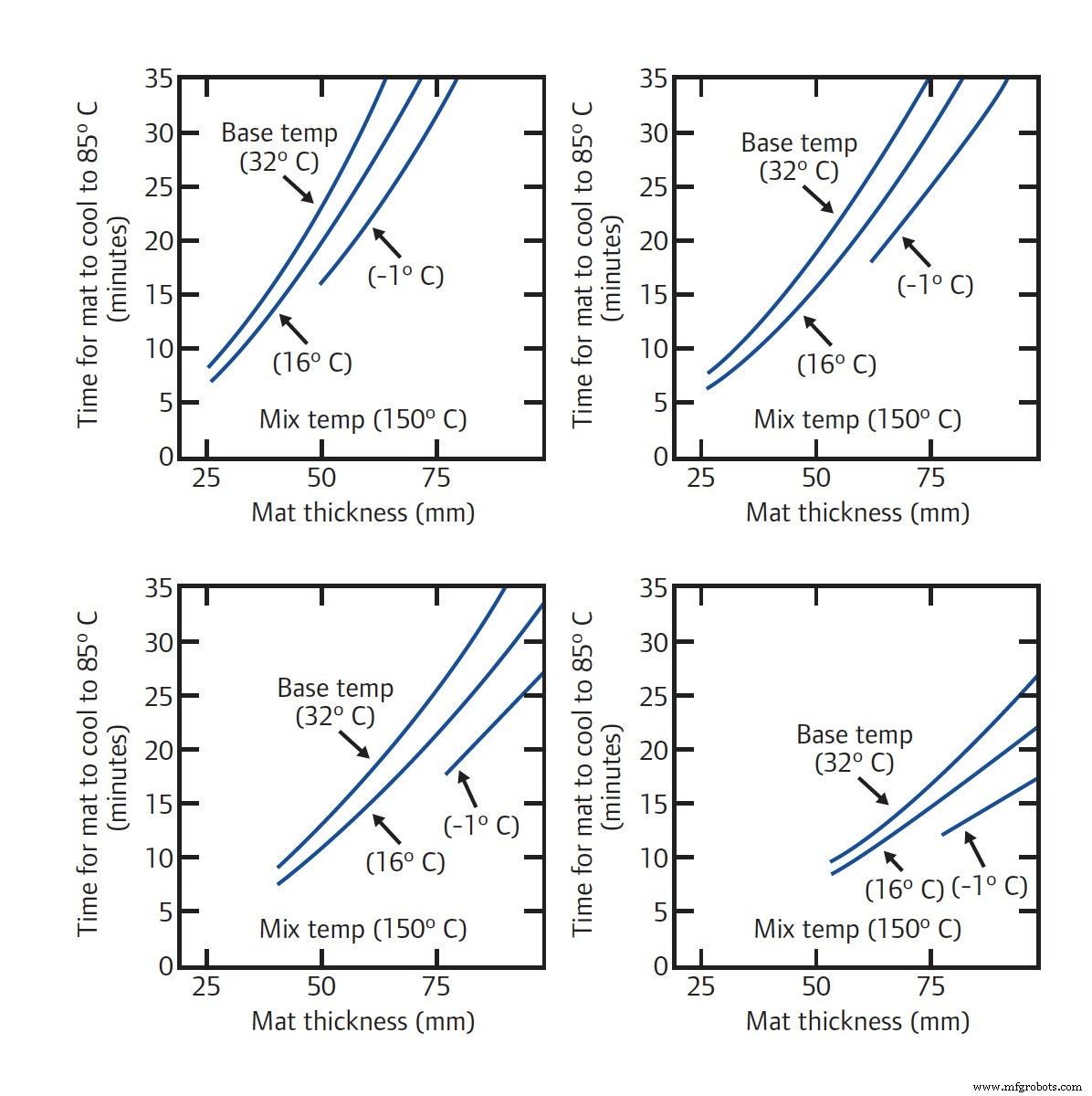 The cooling rate of a pavement panel depends on its mass and ambient conditions. Thicker mats retain heat longer than thinner mats. Panels stay hot longer when laid on a base with a temperature of 90° Fahrenheit (32° Celsius) compared to 30° Fahrenheit (-1° Celsius). Mats cool faster when the ambient temperature is lower and retain heat longer when ambient temperature is higher.
These charts depict time available for compaction (TAC). A 1.5-inch (37.5-millimeter) thick mat, laid at 248° Fahrenheit (120° Celsius) on a base of 60° Fahrenheit (16° Celsius) cools to 185° Fahrenheit (85° Celsius) in eight minutes. A 2-inch (50-millimeter) thick mat, laid at 275° Fahrenheit (135 degrees Celsius) on a base that is 60° Fahrenheit (16° Celsius) cools to 185° Fahrenheit (85° Celsius) in 16 minutes.
COMPACTOR PLACEMENT AND IMPACT ON TIME AVAILABLE FOR COMPACTION (TAC)
How much TAC is lost if the breakdown compactor stays back rather than rolling closely to the paver screed? Scientific calculations, backed by thermal measurements of mat temperature, indicate the following:
- A lift 2.5 inches (62.5 millimeters) thick, placed at 302° Fahrenheit (150° Celsius) on a base that is 30° Fahrenheit (-1° Celsius), will cool to 185° Fahrenheit (85° Celsius) in 20 minutes.
- Moving the breakdown compactor from 6 feet to 50 feet (1.8 meters to 15.2 meters) behind the paver results in an average loss of one minute in TAC.
- This one-minute loss is equal to a decrease of 5° Fahrenheit (-3° Celsius) in pavement temperature.
- This scenario is dependent on a five-pass rolling pattern behind a paver moving at 0.5 miles per hour (0.8 kilometers per hour).
Even for this application, with ground temperatures at the lowest limit for paving, the TAC loss is insignificant. It won’t result in failure to achieve air void reduction in the mix. It makes little difference where temperature and time differential are checked because TAC is consistent throughout the width and length of the breakdown rolling zone.
For safety, the breakdown compactor should stay two-and-a-half compactor lengths behind the paver. So long as you maintain this buffer, there’s minimized risk of injury to ground personnel.
Learn more about the basics of asphalt compaction.

The Basics of Successful Asphalt Compaction
Asphalt compaction is an essential part of the flexible paving process. The production, laydown and compaction of hot mix asphalt ...Read More

3 Tips to keep Asphalt Compactors up to speed with Pavers
Many paving projects use a common practice that contractors should avoid — rolling too fast with the breakdown compactor, especially ...Read More
Industrial equipment
- How Rolling Mills Shape Steel: Inside the Process That Guarantees Strength and Consistency
- Designing Object Models for 3D Printing: CAD, Scanning, and Photogrammetry Explained
- 3 Proven Tips for Synchronizing Asphalt Compactors with Pavers
- Selecting the Right Proportional Valve for Medical Devices: A Comprehensive Guide
- Expert Guide to Maintaining Your Air Compressor for Peak Performance
- Expert Guide: Safely Preparing Machinery for Relocation
- Securely Paying for Used Machinery Deals: A Guide to Safe International Transactions
- Mastering Metal Lathes: A Beginner’s Step‑by‑Step Guide
- Accurate Hydraulic Fitting Measurement: Step‑by‑Step Guide
- Choosing the Right Motor Size for Your Pump: A Practical Guide