



Preventing Production Downtime: Risks of Faulty Actuators
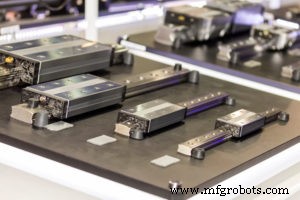
Actuators help streamline manufacturing processes while lowering production costs. However, issues and defects in these components can jeopardize the entire production line and result in severe downtime.
In manufacturing, downtime can translate to significant financial losses. It is estimated that downtime causes every factory to lose at least 5% of productivity, with some factories losing as much as 20%.
One way to prevent downtime and keep your bottom line strong is to ensure optimal condition for all components of your equipment, including actuators.
In this guide, we discuss the role of actuators and the risks associated with actuator failure.
What are actuators?
An actuator is a component of a machine that converts air, electrical, or hydraulic energy into mechanical motion. Essentially, it’s designed to help a machine achieve physical movements.
Actuators allow various kinds of motions, from blocking and lifting to ejecting and clamping. They are critical components in manufacturing and industrial processes, helping activate motors, switches, pumps, and valves.
They involve a control command that signals a change in the machine. The signal can be automatically controlled or human-operated. This generates force needed to move parts or accomplish a task.
Actuators are designed to direct and manipulate mechanized movements, which can be rotary, linear, or oscillatory. Any desired end motion would be unattainable without actuator assistance.
What are actuators used for?
Actuators are classified by motion and power source. The two basic motions are linear and rotary. A rotary actuator converts energy to provide rotational motion. A linear actuator turns energy into straight line motions to create a push or pull action, making them ideal for positioning applications.
They are utilized in practically all industries, most notably in equipment manufacturing, oil and gas processing, mining, marine, military, aviation and aerospace, and road building. They’re also used to operate valves remotely.
Actuators play a critical role in the manufacture of cranes, presses, coal crushers, drill rigs, missile launchers, material handling equipment, and man lifts. They can be found all around us, from electric door locks to aircraft and automobiles. In industrial plants, actuators are often used to operate dampers, valves, and fluid couplings.
The type of industrial actuator will depend on the form of energy it uses to produce motive power. Actuators may use air, hydraulic fluid, or electricity to produce mechanical force.
To control an actuator, a programmable logic controller (PLC) can be used to fire the valve to then control the cylinder. Other models can also be administered by a fixed mechanical or electric system or by a human operator.
The basic structure of an actuator
An actuator typically consists of the following components:
- Power source: Delivers the required energy input to operate the actuator. In industrial applications, the energy is often electric or fluid in nature.
- Power converter: Provides power from the source to the actuator based on the specific measurements set by the controller. Some examples of power converters in industrial systems include electrical inverters and hydraulic proportional valves.
- Actuator: Changes the supplied energy to the desired mechanical force.
- Mechanical load: The mechanical system that is being driven by the actuator.
- Controller: Ensures that the system operates smoothly and aligns with the set points and necessary input quantities decided by an operator
Common types of actuators used in industrial applications
Pneumatic actuators
Pneumatic actuators are known for their reliability, efficiency, and safe source of motion control. They convert the energy of compressed air or pressurized gas into a mechanical motion. Since they’re not reliant on ignition or electricity, pneumatic actuators are ideal for applications where combustion and sparking cannot be tolerated.
Hydraulic actuators
This type of actuator converts hydraulic power into useful mechanical function. They are rugged and ideal for high force applications. Heavy equipment such as winches, excavators, and crane drives rely on hydraulic actuators to function.
Electric actuators
Electric actuators use an electric motor and gear reduction to produce mechanical torque or linear motion. They’re mostly used in applications that require clamping and greater precision.
The dangers of a dysfunctional actuator
Poor output
In manufacturing plants, unexpected actuator failures can disrupt assembly lines and lead to the creation of flawed products. Aside from wasted time and resources, defective products can tarnish a company’s reputation and result in multi-billion dollars in losses.
Damage to other equipment in your application
A misaligned actuator can cause damage to the other components and equipment that are included in the automation process, decreasing operational efficiency. Damaged equipment may also be using increasing levels of fuel and electricity each day which can result in higher costs.
Full actuator failure
An actuator may be relatively small, but it plays a key role in essential functions such as closing valves and protecting process flows where failure is not an option.
When an actuator fails, it could result in catastrophic explosion, spill, chemical release, property damage, power loss, environmental contamination, injury, or even loss of life. Actuators trigger immediate shutdowns which could result in costly production downtime.
Total plant shut down
A manufacturing plant depends on its operational equipment to meet customer demands and generate profit. When actuators start to break down, production schedules are disrupted which can lead to significant downtime and negatively impact your bottom line.
Signs that indicate a faulty or failing actuator
- No longer has enough power
- Loud noises, such as hissing or clanking sounds
- Jerky or erratic behavior – Erratic throttling can be a result of a binding packing issue, a fluctuating air supply, or an unsteady pneumatic or electronic signal.
- Failure to fully retract or fully extend – Usual causes include air leaks which can cause insufficient supply air pressure to the actuator and limit switches out of proper adjustment which can drive the actuator to stop movement prior to opening or closing. In some cases, this can also be a result of travel stops that are not properly set or incorrect coupling between the valve stem and actuator.
Optimize your processes with cutting-edge actuators
Actuators make industrial automation smooth and easy by enabling the seamless movement, control, and positioning of a system or mechanism.
A well-designed and maintained actuator could last decades. Most actuators can easily be repaired by preventive maintenance once a problem is detected. Whether you need a new actuator, or need to service an old actuator, JHFoster can help. We take pride in equipping industrial facilities with durable and powerful actuators for various applications.
Contact our team to get a quote.
Industrial equipment
- Electric Actuators: Driving Efficiency in Industrial Automation
- Types of Actuators: How to Pick the Right One for Your Industrial Machinery
- Selecting the Ideal Pneumatic Actuator: A Practical Guide for Reliable Automation
- Understanding How Electric Linear Actuators Operate
- 10 Key Benefits of Electric Linear Actuators
- Switching from Hydraulic to Electric Actuators: Key Considerations
- Top Causes of Electric Actuator Failures & Prevention Tips
- Choosing Between Electric and Hydraulic Linear Actuators: Which Is Right for Your Application
- Hydraulic Leak Hazards: Protecting Your System & Safety
- Switching to Servo Actuators: Boosting Spot Welding Efficiency and Longevity