



Essential Ladder Safety Guidelines for Workplace and Home
Ladder Safety Basics
Ladders are one of the most useful tools that every organization and household owns. Most people have a basic awareness of what it takes to be safe on a ladder. Yet incredibly, many of the accidents that involve injuries from ladder use come from a lack of ladder safety basics being implemented.
Falls from portable ladders are one of the leading causing of injuries and fatalities in occupational settings. [1]
For workers who use a ladder in the course of their job duties, 1 in 5 fall injuries has involved a ladder. Those who work in construction and aviation are at the highest risk. 81% of fall injuries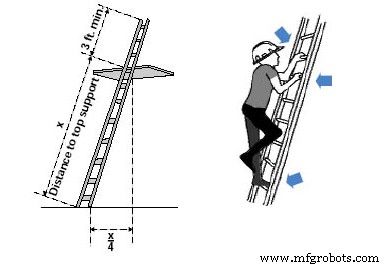 treated in emergency rooms in the United States have involved a ladder for these workers. [2]
These ladder safety basics should be reviewed on a regular basis with all employees, no matter what the occupational setting may be.
- All markings and labels found on a ladder should be followed, including handwritten instructions.
- Watch for overhead obstacles and never use a metal ladder near an energized line.
- Maintain a 3-point contact stance on the ladder at all times. That means two hands and one foot or two feet and one hand.
- Ladders, levelers, hooks, and jacks should only be used for their intended purposes only.
- Self-supporting ladders, such as a step ladder, should not be used in partially-closed environments or as a single ladder.
- Ladders must be secured in some way before they are to be used.
- Never exceed the maximum load rating of the ladder. Include any weight the ladder may be supporting in the maximum load calculations being performed.
By following these basic ladder safety precautions, whether at home or in the course of occupational duties, it is possible to use this tool safely and reduce the risks of experiencing a serious injury.
How to Choose the Right Ladder
Choosing the wrong ladder for the job can be a very dangerous proposition. To ensure the correct ladder is being used, it is important to think about the job duties that must be performed. The right size and style will be critical to a safe user experience.
To ensure that the best possible ladder is being used for the job, these three essential questions should be considered every time.
- How much height is required to complete the task?
- How much weight does the ladder need to hold (including tool weight, platform weight, and user weight)?
- Is the job going to be completed indoors or outdoors? [3]
Once you have found the correct ladder, you’re ready to begin using it. You’ll need to make sure that the ladder has a solid and firm surface that is can be placed upon. Surfaces that are either soft or wet can become slippery and increase the risk of an injury occurring.
There are certain best practices that can be followed to ensure that the ladder can be as supportive a tool as possible.
- Do not lean a ladder against an unstable surface or one that could break, such as a window pane.
- Have an extension ladder or a straight ladder placed 1 foot away from its resting surface for every 4 feet of height being used.
- Fasten extension ladders and straight ladders to an upper support for added stability.
- Make sure a step ladder is open completely and all hinges are locked before using it.
- Boxes, containers, barrels, or steps should never be placed on a ladder as a means of gaining additional height.
If you do need to place a ladder on soft ground, use a board or a plywood sheet to create a firmer surface underneath the feet of the ladder.
What to Do with a Defective Ladder
Ladders that have been identified as needing to be repaired are subject to the following rules. [4]
#1. Structural defects must be immediately tagged.
A portable ladder with a structural defect, which includes missing and broken steps, cleats, or rungs, must be tagged with language that states “Do Not Use.” The language must be clearly visible to indicate the ladder has been withdrawn from service. Component corrosion, defective components, and split rails should also be immediately tagged.
#2. Maintenance defects must also be tagged.
Fixed ladders are often used even though a maintenance defect may be present. Any ladder that is covered in water or ice should be temporarily removed from service until the defect can be remedied. Damage from a lack of maintenance can create a long-term gap in alder service
#3. Blocking a ladder withdraws it from service.
“Do Not Use” language immediately withdraws a ladder from service. Blocking a fixed ladder’s access, such as with a sheet of plywood, is also a method of withdrawing a ladder from service. Both ends of a fixed ladder must be blocked if this option is being taken.
Any repairs that are completed on a defective ladder must be to the standards set forth by manufacturer guidelines. Ladders are considered withdrawn from service until those guidelines are met.
Are You Avoiding Common Ladder Mistakes?
Incorrect placement. Incorrect use. Incorrect ladder choice. Incorrect maintenance.
These are the 4 most common causes of injury that occur when ladders are being used. The risks apply to residential and occupational use of this tool. Organizations which do not promote a culture of safety can place their workers at a higher risk of suffering an accident. That higher risk comes along with a higher risk of liability should an injury occur.
There are steps that can be taken today to limit that risk. Create policies and procedures that take a common-sense approach to ladder safety. Have regular ladder safety training programs. Take damaged ladders out of service immediately.
By being proactive about the basics of ladder safety, there is a better chance that everyone will get to come home at the end of the day.
[1] “Portable Ladder Safety.” OSHA Quick Card. Osha.gov.
[2] “Occupational Ladder Fall Injuries.” Centers for Disease Control and Prevention. April 25, 2014.
[3] “Ladder Safety One Rung at a Time.” National Safety Council.
[4] “Stairways and Ladders: A Guide to OSHA Rules.” Osha.gov.
Industrial equipment
- Automotive Shop Safety Rules: Expert Guidance for Technicians
- How Ladders Boost Workplace Safety, Efficiency, and Reliability
- Top 6 Essential Warehouse Safety Practices
- Essential Warehouse Safety Accessories for Accident-Free Operations
- Ladder Logic 101: Mastering the Fundamentals for Automation Success
- Ensure Safety: Verify Your Industrial Ladders Meet OSHA Standards
- Choosing the Right Industrial Ladder: Expert Tips for Factory Equipment
- Essential Ladder Safety Guidelines for Workplace and Home
- Mastering Material Handling Safety: Best Practices for Efficient, Risk‑Free Operations
- Understanding Pumps: Fundamentals and Applications