



Mastering Pressure Measurements in Automotive Engineering
During vehicle production, a wide array of tests—especially pressure measurements—ensures every component functions safely and efficiently. Understanding how these measurements work is essential for anyone pursuing a career in automotive technology.
Enrolling in a trade school such as Universal Technical Institute (UTI) offers hands‑on experience with pressure gauges and testing equipment, giving students a solid foundation in real‑world applications.1
Below, we break down the primary pressure units, their uses, and how they influence vehicle performance.
Units of Pressure Measurement
Pressure is defined as force per unit area. In the United States, the most common unit for measuring air pressure is pounds per square inch (PSI). Knowing PSI—and its related forms—is critical across many automotive systems.
Typical applications of PSI include:
- Tire inflation
- Engine component testing
- Fuel storage and distribution
Other PSI variants adjust for atmospheric conditions:
- PSI (generic): Often refers to gauge pressure in everyday contexts.
- PSIG (pounds per square inch gauge): Pressure relative to ambient atmospheric pressure. For example, tire pressure is measured in PSIG.
- PSIA (pounds per square inch absolute): Pressure relative to a perfect vacuum (zero pressure). A completely evacuated tire reads 0 PSIA.
Conversion between PSIG and PSIA is straightforward: the average sea‑level atmospheric pressure is 14.7 PSI. To convert PSIA to PSIG, subtract 14.7; to convert PSIG to PSIA, add 14.7.
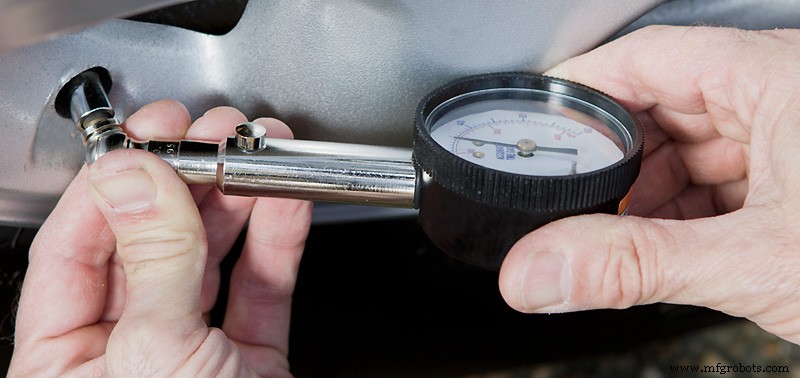
Factors Influencing PSI and PSIG
Temperature
Temperature variations affect molecular motion. Cold temperatures slow molecules, lowering pressure and PSIG readings, while heat accelerates them, raising pressure. Fluctuations typically range from 1 to 5 PSIG, so it’s best to check tire pressure when the vehicle is cold.
Altitude
Higher elevations reduce atmospheric pressure, decreasing PSIG readings by roughly 0.5 PSI per 1,000 feet. Altitude changes often correlate with temperature shifts, further influencing pressure.
Pressure Measurements in Vehicles
PSIG gauges are indispensable for accurate tire pressure readings and for monitoring key engine systems during manufacturing and routine service.
Engine test stands employ PSIG sensors to verify critical parameters:
- Fuel pressure: Ensures efficient delivery and combustion.
- Oil pressure: Confirms proper lubrication and flow.
- Coolant pressure: Maintains optimal engine temperature and protects hoses, lines, and gaskets.
Advanced diagnostics may assess pressure decay or airflow restrictions, identifying leaks or performance bottlenecks.
Learn Pressure Testing at UTI
Hands‑on automotive training is increasingly in demand—by 2029 the industry expects more than 728,000 technicians nationwide.47
UTI’s Automotive Technology program equips students with the skills to perform precision pressure tests across all vehicle systems. Enroll today and take the first step toward a rewarding career.
Industrial equipment
- Revolutionizing Health Monitoring: Sensor‑Based Vital Sign Measurements
- Digital Sensors in Industrial Machinery: Function, Types, and Best Practices
- Understanding Suction Pressure: Key to HVAC Efficiency
- Pressure Relief Valve Explained: How It Safeguards Industrial Systems
- How Pressure Gauges Work: Types, Functions, and Benefits
- Diaphragm Pressure Gauges Explained: Precision and Reliability
- Mastering Bourdon Pressure Gauges: Design, Function, and Applications
- Radiator Pressure Caps: Function, Importance, and Maintenance
- PSI, CFM, and HP Explained: Choosing the Right Air Compressor
- Understanding PSI, PSIA, and PSIG: Key Differences Explained